Welter John J, Lennox Alison T, Krishnan Sankaran, Kim Christy, Krishnan Sheila, Thompson Haley, McAllister Emily, Huang Kristen, Nwaedozie Kasiemobi, Dozor Allen J
Division of Pediatric Pulmonology New York Medical College Valhalla New York USA.
Touro College of Osteopathic Medicine New York New York USA.
Health Sci Rep. 2022 Oct 28;5(6):e910. doi: 10.1002/hsr2.910. eCollection 2022 Nov.
A major focus in cystic fibrosis (CF) care aims to increase weight gain. Rates of overweight and obese people with CF have gradually increased over the past decade. Obesity could be a risk for restriction of lung volumes and airway obstruction as well as increase rates of pulmonary exacerbations in people with CF.
To assess the relationship between weight categories and pulmonary outcomes in children and adults with CF.
Patients 6 years of age and older were categorized into weight categories based on the Centers for Disease Control and Prevention (CDC) definitions. A retrospective chart review was conducted to obtain lung function testing and other outcomes.
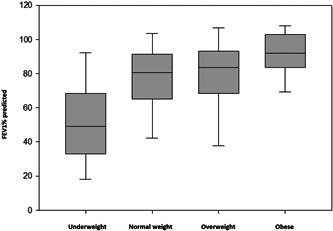
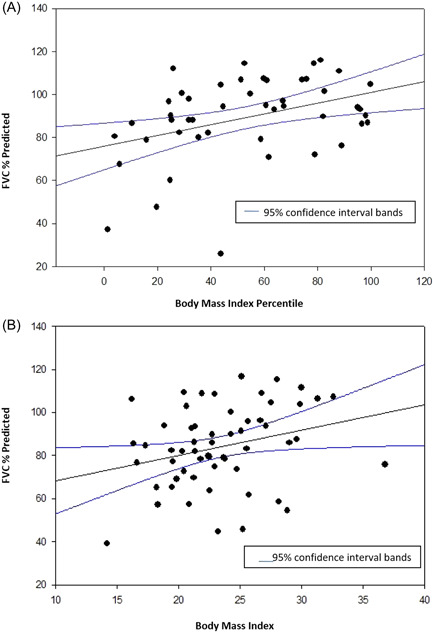
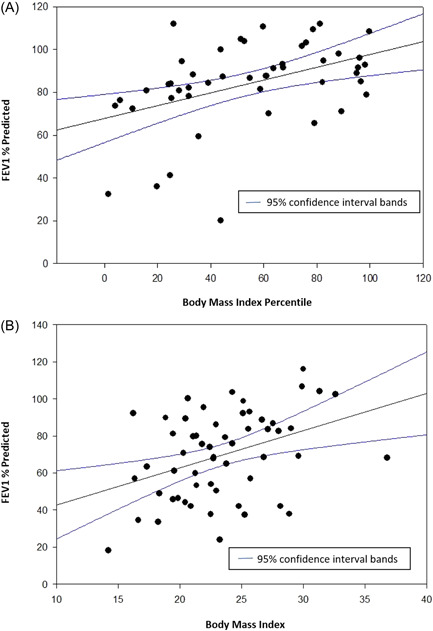
One hundred five patients with a median age of 20.6 years were included in this analysis. 8.4%, 64%, 18%, and 10% of patients were underweight, normal/healthy weight, overweight, and obese, respectively. Forced expiratory volume in 1 s (FEV) and forced vital capacity (FVC) (% predicted) did not differ between patients with weights in the normal range versus patients in the overweight/obese categories. Linear regression analysis showed a direct correlation between body mass index (BMI) and FEV that continued as BMI entered overweight and obese categories in both pediatric and adult patients. Overweight/obese patients did not have increased rates of pulmonary exacerbations compared to those in the normal/healthy weight category.
As CF therapies continue to improve, an increasing number of people with CF are exceeding the CDC's normal-weight range. Gaining weight past the normal range does not appear to negatively impact pulmonary health of people with CF. If this trend of increased weight gain continues, it remains to be seen if it will eventually negatively affect lung health.
囊性纤维化(CF)护理的一个主要重点是增加体重。在过去十年中,CF患者中超重和肥胖人群的比例逐渐上升。肥胖可能会导致肺容量受限和气道阻塞,同时增加CF患者肺部急性加重的发生率。
评估CF儿童和成人的体重类别与肺部结局之间的关系。
根据美国疾病控制与预防中心(CDC)的定义,将6岁及以上的患者分为不同的体重类别。通过回顾性病历审查来获取肺功能测试和其他结局。
本分析纳入了105例患者,中位年龄为20.6岁。分别有8.4%、64%、18%和10%的患者体重过轻、体重正常/健康、超重和肥胖。体重在正常范围内的患者与超重/肥胖类别的患者相比,1秒用力呼气量(FEV)和用力肺活量(FVC)(预测值%)没有差异。线性回归分析显示,在儿童和成人患者中,体重指数(BMI)与FEV之间存在直接相关性,且随着BMI进入超重和肥胖类别这种相关性依然存在。与体重正常/健康类别的患者相比,超重/肥胖患者的肺部急性加重发生率并未增加。
随着CF治疗方法不断改进,越来越多的CF患者体重超过了CDC的正常体重范围。体重超过正常范围似乎不会对CF患者的肺部健康产生负面影响。如果体重增加的这种趋势持续下去,最终是否会对肺部健康产生负面影响还有待观察。