Department of Health Education and Promotion, East Carolina University, Greenville, North Carolina, USA
Center for the Study of Tobacco Products, Virginia Commonwealth University, Richmond, Virginia, USA.
Tob Control. 2022 Nov;31(Suppl 3):s197-s205. doi: 10.1136/tc-2022-057454.
BackgroundRegulations have been proposed to limit e-cigarette flavours, but limited research has examined potential impacts of such policies. This study examined adult e-cigarette users' reactions to a hypothetical e-cigarette flavour ban.
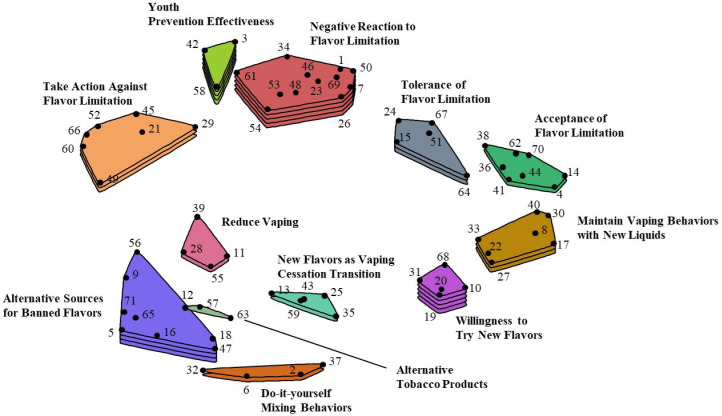
In 2019, a convenience sample of current e-cigarette users in the USA (n=81, 53.1% women, mean age=37.6, 59.3% dual users of cigarettes) completed an online concept mapping study. Participants provided statements describing anticipated reactions to a hypothetical policy in which only tobacco, menthol or unflavoured e-cigarettes were available for purchase. Seventy-one unique statements were generated. Participants sorted statements into thematic groups and rated statements on how likely they would be to have each reaction. Multidimensional scaling was used to identify thematic clusters of statements.
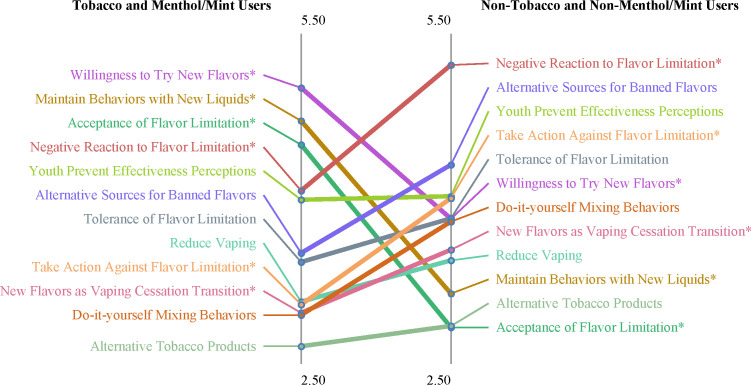
Twelve clusters were identified: negative reaction, take action against flavour limitation, youth prevention effectiveness perception, tolerance, acceptance, willingness to try new flavours, maintain vaping, reduce vaping, new flavours as vaping cessation transition, alternative sources for banned flavours, do-it-yourself mixing behaviours and alternative tobacco products. The highest rated cluster (negative reaction) described being angry or upset that flavours were banned, while the lowest rated clusters related to quitting/reducing e-cigarette use or switching to other tobacco products. Non-tobacco or non-menthol/mint flavoured e-cigarette users had higher ratings for clusters describing negative sentiment for the hypothetical policy.
Some e-cigarette users may dislike an e-cigarette flavour ban; however, some e-cigarette users would likely be willing to use tobacco, menthol or unflavoured e-cigarette liquids with lower likelihood of quitting vaping or switching to other tobacco products.
提出了限制电子烟口味的规定,但对这些政策的潜在影响进行的研究有限。本研究调查了成年电子烟使用者对电子烟口味禁令的假设反应。
2019 年,在美国对当前电子烟使用者(n=81,53.1%为女性,平均年龄为 37.6 岁,59.3%同时使用香烟和电子烟)进行了一项方便样本的在线概念映射研究。参与者提供了描述对购买只能购买烟草、薄荷醇或无味电子烟的假设政策的预期反应的陈述。共生成了 71 个独特的陈述。参与者将陈述归类为主题组,并对每个陈述的可能性进行了评分。多维尺度用于识别陈述的主题集群。
确定了 12 个集群:负面反应、采取行动反对口味限制、对预防青少年效果的认知、容忍、接受、尝试新口味的意愿、保持电子烟使用、减少电子烟使用、新口味作为电子烟戒烟过渡、禁止口味的替代来源、自行混合行为和替代烟草产品。评分最高的集群(负面反应)描述为对口味禁令感到愤怒或不安,而评分最低的集群与减少电子烟使用或转向其他烟草产品有关。非烟草或非薄荷醇/薄荷味电子烟使用者对假设政策的负面情绪相关集群的评分更高。
一些电子烟使用者可能不喜欢电子烟口味禁令;然而,一些电子烟使用者可能更愿意使用烟草、薄荷醇或无味电子烟液体,不太可能停止使用电子烟或转向其他烟草产品。