Manzardo Olimpia A, Toll Luisa J, Müller Katharina, Nickel Erika, Jonas Daniel, Baumgartner Jana, Wenzel Folker, Klotz Daniel
Department of Neonatology, Center for Pediatrics, Medical Center, Faculty of Medicine, University of Freiburg, Freiburg, Germany.
Faculty of Medical and Life Sciences, Furtwangen University, Furtwangen, Germany.
Front Pediatr. 2022 Oct 18;10:990871. doi: 10.3389/fped.2022.990871. eCollection 2022.
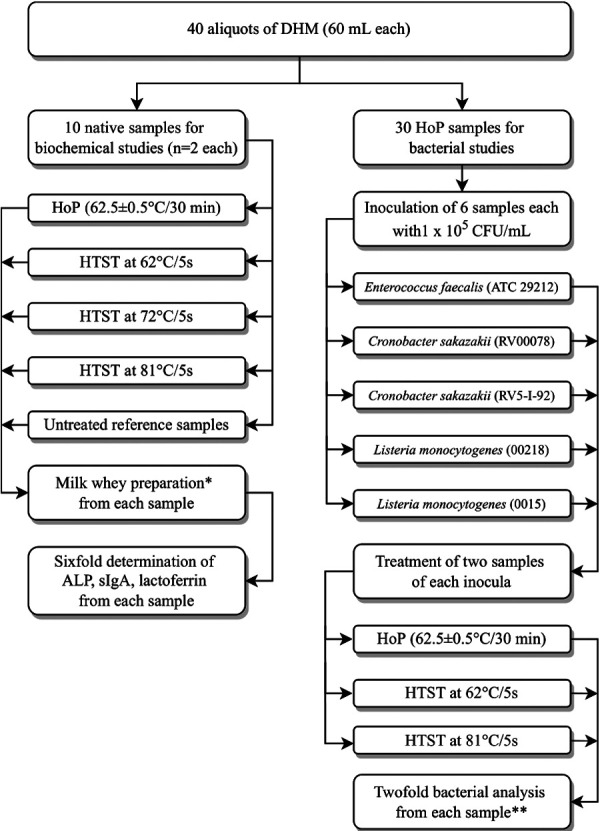
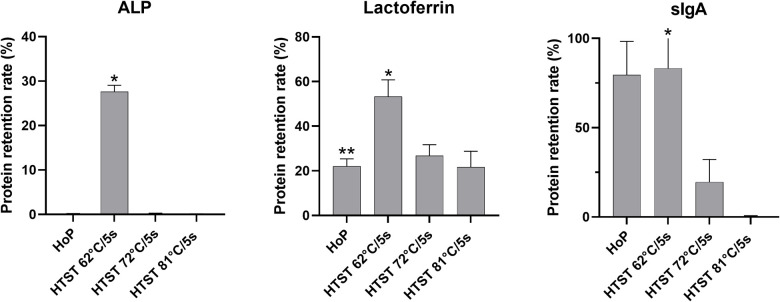
Human milk (HM) is the recommended nutrition for premature infants, but it may require processing to ensure microbial safety. The current standard is Holder pasteurisation (HoP), i.e. heating milk at 62.5 ± 0.5°C for 30 min, which eliminates bacteria but destroys heat labile bioactive HM components. We aimed to test an alternative thermal method, high-temperature short-time (HTST) pasteurisation using a modified Holder pasteurisation platform as this method has shown to preserve proteins in experimental HM flow pasteurisers. We analysed the ability of this batch process to eliminate bacterial species and to retain alkaline phosphatase, secretory immunoglobulin A and lactoferrin in HM. HTST at 81°C/5 s was as effective as HoP in bacterial count reduction while the retention of bioactive components was only improved at 62°C/5 s as compared to 72°C/5 s and HoP. HTST is a promising alternative to HoP but an optimal temperature-time combination needs to be determined for each technical platform separately.
母乳是早产儿推荐的营养来源,但可能需要经过处理以确保微生物安全。当前的标准是间歇式巴氏杀菌法(HoP),即将牛奶在62.5±0.5°C加热30分钟,这种方法能消灭细菌,但会破坏母乳中对热不稳定的生物活性成分。我们旨在测试一种替代热法,即使用改良的间歇式巴氏杀菌平台进行高温短时(HTST)巴氏杀菌,因为该方法已显示在实验性母乳连续流动巴氏杀菌器中能保留蛋白质。我们分析了这种分批处理方法消除细菌种类以及保留母乳中碱性磷酸酶、分泌型免疫球蛋白A和乳铁蛋白的能力。81°C/5秒的HTST在减少细菌数量方面与HoP一样有效,而与72°C/5秒和HoP相比,在62°C/5秒时生物活性成分的保留情况才有所改善。HTST是HoP的一个有前景的替代方法,但需要为每个技术平台分别确定最佳的温度 - 时间组合。