Department of Chemical Engineering, National Taiwan University, Taipei, 10617, Taiwan.
Materials Science and Engineering Program, University of California San Diego, La Jolla, CA, 92093, USA.
Sci Rep. 2022 Nov 4;12(1):18729. doi: 10.1038/s41598-022-23002-5.
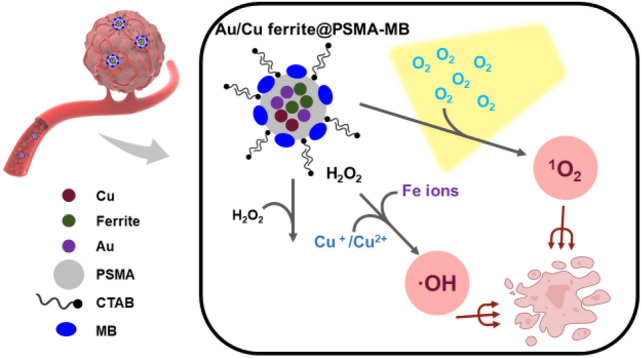
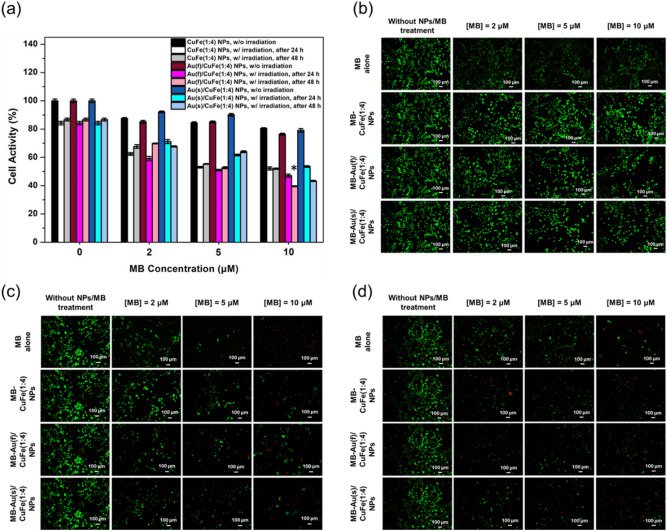
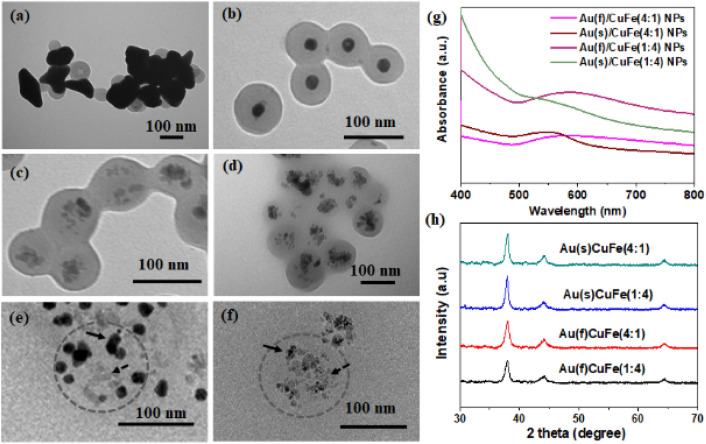
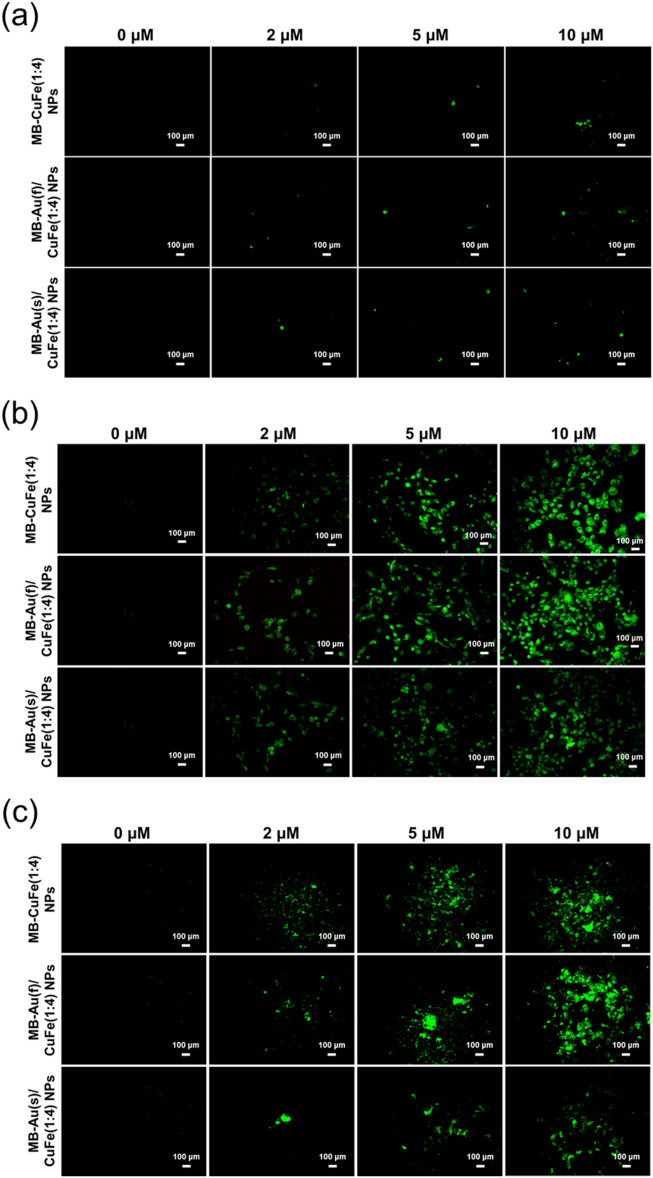
Nanoparticles are widely used in biomedical applications and cancer treatments due to their minute scale, multi-function, and long retention time. Among the various nanoparticles, the unique optical property derived from the localized surface plasmon resonance effect of metallic nanoparticles is a primary reason that metallic nanoparticles are researched and applied. Copper and Iron nanoparticles have the potential to generate hydroxyl radicals in excess HO via Fenton or Fenton-like reactions. On the other hand, gold nanoparticles equipped with a photosensitizer can transfer the energy of photons to chemical energy and enhance the production of singlet oxygen, which is suitable for cancer treatment. With the actions of these two reactive oxygen species in the tumor microenvironment, cell apoptosis can further be induced. In this work, we first synthesized dual metal nanoparticles with poly[styrene-alt-(maleic acid, sodium salt)(Cu ferrite oxide-polymer) by a simple one-step hydrothermal reduction reaction. Then, gold(III) was reduced and doped into the structure, which formed a triple metal structure, Au-doped Cu ferrite nanoparticles (Au/Cu ferrite oxide-polymer NPs). The metal ratio of the product could be controlled by manipulating the Fe/Cu ratio of reactants and the sequence of addition of reactants. The core-shell structure was verified by transmission electron microscopy. Moreover, the hydroxyl radical and singlet oxygen generation ability of Au/Cu ferrite oxide-polymer was proved. The chemodynamic and photodynamic effect was measured, and the in vitro ROS generation was observed. Furthermore, the behavior of endocytosis by cancer cells could be controlled by the magnetic field. The result indicated that Au/Cu ferrite oxide-polymer core-shell nanoreactor is a potential agent for chemodynamic/photodynamic synergetic therapy.
纳米粒子由于其微小的尺寸、多功能性和较长的保留时间,广泛应用于生物医学应用和癌症治疗。在各种纳米粒子中,金属纳米粒子的局域表面等离激元共振效应产生的独特光学性质是研究和应用金属纳米粒子的主要原因。铜和铁纳米粒子有可能通过芬顿或类芬顿反应产生过量的 HO 中的羟基自由基。另一方面,配备光敏剂的金纳米粒子可以将光子的能量转移到化学能,并增强单线态氧的产生,这适用于癌症治疗。在肿瘤微环境中,这两种活性氧物质的作用可以进一步诱导细胞凋亡。在这项工作中,我们首先通过简单的一步水热还原反应合成了具有聚[苯乙烯-alt-(马来酸,钠盐)(Cu 铁氧体-聚合物)的双金属纳米粒子。然后,金(III)被还原并掺杂到结构中,形成了三重金属结构,Au 掺杂的 Cu 铁氧体纳米粒子(Au/Cu 铁氧体-聚合物 NPs)。通过操纵反应物的 Fe/Cu 比和反应物的添加顺序,可以控制产物的金属比。通过透射电子显微镜验证了核壳结构。此外,还证明了 Au/Cu 铁氧体-聚合物的羟基自由基和单线态氧生成能力。测量了化学动力学和光动力效应,并观察了体外 ROS 的产生。此外,还可以通过磁场控制癌细胞的内吞作用。结果表明,Au/Cu 铁氧体-聚合物核壳纳米反应器是化学动力学/光动力协同治疗的潜在药物。