Department of Nutrition and Bioprogramming, National Institute of Perinatology, Mexico City, Mexico.
Centro de Investigación en Nutrición y Salud, Instituto Nacional de Salud Pública, 3226, Avenida Universidad 655, Santa María Ahuacatitlán, Morelos, 62100, Cuernavaca, México.
BMC Pregnancy Childbirth. 2022 Nov 4;22(1):811. doi: 10.1186/s12884-022-05154-4.
Woman's weight changes during pregnancy and postpartum contribute to obesity and health outcomes later in life. This study aimed to identify and characterize weight change trajectories from pregnancy to one year postpartum among adult women.
We used data from an ongoing cohort of healthy adult women (n = 819) with singleton pregnancies from 2007 - 2011. Sociodemographic data, pre-pregnancy body weight, and sedentary and breastfeeding practices were collected using questionaries applied by trained professionals. We applied a group-based trajectory modeling to distinguish weight change measured in the second and third trimesters of pregnancy and at one month, six, and 12 months postpartum. Multinomial regression models were run to characterize each trajectory.
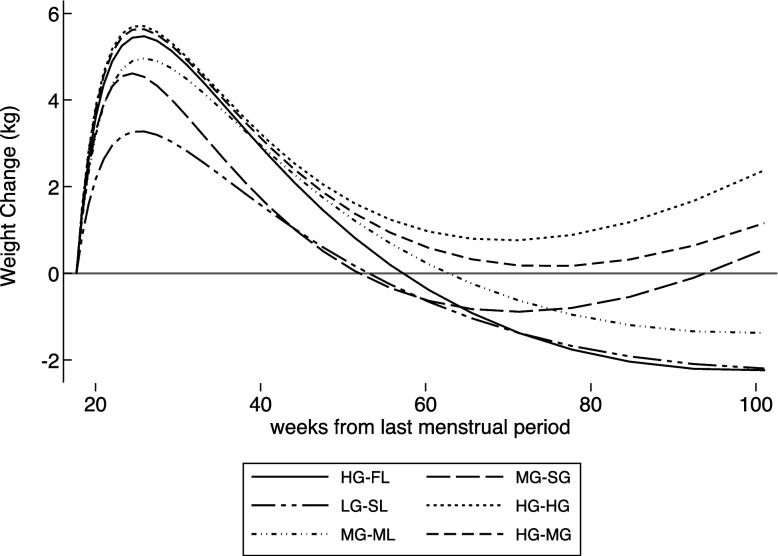
We identified six weight change trajectories with the main difference in the patterns followed after one month of delivery. One in three women (36.7%) was classified in some of the three postpartum weight gain trajectories and regained weight from the second trimester of the first year postpartum. Women who followed some of these trajectories were more likely to have higher age, obesity before pregnancy, < 10 years of schooling, and partner, compared with women (10.7%, n = 87) in a postpartum sustained-fast-lost-weight trajectory (p < 0.05).
Women with obesity before pregnancy have higher odds of regaining gestational weight after delivery without reaching their pre-pregnancy weight. The first six months postpartum are crucial to establishing obesity prevention strategies. Further research is needed to evaluate the effect of the interventions that prevent substantial weight gain through reproductive years in high-risk women.
女性在怀孕期间和产后的体重变化会导致肥胖和以后生活中的健康问题。本研究旨在确定并描述成年女性从怀孕到产后一年的体重变化轨迹。
我们使用了一项正在进行的队列研究的数据,该研究纳入了 2007 年至 2011 年间的健康成年单胎孕妇(n=819)。通过受过专业培训的人员应用问卷调查收集了社会人口统计学数据、孕前体重以及久坐和母乳喂养情况。我们应用基于群组的轨迹建模来区分怀孕第二和第三个三个月以及产后一个月、六个月和十二个月的体重变化。运行多项分类回归模型来描述每个轨迹。
我们确定了六种体重变化轨迹,主要区别在于产后一个月后遵循的模式。三分之一的女性(36.7%)被归类为产后体重增加的三个轨迹中的某一个,并且从产后第一年的第二个三个月开始体重增加。与遵循产后持续快速减肥体重轨迹的女性(10.7%,n=87)相比,遵循这些轨迹的女性年龄更大、孕前肥胖、受教育程度<10 年且有伴侣的可能性更高(p<0.05)。
孕前肥胖的女性在分娩后更有可能恢复妊娠体重,而不会恢复到孕前体重。产后的前六个月对于建立肥胖预防策略至关重要。需要进一步研究评估在高风险女性中通过生殖年预防体重显著增加的干预措施的效果。