Research Unit of Obstetrics and Gynecology, Department of Clinical Research, University of Southern Denmark, Odense, Denmark.
Open Patient Data Explorative Network (OPEN), Department of Clinical Research, University of Southern Denmark and Odense University Hospital, Odense, Denmark.
PLoS Med. 2021 Apr 2;18(4):e1003486. doi: 10.1371/journal.pmed.1003486. eCollection 2021 Apr.
One-fourth of women experience substantially higher weight years after childbirth. We examined weight change from prepregnancy to 18 months postpartum according to subsequent maternal risk of hypertension and cardiovascular disease (CVD).
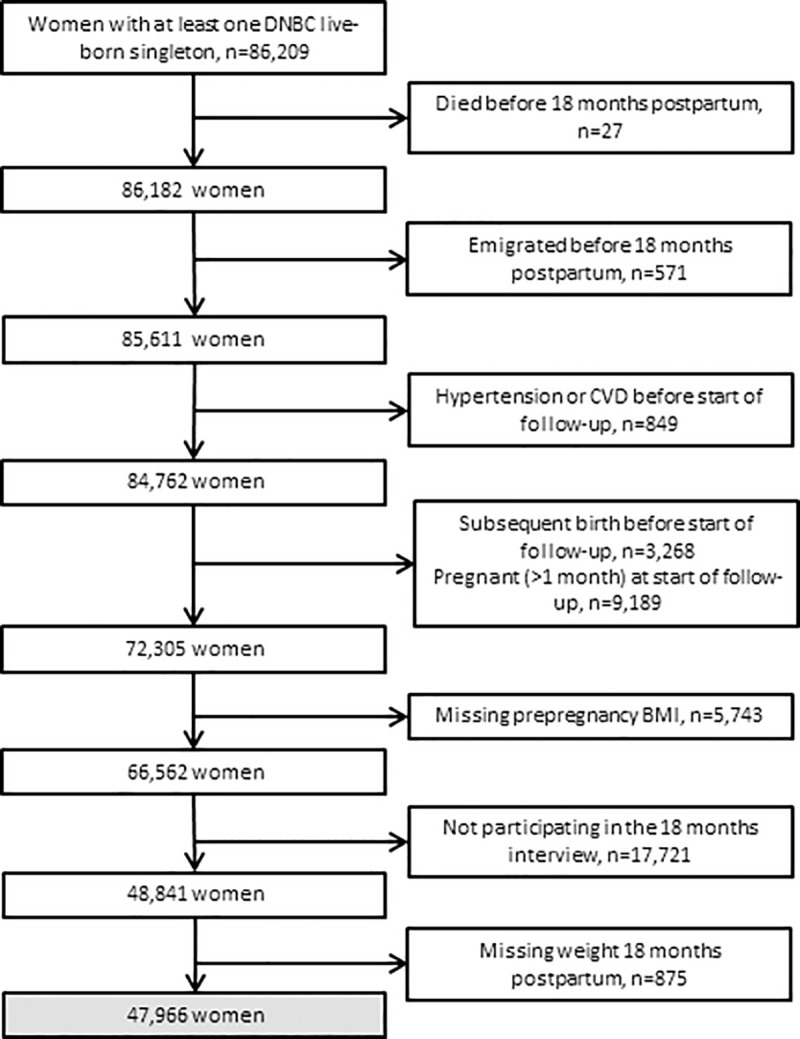
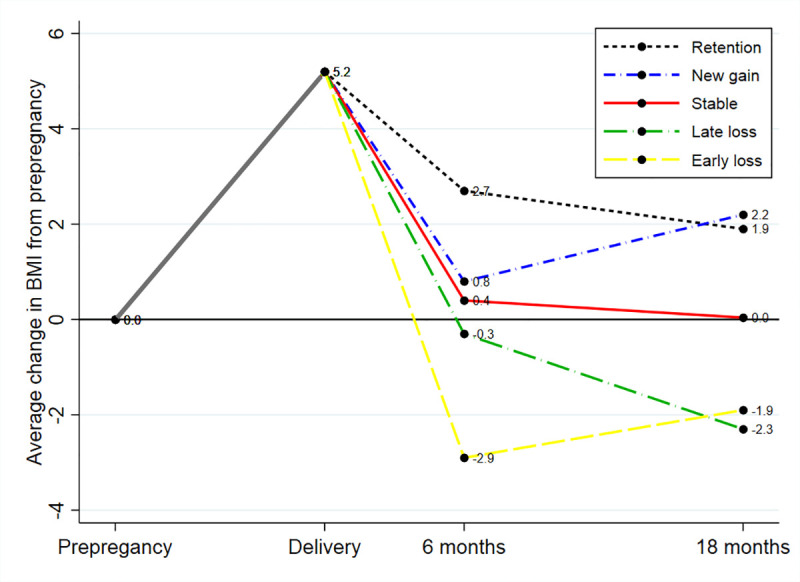
We conducted a cohort study of 47,966 women with a live-born singleton within the Danish National Birth Cohort (DNBC; 1997-2002). Interviews during pregnancy and 6 and 18 months postpartum provided information on height, gestational weight gain (GWG), postpartum weights, and maternal characteristics. Information on pregnancy complications, incident hypertension, and CVD was obtained from the National Patient Register. Using Cox regression, we estimated adjusted hazard ratios (HRs; 95% confidence interval [CI]) for hypertension and CVD through 16 years of follow-up. During this period, 2,011 women were diagnosed at the hospital with hypertension and 1,321 with CVD. The women were on average 32.3 years old (range 18.0-49.2) at start of follow-up, 73% had a prepregnancy BMI <25, and 27% a prepregnancy BMI ≥25. Compared with a stable weight (±1 BMI unit), weight gains from prepregnancy to 18 months postpartum of >1-2 and >2 BMI units were associated with 25% (10%-42%), P = 0.001 and 31% (14%-52%), P < 0.001 higher risks of hypertension, respectively. These risks were similar whether weight gain presented postpartum weight retention or a new gain from 6 months to 18 months postpartum and whether GWG was below, within, or above the recommendations. For CVD, findings differed according to prepregnancy BMI. In women with normal-/underweight, weight gain >2 BMI units and weight loss >1 BMI unit were associated with 48% (17%-87%), P = 0.001 and 28% (6%-55%), P = 0.01 higher risks of CVD, respectively. Further, weight loss >1 BMI unit combined with a GWG below recommended was associated with a 70% (24%-135%), P = 0.001 higher risk of CVD. No such increased risks were observed among women with overweight/obesity (interaction by prepregnancy BMI, P = 0.01, 0.03, and 0.03, respectively). The limitations of this observational study include potential confounding by prepregnancy metabolic health and self-reported maternal weights, which may lead to some misclassification.
Postpartum weight retention/new gain in all mothers and postpartum weight loss in mothers with normal-/underweight may be associated with later adverse cardiovascular health.
四分之一的女性在产后多年体重明显增加。我们根据随后发生高血压和心血管疾病(CVD)的母亲风险,检查了从怀孕前到产后 18 个月的体重变化。
我们对丹麦全国出生队列(DNBC;1997-2002 年)中的 47966 名单胎活产女性进行了队列研究。怀孕期间以及产后 6 个月和 18 个月的访谈提供了身高、妊娠体重增加(GWG)、产后体重和产妇特征的信息。通过全国患者登记处获得了妊娠并发症、新发高血压和 CVD 的信息。使用 Cox 回归,我们通过 16 年的随访估计了高血压和 CVD 的调整后的危险比(HR;95%置信区间[CI])。在此期间,有 2011 名女性在医院被诊断为高血压,1321 名女性被诊断为 CVD。女性在随访开始时平均年龄为 32.3 岁(范围 18.0-49.2),73%的人孕前 BMI<25,27%的人孕前 BMI≥25。与稳定体重(±1 BMI 单位)相比,从怀孕前到产后 18 个月体重增加>1-2 和>2 BMI 单位与高血压的风险分别增加 25%(10%-42%),P=0.001 和 31%(14%-52%),P<0.001。无论产后体重是否保持或从 6 个月到 18 个月增加,体重增加是否为 GWG 推荐值内、以上或以下,这些风险均相似。对于 CVD,结果因孕前 BMI 而异。在正常/体重不足的女性中,体重增加>2 BMI 单位和体重减轻>1 BMI 单位与 CVD 的风险分别增加 48%(17%-87%),P=0.001 和 28%(6%-55%),P=0.01。此外,体重减轻>1 BMI 单位合并 GWG 低于推荐值与 CVD 的风险增加 70%(24%-135%),P=0.001 相关。在超重/肥胖的女性中未观察到这种风险增加(与孕前 BMI 的交互作用,P=0.01、0.03 和 0.03)。这项观察性研究的局限性包括孕前代谢健康和自我报告的产妇体重可能导致的潜在混杂因素,这可能导致一些分类错误。
所有母亲的产后体重保持/新增加以及正常/体重不足母亲的产后体重减轻可能与以后的心血管健康不良有关。