Department of Medical Sciences, Renal Medicine, Uppsala University, Uppsala, Sweden.
Department of Medical Biochemistry and Microbiology, Zoonosis Science Centre, Uppsala University, Uppsala, Sweden.
Ups J Med Sci. 2022 Oct 13;127. doi: 10.48101/ujms.v127.8959. eCollection 2022.
The hemodialysis (HD) population has been a vulnerable group during the coronavirus disease 2019 (COVID-19) pandemic. Advanced chronic kidney disease with uremia is associated with weaker immune response to infections and an attenuated response to vaccines. The aim of this study was to study the humoral and cellular response to the second and third doses of Severe Acute Respiratory Syndrome Coronavirus 2 (SARS‑CoV‑2) BNT162b2 mRNA vaccine in HD patients and to follow the response over time.
The patients received their first two vaccine doses from 28 December 2020 within a 4-week interval and the third dose in September 2021 and were followed-up for humoral and cellular immune response at 1) 7-15 weeks and 2) 6-8 months after dose two (no t-cell reactivity measured), and 3) 3 weeks and 4) 3 months after dose three. Fifty patients were initially enrolled, and 40 patients were followed during the entire study. Levels of COVID-19 (SARS-CoV-2) IgG antibody against the Spike antigen (anti-S) and T-cell reactivity testing against the Spike protein using Enzyme-Linked ImmunoSpot (ELISPOT) technology were evaluated.
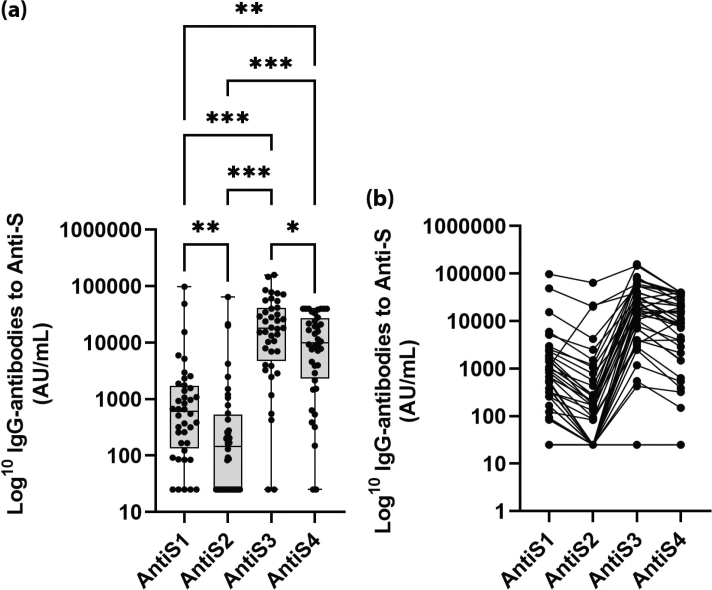
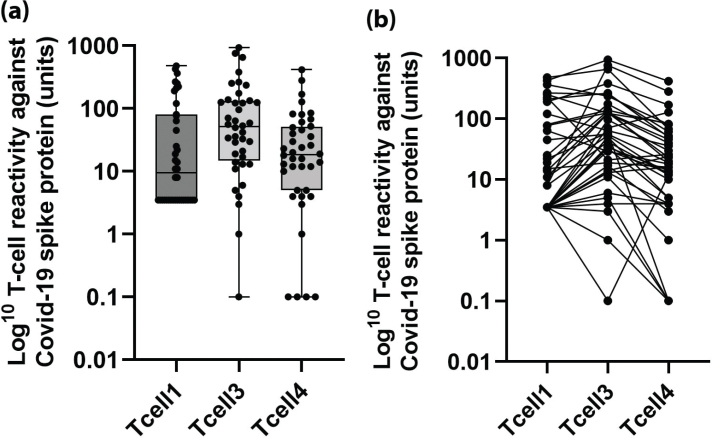
IgG antibodies to anti-S were detected in 35 (88%) of the 40 patients 7-15 weeks after vaccine dose two, 31 (78%) were positive, and 4 (10%) borderline. The median anti-S titer was 606 Abbott Units/milliliter (AU/mL) (interquartile range [IQR] 134-1,712). Three months after the third dose, anti-S was detected in 38 (95%) of 40 patients ( < 0.01 compared to after dose two), and the median anti-S titer was 9,910 AU/mL (IQR 2,325-26,975). Cellular reactivity was detected in 22 (55%), 34 (85%), and 28 (71%) of the 40 patients, and the median T-cell response was 9.5 (IQR 3.5-80), 51.5 (14.8-132), and 19.5 (8.8-54.2) units, respectively, for 6-8 months after dose two, 3 weeks, and 3 months after dose three.
Our data show that a third dose of SARS‑CoV‑2 BNT162b2 mRNA vaccine gives a robust and improved immunological response in HD patients, but a few patients did not develop any anti-S response during the entire study, indicating the importance to monitor the vaccine response since those who do not respond could now be given monoclonal antibodies if they contract a COVID-19 infection or in the future antivirals.
在 2019 年冠状病毒病(COVID-19)大流行期间,血液透析(HD)患者一直是一个弱势群体。患有晚期慢性肾脏病伴尿毒症的患者对感染的免疫反应较弱,对疫苗的反应也较弱。本研究旨在研究 HD 患者对第二和第三剂严重急性呼吸系统综合征冠状病毒 2(SARS-CoV-2)BNT162b2 mRNA 疫苗的体液和细胞反应,并随时间观察反应情况。
患者于 2020 年 12 月 28 日至 4 周内接种前两剂疫苗,第三剂于 2021 年 9 月接种,并在以下时间点进行体液和细胞免疫反应随访:1)接种后 7-15 周;2)接种后 6-8 个月(无 T 细胞反应性测量);3)接种后 3 周;4)接种后 3 个月。最初纳入了 50 名患者,其中 40 名患者在整个研究期间进行了随访。使用酶联免疫斑点(ELISPOT)技术评估了针对 Spike 抗原(抗-S)的 COVID-19(SARS-CoV-2)IgG 抗体水平和针对 Spike 蛋白的 T 细胞反应性检测。
在接种后 7-15 周时,40 名患者中有 35 名(88%)检测到针对抗-S 的 IgG 抗体,其中 31 名(78%)为阳性,4 名(10%)为弱阳性。抗-S 的中位数滴度为 606 雅培单位/毫升(AU/mL)(四分位距[IQR] 134-1712)。在接种后 3 个月,40 名患者中有 38 名(95%)(与接种后 2 相比,P<0.01)检测到抗-S,抗-S 的中位数滴度为 9910 AU/mL(IQR 2325-26975)。在 40 名患者中,分别有 22 名(55%)、34 名(85%)和 28 名(71%)在接种后 6-8 个月、接种后 3 周和 3 个月检测到细胞反应性,T 细胞反应的中位数分别为 9.5(IQR 3.5-80)、51.5(14.8-132)和 19.5(8.8-54.2)单位。
我们的数据表明,第三剂 SARS-CoV-2 BNT162b2 mRNA 疫苗可在 HD 患者中产生强大且改善的免疫反应,但在整个研究过程中,少数患者未产生任何抗-S 反应,这表明监测疫苗反应的重要性,因为如果这些患者感染 COVID-19 或未来使用抗病毒药物,那些未产生反应的患者现在可能需要使用单克隆抗体。