Muzzi Beatrice, Lottini Elisabetta, Yaacoub Nader, Peddis Davide, Bertoni Giovanni, de Julián Fernández César, Sangregorio Claudio, López-Ortega Alberto
Department of Biotechnology, Chemistry and Pharmacy, University of Siena 1240, I-53100Siena, Italy.
ICCOM-CNR, I-50019Sesto Fiorentino, Italy.
ACS Appl Nano Mater. 2022 Oct 28;5(10):14871-14881. doi: 10.1021/acsanm.2c03161. Epub 2022 Sep 21.
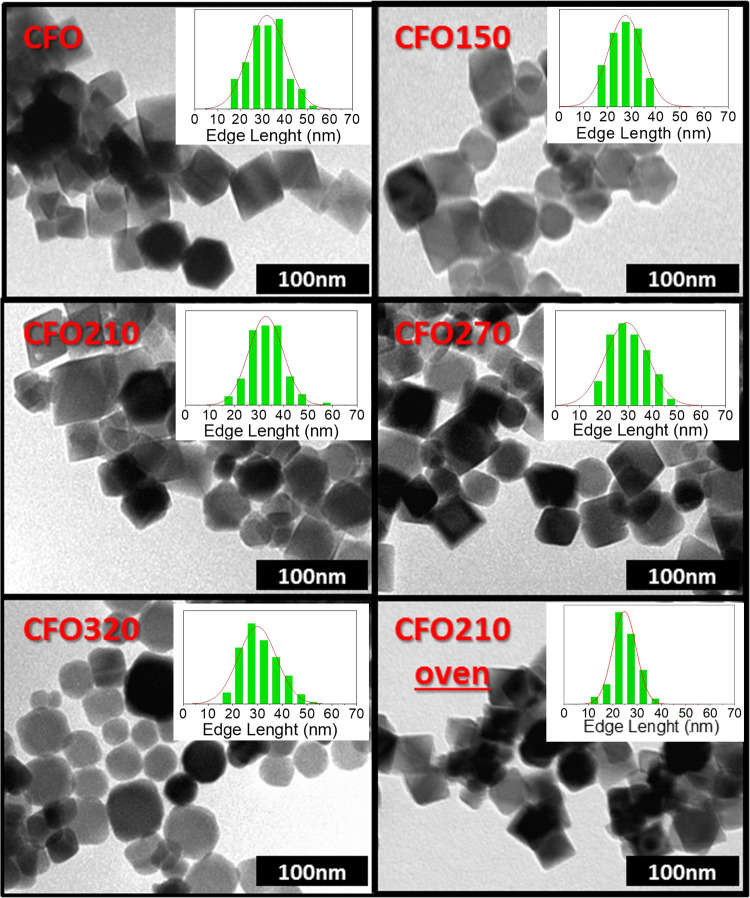
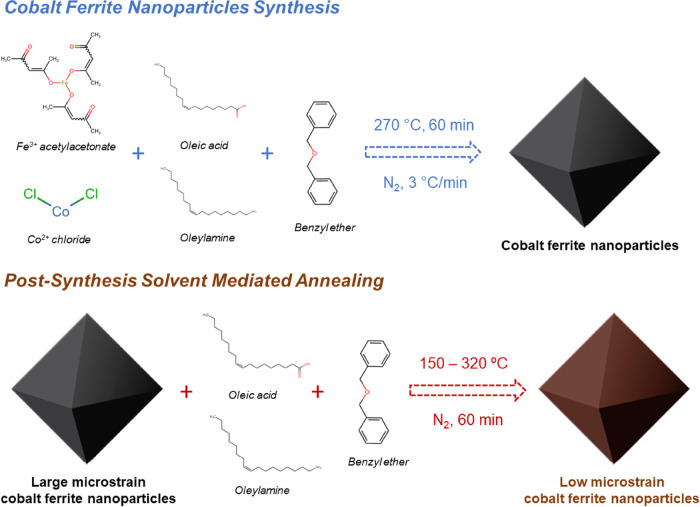
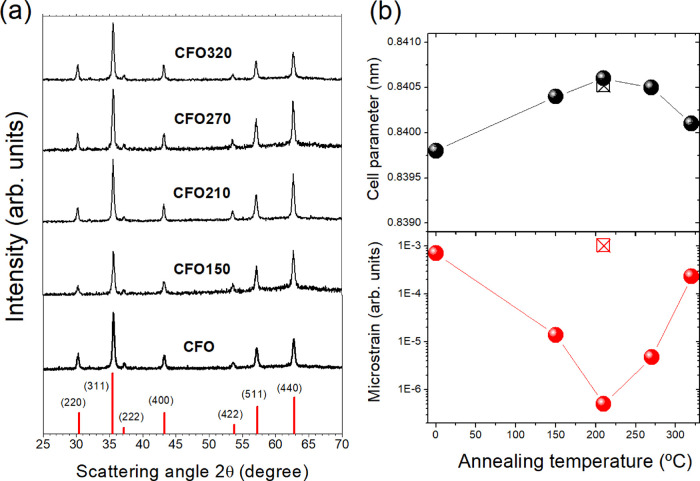
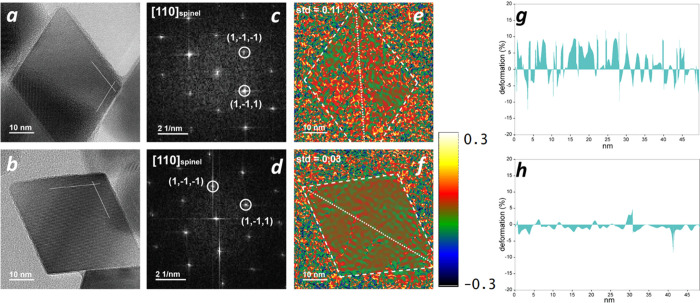
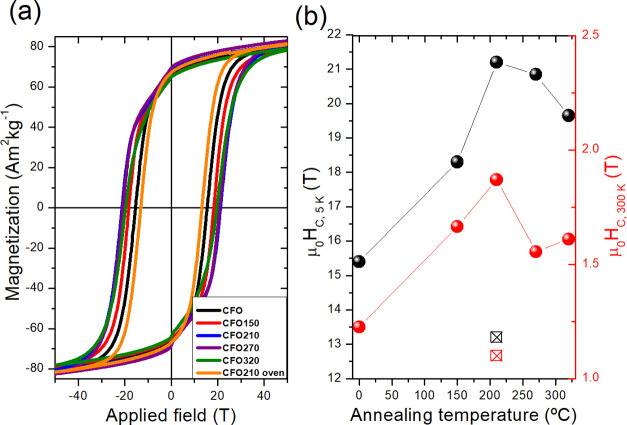
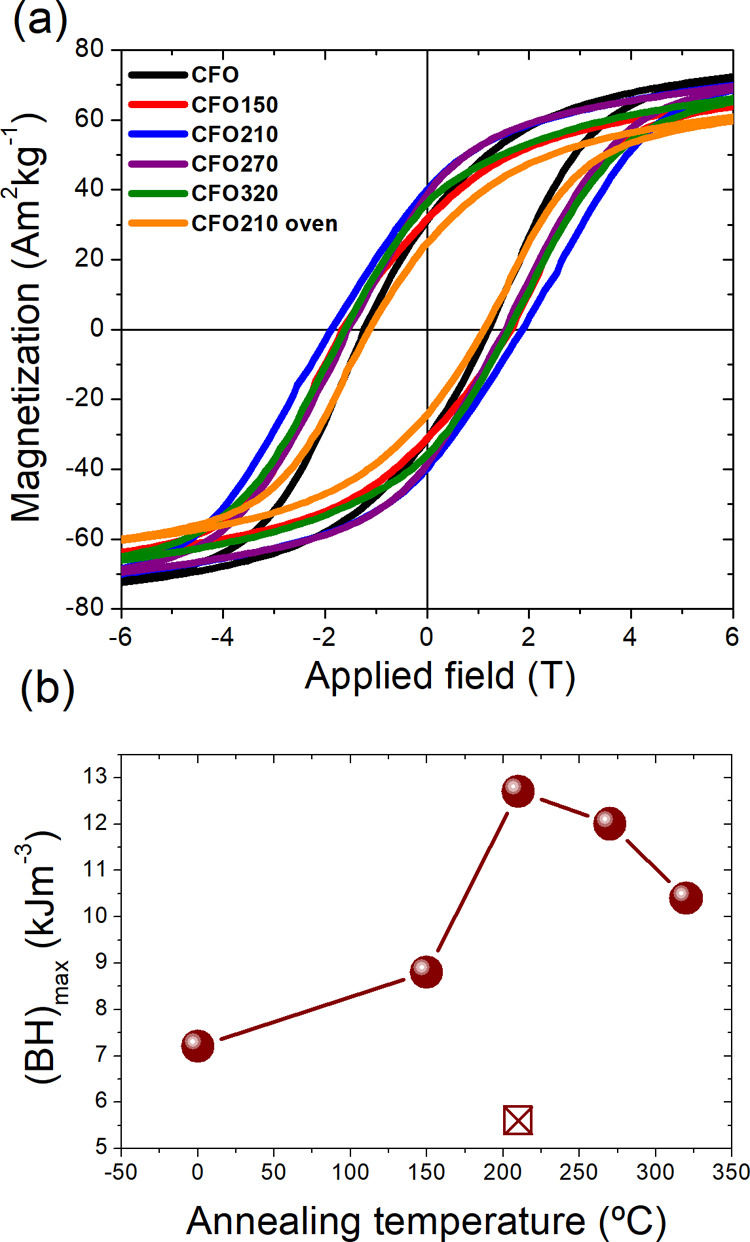
In this work, we demonstrate that the reduction of the local internal stress by a low-temperature solvent-mediated thermal treatment is an effective post-treatment tool for magnetic hardening of chemically synthesized nanoparticles. As a case study, we used nonstoichiometric cobalt ferrite particles of an average size of 32(8) nm synthesized by thermal decomposition, which were further subjected to solvent-mediated annealing at variable temperatures between 150 and 320 °C in an inert atmosphere. The postsynthesis treatment produces a 50% increase of the coercive field, without affecting neither the remanence ratio nor the spontaneous magnetization. As a consequence, the energy product and the magnetic energy storage capability, key features for applications as permanent magnets and magnetic hyperthermia, can be increased by ca. 70%. A deep structural, morphological, chemical, and magnetic characterization reveals that the mechanism governing the coercive field improvement is the reduction of the concomitant internal stresses induced by the low-temperature annealing postsynthesis treatment. Furthermore, we show that the medium where the mild annealing process occurs is essential to control the final properties of the nanoparticles because the classical annealing procedure ( > 350 °C) performed on a dried powder does not allow the release of the lattice stress, leading to the reduction of the initial coercive field. The strategy here proposed, therefore, constitutes a method to improve the magnetic properties of nanoparticles, which can be particularly appealing for those materials, as is the case of cobalt ferrite, currently investigated as building blocks for the development of rare-earth free permanent magnets.
在这项工作中,我们证明通过低温溶剂介导的热处理降低局部内应力是一种用于化学合成纳米颗粒磁硬化的有效后处理工具。作为一个案例研究,我们使用了通过热分解合成的平均尺寸为32(8) nm的非化学计量钴铁氧体颗粒,并在惰性气氛中于150至320 °C的可变温度下对其进行溶剂介导的退火处理。合成后处理使矫顽场增加了50%,而不影响剩磁比和自发磁化强度。因此,作为永磁体和磁热疗应用的关键特性的能量积和磁储能能力可提高约70%。深入的结构、形态、化学和磁性表征表明,控制矫顽场改善的机制是合成后低温退火处理所诱导的伴随内应力的降低。此外,我们表明发生温和退火过程的介质对于控制纳米颗粒的最终性能至关重要,因为在干粉上进行的经典退火程序(> 350 °C)不允许晶格应力释放,导致初始矫顽场降低。因此,这里提出的策略构成了一种改善纳米颗粒磁性的方法,对于那些目前作为无稀土永磁体开发的构建块而被研究的材料,如钴铁氧体,可能特别有吸引力。