Centro de Biotecnología Acuícola, Facultad de Química y Biología, Universidad de Santiago de Chile, Santiago, Chile.
Departamento de Biología, Facultad de Química y Biología, Universidad de Santiago de Chile, Santiago, Chile.
Front Public Health. 2022 Oct 20;10:976875. doi: 10.3389/fpubh.2022.976875. eCollection 2022.
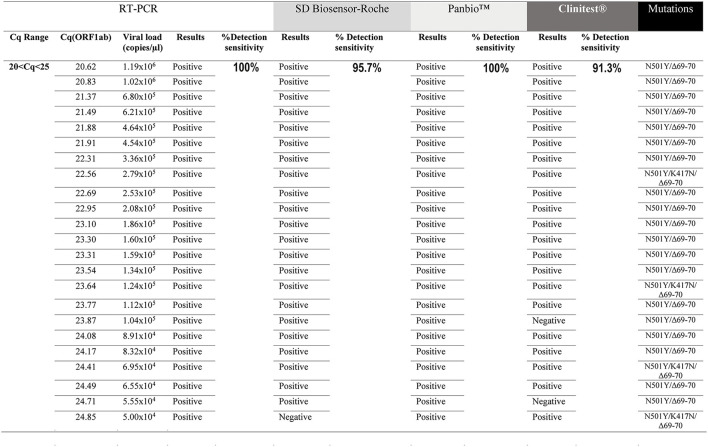
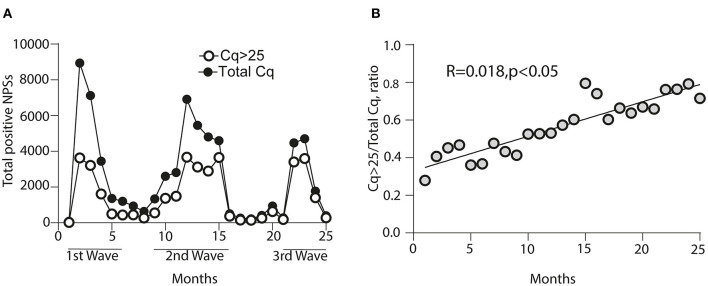
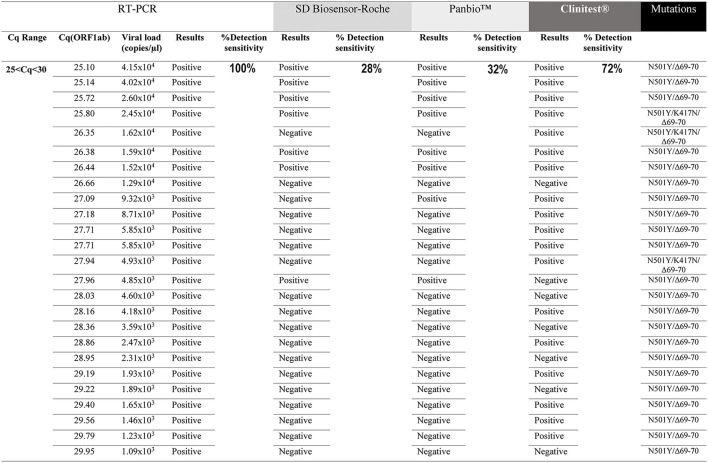
The COVID-19 pandemic continues to be a concern and keeps global health authorities on alert. The RT-PCR technique has been the gold-standard assay for detecting the SARS-CoV-2 virus. However, rapid antigen tests (RATs) have been widely used to increase the number of tests faster and more efficiently in the population. Nevertheless, the appearance of new viral variants, with genomic mutations associated with greater contagiousness and immune evasion, highlights the need to evaluate the sensitivity of these RATs. This report evaluates the sensitivity of SD Biosensor-Roche, Panbio™, and Clinitest® RATs widely used in Santiago de Chile in the detection of the Omicron variant from Nasopharyngeal samples (NPSs), the most predominant SARS-CoV-2 variant in Chile and the world. SD Biosensor-Roche shows a detection sensitivity of 95.7% in the viral amplification range of 20 ≤ Cq < 25, while Panbio™ and Clinitest® show 100% and 91.3%, respectively. In the viral amplification ranges of 25 ≤ Cq < 30, the detection sensitivity decreased to 28% for SD Biosensor-Roche, 32% for Panbio™, and 72% for Clinitest®. This study indicates that the tested RATs have high sensitivity in detecting the Omicron variant of concern (VOC) at high viral loads. By contrast, its sensitivity decreases at low viral loads. Therefore, it is suggested to limit the use of RATs as an active search method, considering that infections in patients are increasingly associated with lower viral loads of SARS-CoV-2. These antecedents could prevent contagion outbreaks and reduce the underestimation of the current Omicron variant circulation at the local level.
新型冠状病毒肺炎(COVID-19)疫情仍令人担忧,全球卫生机构对此保持警惕。逆转录聚合酶链反应(RT-PCR)技术一直是检测 SARS-CoV-2 病毒的金标准检测方法。然而,快速抗原检测(RAT)已被广泛用于增加人群中的检测数量,提高检测效率。然而,新的病毒变体的出现,其基因组突变与更高的传染性和免疫逃避有关,这突显了评估这些 RAT 敏感性的必要性。本报告评估了在智利圣地亚哥广泛使用的 SD Biosensor-Roche、Panbio™和 Clinitest® RAT 检测鼻咽样本(NPS)中奥密克戎变体的敏感性,奥密克戎变体是智利和全球最主要的 SARS-CoV-2 变体。SD Biosensor-Roche 在 20≤Cq<25 的病毒扩增范围内的检测灵敏度为 95.7%,而 Panbio™和 Clinitest®的检测灵敏度分别为 100%和 91.3%。在 25≤Cq<30 的病毒扩增范围内,SD Biosensor-Roche 的检测灵敏度降至 28%,Panbio™降至 32%,Clinitest®降至 72%。本研究表明,所测试的 RAT 在检测高病毒载量的奥密克戎关切变异株(VOC)时具有高灵敏度。相比之下,其灵敏度在低病毒载量时下降。因此,建议限制 RAT 作为主动搜索方法的使用,因为患者感染越来越与 SARS-CoV-2 的低病毒载量有关。这些情况可能会防止传染爆发,并减少当地对当前奥密克戎变异株传播的低估。