Chen Shuai, Huang Wucui, Zhou Guowei, Sun Xiaohe, Jin Jie, Li Zhiwei
Department of Orthopaedics, The Second Affiliated Hospital of Nanjing University of Chinese Medicine, Nanjing, China.
Department of Respiratory and Critical Care Medicine, Zhongda Hospital Affiliated to Southeast University, Nanjing, China.
Int J Endocrinol. 2022 Oct 26;2022:2205616. doi: 10.1155/2022/2205616. eCollection 2022.
Thyroid hormone is acknowledged as a pivotal factor in skeletal development and adult bone maintenance. However, available data about the relationship between sensitivity to thyroid hormone and bone mineral density (BMD) remain limited and conflicting. The purpose of the study was to explore the complex relationship between sensitivity to thyroid hormone indices and BMD using cross-sectional analysis.
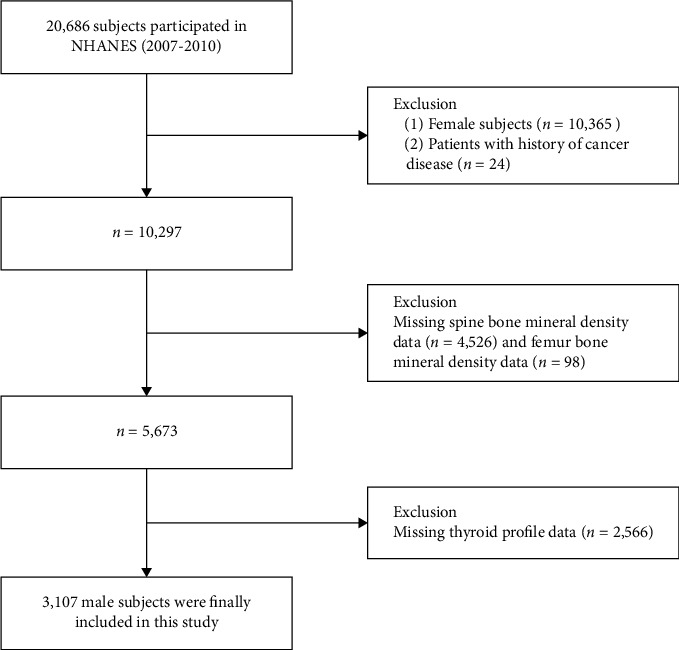
An overall sample of 3,107 males from the National Health and Nutrition Examination Survey (NHANES) was studied in the study. The thyroid hormone sensitivity indices included free triiodothyronine/tree thyroxine (FT3/FT4), thyroid-stimulating hormone index (TSHI), thyrotroph thyroxine resistance index (TT4RI), and thyroid feedback quantile-based index (TFQI). Given the complex study design and sample weights, the correlation between sensitivity to thyroid hormone indices and BMD was evaluated through multivariate linear regression models, and extra subgroup analyses were performed to examine the robustness of the results.
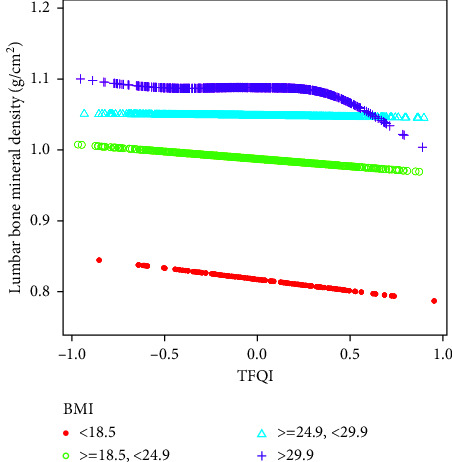
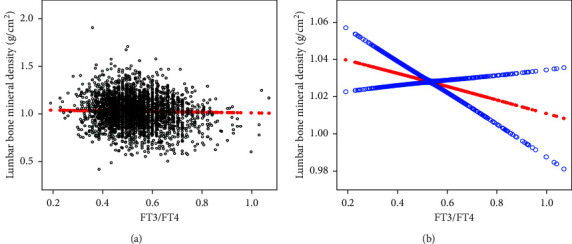
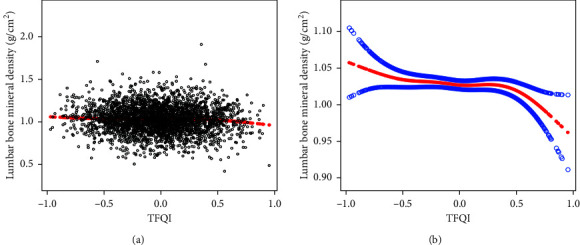
Among the 3,107 participants, we demonstrated that FT3/FT4 was negatively correlated with lumbar BMD ( = -0.0.35, 95% CI: -0.084-0.013, < 0.05). In the terms of central sensitivity to thyroid hormone, TFQI showed a significant negative relationship with the BMD of the lumbar ( = -0.018, 95% CI: -0.033 to -0.003, < 0.05), total femur ( = -0.020, 95% CI: -0.035 to -0.006, < 0.01), and femur neck ( = -0.018, 95% CI: -0.031 to -0.005, < 0.01). In the subgroup analyses stratified by body mass index (BMI), the significant negative correlation between TFQI and lumbar BMD remained in the male participants with BMI between 18.5 and 24.9 kg/m.
Decreased indices of sensitivity to thyroid hormones are strongly associated with increased lumbar BMD, suggesting that the dysfunction of peripheral and central response to thyroid hormone might contribute to bone loss. In addition, FT3/FT4 and TFQI were considered to be the preferable indicators to guide the prevention and clinical treatment of osteoporosis.
甲状腺激素被认为是骨骼发育和成人骨骼维持的关键因素。然而,关于甲状腺激素敏感性与骨密度(BMD)之间关系的现有数据仍然有限且相互矛盾。本研究的目的是通过横断面分析探讨甲状腺激素指标敏感性与骨密度之间的复杂关系。
本研究对来自美国国家健康与营养检查调查(NHANES)的3107名男性进行了总体样本研究。甲状腺激素敏感性指标包括游离三碘甲状腺原氨酸/游离甲状腺素(FT3/FT4)、促甲状腺激素指数(TSHI)、促甲状腺素甲状腺素抵抗指数(TT4RI)和基于甲状腺反馈分位数的指数(TFQI)。鉴于复杂的研究设计和样本权重,通过多元线性回归模型评估甲状腺激素指标敏感性与骨密度之间的相关性,并进行额外的亚组分析以检验结果的稳健性。
在3107名参与者中,我们发现FT3/FT4与腰椎骨密度呈负相关(β = -0.035,95%CI:-0.084至-0.013,P < 0.05)。就甲状腺激素的中枢敏感性而言,TFQI与腰椎(β = -0.018,95%CI:-0.033至-0.003,P < 0.05)、全股骨(β = -0.020,95%CI:-0.035至-0.006,P < 0.01)和股骨颈(β = -0.018,95%CI:-0.031至-0.005,P < 0.01)的骨密度均呈显著负相关。在按体重指数(BMI)分层的亚组分析中,TFQI与腰椎骨密度之间的显著负相关在BMI为18.5至24.9kg/m²的男性参与者中仍然存在。
甲状腺激素敏感性指标降低与腰椎骨密度增加密切相关,提示甲状腺激素外周和中枢反应功能障碍可能导致骨质流失。此外,FT3/FT4和TFQI被认为是指导骨质疏松症预防和临床治疗的优选指标。