Research Center for Social Science and Medicine, Tokyo Metropolitan Institute of Medical Science, 2-1-6 Kamikitazawa, Setagaya-ku, Tokyo, 156-8506, Japan.
Department of Neuropsychiatry, The University of Tokyo, 7-3-1 Hongo, Bunkyo-ku, Tokyo, 113-8655, Japan.
Transl Psychiatry. 2022 Nov 7;12(1):466. doi: 10.1038/s41398-022-02238-9.
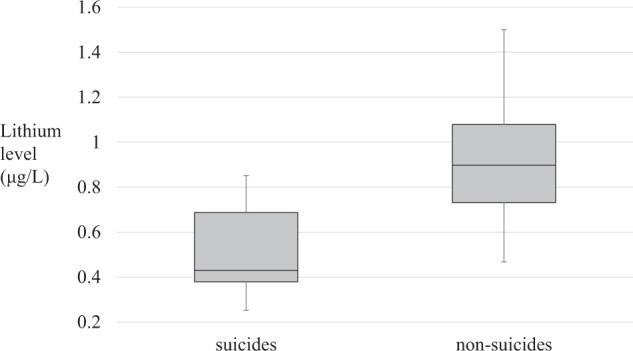
Ecological studies have suggested the protective effect of micro-dose lithium in drinking water against suicide, however, the association between body lithium level and suicide is unknown. We aimed to compare body lithium levels between suicide and non-suicide fatalities. This cross-sectional study included 12 suicides and 16 non-suicides who were examined or dissected at the Tokyo Medical Examiner's Office from March 2018 to June 2021. The aqueous humor lithium concentration was measured twice using inductively coupled plasma mass spectrometry. Analysis of covariance (ANCOVA) was used to compare the lithium concentration between suicides and non-suicides. Mixed-effects model was conducted to account for all lithium concentration data. The aqueous humor lithium concentration did not change after death (t(7) = -0.70, [Formula: see text], SE = 0.03, 95% CI = [-0.09, 0.05], P = 0.51, Cohen's d = 0.01). The aqueous humor lithium concentration was lower in suicides (mean 0.50 μg/L (variance s 0.04)) than in non-suicides (mean 0.9 μg/L (s 0.07)) (t(26) = 4.47, [Formula: see text], SE = 0.09, 95% CI = [0.22 to 0.61], P < 0.001, Cohen's d = 1.71). The ANCOVA showed that death by suicide was significantly associated with lower lithium concentration (F(1, 24) = 8.57, P = 0.007), and the effect size was large (η = 0.26). The random intercept model showed a significant effect of suicide on aqueous humor lithium concentration (b = -0.261, SE = 0.102, 95% CI = [-0.471 to -0.051], t(24) = -2.568, P = 0.017). The results of this study demonstrate that even micro-dose lithium is associated with suicide death. Clinical studies are warranted to examine the effects of micro-dose lithium on suicide prevention.
生态研究表明,饮用水中的微量锂对自杀有保护作用,但人体锂水平与自杀之间的关系尚不清楚。我们旨在比较自杀和非自杀性死亡者的体内锂水平。这项横断面研究纳入了 2018 年 3 月至 2021 年 6 月在东京法医办公室接受检查或解剖的 12 例自杀者和 16 例非自杀性死亡者。使用电感耦合等离子体质谱法两次测量房水锂浓度。采用协方差分析(ANCOVA)比较自杀者和非自杀者的锂浓度。采用混合效应模型对所有锂浓度数据进行分析。死后房水锂浓度没有变化(t(7)=-0.70,[公式:见文本],SE=0.03,95%CI=[-0.09,0.05],P=0.51,Cohen's d=0.01)。自杀者的房水锂浓度较低(平均值 0.50μg/L(方差 s 0.04)),而非自杀者的房水锂浓度较高(平均值 0.9μg/L(方差 s 0.07))(t(26)=4.47,[公式:见文本],SE=0.09,95%CI=[0.22,0.61],P<0.001,Cohen's d=1.71)。ANCOVA 显示,自杀死亡与较低的锂浓度显著相关(F(1, 24)=8.57,P=0.007),且效应量较大(η=0.26)。随机截距模型显示,自杀对房水锂浓度有显著影响(b=-0.261,SE=0.102,95%CI=[-0.471,-0.051],t(24)=-2.568,P=0.017)。本研究结果表明,即使是微量锂也与自杀死亡有关。有必要进行临床研究,以检验微量锂对预防自杀的影响。