Shi Huiping, Wang Zhaoyue
MOH Key Lab of Thrombosis and Hemostasis, Jiangsu Institute of Hematology, the First Affiliated Hospital of Soochow University, Suzhou, China.
Collaborative Innovation Center of Hematology, Soochow University, Suzhou, China.
Transl Pediatr. 2022 Oct;11(10):1717-1725. doi: 10.21037/tp-22-15.
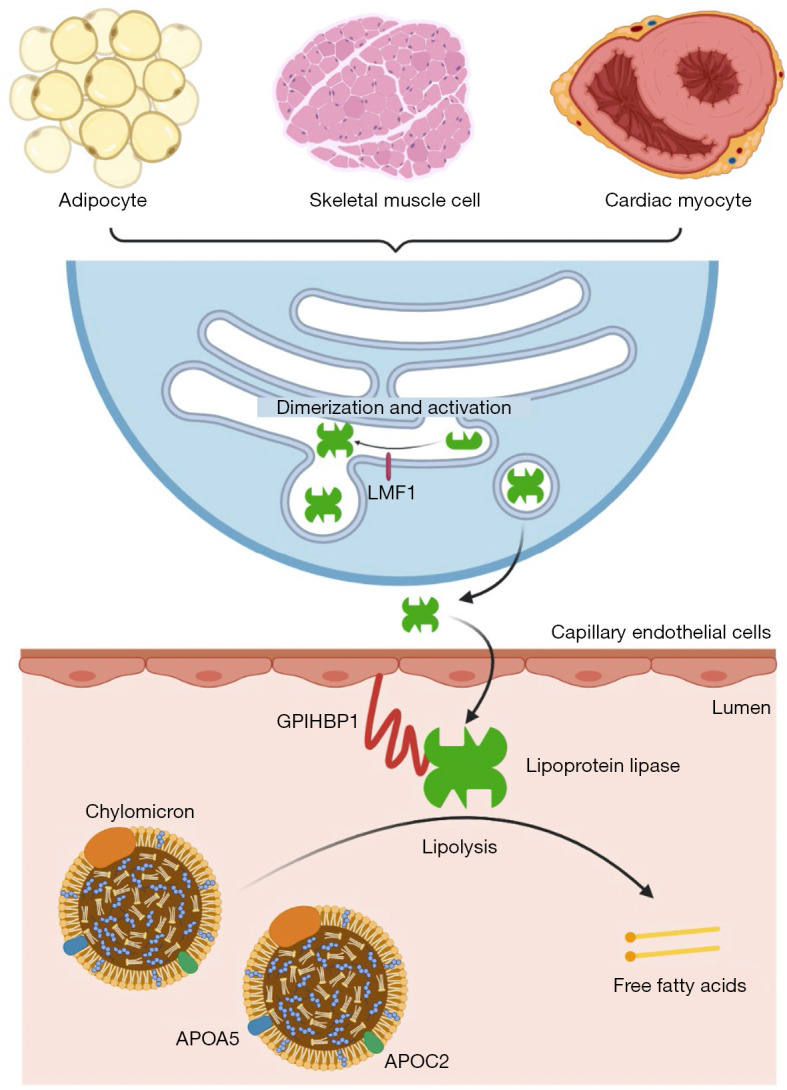
Familial chylomicronemia syndrome (FCS) is a rare autosomal recessive disorder, typically caused by biallelic pathogenic variants in the lipoprotein lipase () gene. Lipoprotein lipase, encoded by the gene, catalyzes the hydrolysis of triglycerides, and its deficiency or dysfunction can lead to chylomicronemia and potentially fatal recurrent acute pancreatitis.
Here, we report an Asian child with FCS due to compound heterozygous variants. The 4-year-old patient presented with splenomegaly and severe hypertriglyceridemia, specifically chylomicronemia which resulted in abnormal coagulation measured by a turbidity-based assay. Based on the clinical features and family history, the diagnosis of FCS was suspected, and confirmed by the identification of compound heterozygous variants in the gene (c.461A>G; p.His154Arg and c.788T>A; p.Leu263Gln) in the patient, inheriting one from each parent. According to the clinical and genetic findings, the patient was diagnosed with FCS. experimental validation found that the p.H154R variant reduced the expression of lipoprotein lipase and decreased its lipolytic activity, while the p.L263Q variant mainly impaired its lipolytic activity.
FCS was molecularly diagnosed using whole exome sequencing in the case presented. When interpreting abnormal coagulation profiles measured by turbidity-based assay, the possibility of lipemic blood (or chylomicronemia) should be considered and the presence of this phenomenon might indicate the diagnosis of FCS. experiments showed that the two variants impaired lipoprotein lipase expression and/or function making them likely to be pathogenic.
家族性乳糜微粒血症综合征(FCS)是一种罕见的常染色体隐性疾病,通常由脂蛋白脂肪酶(LPL)基因的双等位基因致病变异引起。由LPL基因编码的脂蛋白脂肪酶催化甘油三酯的水解,其缺乏或功能障碍可导致乳糜微粒血症,并可能引发致命的复发性急性胰腺炎。
在此,我们报告一名因复合杂合LPL变异而患FCS的亚洲儿童。这名4岁患者出现脾肿大和严重的高甘油三酯血症,特别是乳糜微粒血症,这通过基于浊度的检测导致凝血异常。基于临床特征和家族史,怀疑为FCS,并通过在患者中鉴定出LPL基因的复合杂合变异(c.461A>G;p.His154Arg和c.788T>A;p.Leu263Gln)得到证实,该变异分别从父母双方遗传而来。根据临床和基因发现,该患者被诊断为FCS。实验验证发现,LPL p.H154R变异降低了脂蛋白脂肪酶的表达并降低了其脂解活性,而LPL p.L263Q变异主要损害其脂解活性。
在本病例中使用全外显子组测序对FCS进行了分子诊断。在解释基于浊度的检测所测得的异常凝血谱时,应考虑脂血(或乳糜微粒血症)的可能性,这种现象的存在可能提示FCS的诊断。实验表明,这两个LPL变异损害了脂蛋白脂肪酶的表达和/或功能,使其可能具有致病性。