JC School of Public Health and Primary Care, Faculty of Medicine, The Chinese University of Hong Kong, Hong Kong, China.
Center for Health Systems and Policy Research, JC School of Public Health and Primary Care, Centre for Health Systems and Policy Research, The Chinese University of Hong Kong, Hong Kong, China.
Health Expect. 2023 Feb;26(1):245-255. doi: 10.1111/hex.13651. Epub 2022 Nov 8.
Health literacy (HL) refers to individuals' abilities to process and use health information to promote health. This study aimed to develop the first HL measurement tool for the Chinese Hong Kong population.
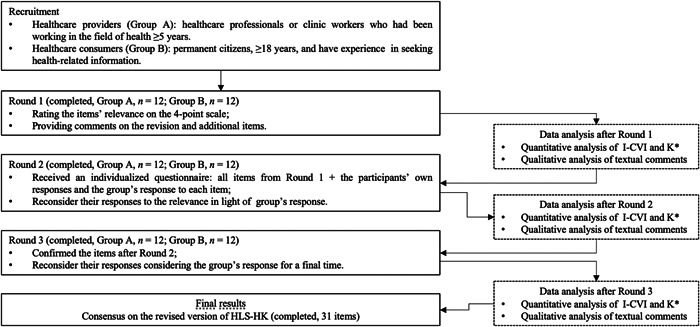
A two-phase methodology was adopted. In Phase I, evidence synthesis with a deductive method was conducted to formulate the item list from the literature. In Phase II, a modified e-Delphi survey was conducted among stakeholders (i.e., healthcare providers and healthcare consumers) to confirm the content validity of the item list. The stakeholders were invited to rate the relevance of each draft item on a 4-point scale and provide suggestions for revisions, removal or adding new items.
In Phase I, a total of 34 items covering functional, interactive and critical HL were generated. In Phase II, to obtain a balanced view from experts and laypeople, healthcare professionals (n = 12) and consumers (n = 12) were invited to participate in the Delphi panel. The response rates of the three rounds were 100%. After the third round, the consensus was reached for 31 items, and no further comments for adding or revising items were received. All items exhibited excellent content validity (item content validity index: 0.79-1.00; K*: 0.74-1.00).
A Health Literacy Scale for Hong Kong was developed. Compared with existing HL scales, the scale fully operationalized the skills involved in functional, interactive and critical HL. The Delphi study shows evidence supporting the high content validity of all items in the scale. In future studies, these items should undergo rigorous testing to examine their psychometric properties in our target population groups. By illuminating the details in the development process, this paper provides a deeper understanding of the scale's scope and limitations for others who are interested in using this tool.
Public as healthcare consumers, in addition to healthcare providers, were involved in developing a new HL scale for this study. The input from the public contributed to examining the scale's content validity by judging whether all items reflected the skills that they need to find and use health-related information in their daily life.
健康素养(HL)是指个体处理和使用健康信息以促进健康的能力。本研究旨在为中国香港人群开发首个 HL 测量工具。
采用两阶段方法。第一阶段采用演绎法进行证据综合,从文献中制定项目清单。第二阶段,利益相关者(即医疗保健提供者和医疗保健消费者)进行了改良的电子德尔菲调查,以确认项目清单的内容有效性。邀请利益相关者对每个草案项目的相关性进行 4 分制评分,并就修订、删除或添加新项目提出建议。
第一阶段共生成了 34 个项目,涵盖功能性、互动性和批判性 HL。第二阶段,为了从专家和非专业人士那里获得平衡的观点,邀请了 12 名医疗保健专业人员和 12 名消费者参加德尔菲小组。三轮的回复率均为 100%。第三轮后,31 项达成共识,没有收到添加或修订项目的进一步意见。所有项目均表现出极好的内容有效性(项目内容有效性指数:0.79-1.00;K*:0.74-1.00)。
开发了香港健康素养量表。与现有的 HL 量表相比,该量表充分实现了功能性、互动性和批判性 HL 所涉及的技能。德尔菲研究为量表中所有项目的高内容有效性提供了证据支持。在未来的研究中,应在目标人群中对这些项目进行严格测试,以检验其在量表中的心理测量特性。通过阐明发展过程中的细节,本文为对使用该工具感兴趣的其他人提供了对量表范围和局限性的更深入理解。
除了医疗保健提供者外,公众作为医疗保健消费者也参与了这项研究的新 HL 量表的开发。公众的投入有助于通过判断所有项目是否反映了他们在日常生活中查找和使用与健康相关信息所需的技能,来检验量表的内容有效性。