UCL Centre for Behaviour Change, Division of Psychology and Language Sciences, University College London, London, UK.
Division of Psychiatry, University College London, London, UK.
Health Expect. 2024 Jun;27(3):e14102. doi: 10.1111/hex.14102.
The mental health of young people (aged 16-25 years) is a growing public health concern in the United Kingdom due to the increasing numbers of young people experiencing mental health difficulties, with many not in contact with mental health services. To design services that meet the needs of all young people, a diversity of young people must be involved in mental health research, beyond being participants. This Delphi study aimed to identify different types of 'involvement' and to define and describe 'under-representation' in young people's involvement in mental health research.
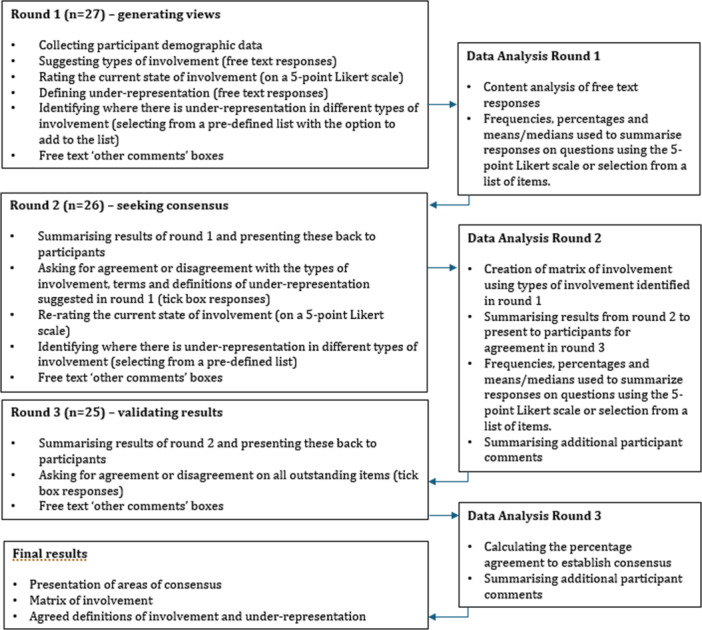
Twenty-seven experts in young people's mental health research completed a series of online questionnaires. The experts were academic researchers, patient and public involvement (PPI) professionals and young 'experts by experience'. Round 1 generated panellists' views on 'involvement' and 'under-representation'. Round 2 summarised panellists' responses from Round 1 and sought consensus (minimum 70% agreement) in nine question areas. Round 3 validated the findings of the previous rounds.
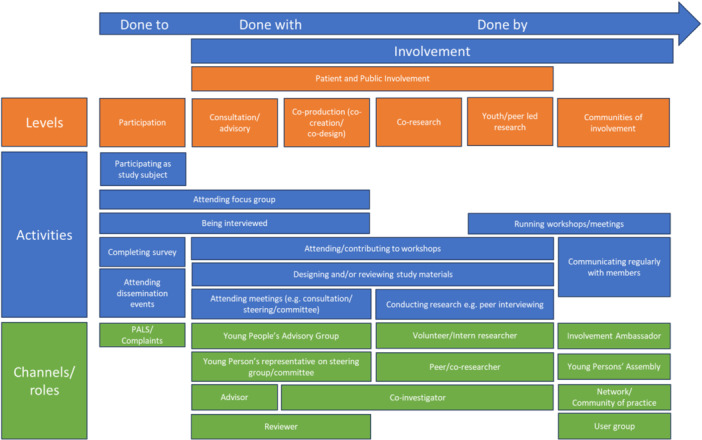
Consensus was achieved in eight out of nine areas, resulting in a matrix (with definitions) of the different types of young people's involvement in mental health research, from being advisors to involvement ambassadors. The findings generated an agreed-upon definition of under-representation, an identification of when in the research process there is under-representation and the characteristics of the young people who are under-represented. Experts further agreed on demographic data that should be collected to improve reporting on involvement.
This study adds to our understanding of involvement and under-representation in the context of young people's mental health research through expert consensus. It provides a practical resource for researchers considering involving young people in the research process and suggests the data that should be collected to improve reporting on the diversity of the young people involved.
A research oversight group of five young people advised on this study. They contributed throughout the project-from endorsing the research question to commenting on the findings and dissemination. Two of the group reviewed all participant materials and piloted the initial questionnaire.
由于越来越多的年轻人经历心理健康困难,而许多人并未接触心理健康服务,因此年轻人(16-25 岁)的心理健康问题成为英国日益严重的公共卫生关注。为了设计满足所有年轻人需求的服务,必须让更多不同类型的年轻人参与心理健康研究,而不仅仅是作为参与者。这项德尔菲研究旨在确定不同类型的“参与”,并定义和描述年轻人参与心理健康研究中的“代表性不足”。
27 名青年心理健康研究专家完成了一系列在线问卷。这些专家是学术研究人员、患者和公众参与(PPI)专业人员以及有经验的青年“专家”。第一轮让小组成员就“参与”和“代表性不足”发表意见。第二轮总结了第一轮小组成员的回答,并在九个问题领域寻求共识(至少 70%的人同意)。第三轮验证了前两轮的结果。
在九个领域中的八个领域达成了共识,从而形成了一个矩阵(附有定义),其中包括年轻人参与心理健康研究的不同类型,从担任顾问到参与大使。研究结果生成了对代表性不足的一致定义,确定了在研究过程中的哪个阶段存在代表性不足,以及代表性不足的年轻人的特征。专家们还就应该收集哪些人口统计数据以改善参与情况的报告达成了一致意见。
这项研究通过专家共识,进一步了解了年轻人心理健康研究中参与和代表性不足的情况。它为研究人员在研究过程中考虑让年轻人参与提供了实用资源,并提出了应该收集哪些数据以改善对参与研究的年轻人多样性的报告。
一个由五名年轻人组成的研究监督小组为这项研究提供了建议。他们从认可研究问题到对研究结果发表评论和传播,一直参与该项目。该小组的两名成员审查了所有参与者的材料,并对初始问卷进行了试点。