is with the Division of Gastroenterology and Nutrition, Johns Hopkins University School of Medicine, Baltimore, USA.
is with the MRC Unit, The Gambia and MRC International Nutrition Group, London School of Hygiene & Tropical Medicine, London, UK.
Nutr Rev. 2023 Jun 9;81(7):823-843. doi: 10.1093/nutrit/nuac089.
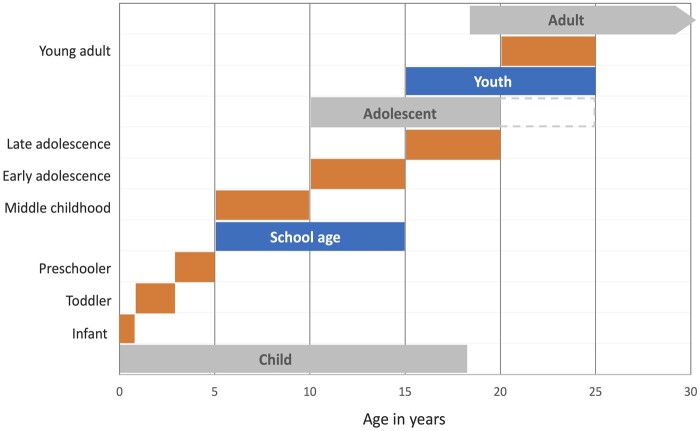
Middle childhood and early adolescence have received disproportionately low levels of scientific attention relative to other life stages, especially as related to nutrition and health. This is partly due to the justified emphasis on the first 1000 days of life, and the idea that early deficits and consequences may not be fully reversible. In addition, these stages of life may superficially appear less "eventful" than infancy or late adolescence. Finally, there has been historical ambiguity and inconsistency in terminology, depending on whether viewing "childhood" through physiologic, social, legal, or other lenses. Nevertheless, this age bracket, which encompasses most of the primary education and basic schooling years for most individuals, is marked by significant changes, inflection points, and sexually driven divergence in somatic and brain growth and development trajectories. These constitute transformative changes, and thus middle childhood and early adolescence represents a major and last opportunity to influence long-term health and productivity. This review highlights the specificities of growth and development in school age, with a focus on middle childhood and early adolescence (5 years-15 years of age, for the purposes of this review), the role of nutrition, the short- and long-term consequences of inadequate nutrition, and the current global status of nutrition in this age group. Adequate attention and emphasis on nutrition in the school-age years is critical: (a) for maintaining an adequate course of somatic and cognitive development, (b) for taking advantage of this last major opportunity to correct deficits of undernutrition and "catch-up" to normal life course development, and (c) for addressing the nutritional inadequacies and mitigating the longer-term consequences of overnutrition. This review summarizes and provides a rationale for prioritizing nutrition in school-age children, and for the need to revisit priorities and focus on this part of the life cycle to maximize individuals' potential and their contribution to society.
儿童中期和青春期早期相对于其他生命阶段,如营养和健康,得到的科学关注相对较少。这部分是由于对生命最初 1000 天的重视,以及早期缺陷和后果可能无法完全逆转的观点。此外,这些生命阶段表面上看起来不如婴儿期或青春期后期那么“重要”。最后,由于取决于通过生理、社会、法律或其他视角来看待“儿童期”,因此在术语上存在历史上的模糊性和不一致性。然而,这个年龄段涵盖了大多数个体的大部分基础教育和基本学校教育年限,其特点是身体和大脑生长发育轨迹发生了重大变化、拐点和性驱动的分化。这些变化构成了转型变化,因此儿童中期和青春期早期是影响长期健康和生产力的最后一个主要机会。这篇综述强调了学龄期生长发育的特殊性,重点关注儿童中期和青春期早期(本综述的目的是 5 岁至 15 岁),营养的作用,营养不足的短期和长期后果,以及当前全球营养状况在这个年龄组。在学龄期适当关注和强调营养至关重要:(a) 维持身体和认知发育的适当进程,(b) 利用这最后一个主要机会纠正营养不良的缺陷,并“追赶”到正常的生命过程发育,以及 (c) 解决营养不足问题并减轻营养过剩的长期后果。这篇综述总结并为在学龄儿童中优先考虑营养提供了理由,并需要重新审视优先事项,关注生命周期的这一部分,以最大限度地发挥个人的潜力及其对社会的贡献。