Wits Reproductive Health and HIV Institute, Faculty of Health Sciences, University of the Witwatersrand, Johannesburg, South Africa.
Wits Reproductive Health and HIV Institute, Faculty of Health Sciences, University of the Witwatersrand, Johannesburg, South Africa.
Int J Infect Dis. 2022 Dec;125:241-249. doi: 10.1016/j.ijid.2022.10.036. Epub 2022 Nov 5.
After South Africa's second wave of COVID-19, this study estimated the SARS-CoV-2 seroprevalence among pregnant women in inner-city Johannesburg, South Africa.
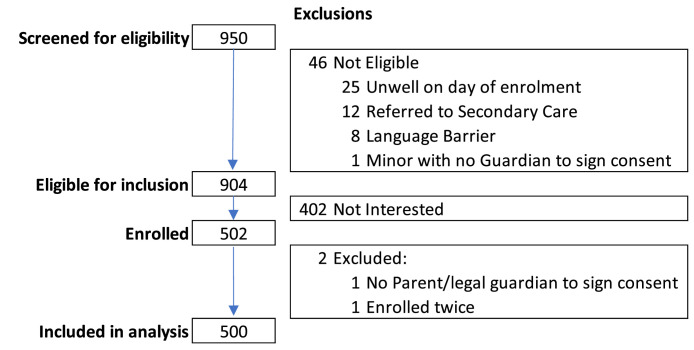
In this cross-sectional survey, 500 pregnant women who were non-COVID-19-vaccinated (aged ≥12 years) were enrolled, and demographic and clinical data were collected. Serum samples were tested using the Wantai SARS-CoV-2 spike antibody enzyme-linked immunosorbent assay and Roche Elecsys® anti-SARS-CoV-2 nucleocapsid antibody assays. Seropositivity was defined as SARS-CoV-2 antibodies on either (primary) or both (secondary) assays. Univariate Poisson regression assessed risk factors associated with seropositivity.
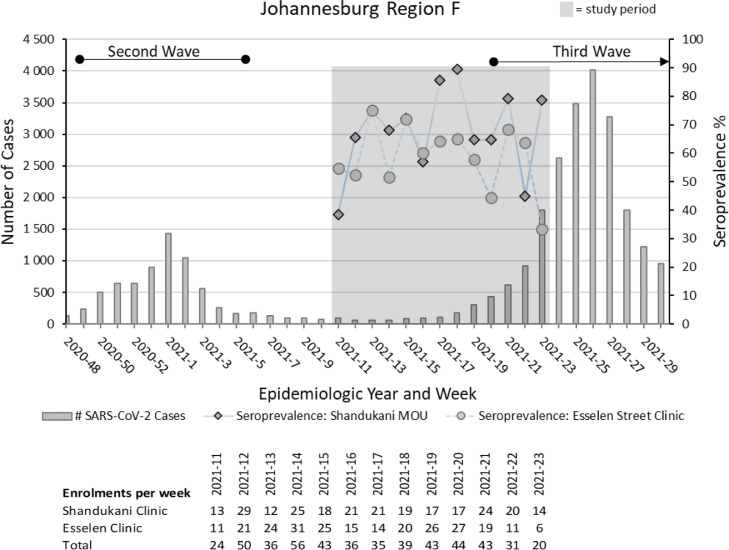
The median age was 27.4 years, and HIV prevalence was 26.7%. SARS-CoV-2 seroprevalence was 64.0% (95% confidence interval [CI]: 59.6-68.2%) on the primary and 54% (95% CI: 49.5-58.4%) on the secondary measure. Most (96.6%) women who were SARS-CoV-2-seropositive reported no symptoms. On the Roche assay, we detected lower seroprevalence among women living with HIV than women without HIV (48.9% vs 61.7%, P-value = 0.018), and especially low levels among women living with HIV with a clusters of differentiation 4 <350 cells/ml compared with women without immune suppression (22.2% vs 56.4%, prevalence rate ratio = 0.4; 95% CI: 0.2-0.9; P-value = 0.046).
Pregnant women attending routine antenatal care had a high SARS-CoV-2 seroprevalence after the second wave in South Africa, and most had asymptomatic infections. Seroprevalence surveys in pregnant women present a feasible method of monitoring the course of the pandemic over time.
南非第二波 COVID-19 疫情过后,本研究估计了南非约翰内斯堡市中心孕妇的 SARS-CoV-2 血清流行率。
在这项横断面研究中,招募了 500 名未接种 COVID-19 疫苗(年龄≥12 岁)的孕妇,并收集了人口统计学和临床数据。使用万泰 SARS-CoV-2 刺突抗体酶联免疫吸附试验和罗氏 Elecsys®抗 SARS-CoV-2 核衣壳抗体检测试剂盒检测血清样本。血清阳性定义为两种检测方法中的任一种(主要)或两种(次要)均为阳性。单变量泊松回归评估了与血清阳性相关的危险因素。
中位年龄为 27.4 岁,HIV 流行率为 26.7%。在主要检测中,SARS-CoV-2 血清阳性率为 64.0%(95%置信区间[CI]:59.6-68.2%),在次要检测中为 54%(95% CI:49.5-58.4%)。大多数(96.6%)血清阳性的女性无症状。在罗氏检测中,我们发现 HIV 感染者的血清阳性率低于无 HIV 感染者(48.9% vs 61.7%,P 值=0.018),尤其是 CD4 细胞<350 个/ml 的 HIV 感染者血清阳性率明显低于无免疫抑制的 HIV 感染者(22.2% vs 56.4%,患病率比=0.4;95% CI:0.2-0.9;P 值=0.046)。
在南非第二波疫情过后,接受常规产前保健的孕妇 SARS-CoV-2 血清阳性率较高,且大多数为无症状感染。对孕妇进行血清阳性率调查是一种可行的方法,可随时间监测大流行的进程。