Wang Guoqiao, Li Yan, Xiong Chengjie, McDade Eric, Clifford David B, Mills Susan L, Santacruz Anna M, Aschenbrenner Andrew J, Hassenstab Jason, Benzinger Tammie L S, Gordon Brian A, Fagan Anne M, Coalier Kelley A, Libre-Guerra Jorge J, McCullough Austin, Joseph-Mathurin Nelly, Chen Charles D, Mummery Catherine, Wendelberger Barbara A, Gauthier Serge, Masellis Mario, Holdridge Karen C, Yaari Roy, Chatterjee Saptarshi, Sims John, Delmar Paul, Kerchner Geoffrey A, Bittner Tobias, Hofmann Carsten, Bateman Randall J
Washington University St Louis School of Medicine St. Louis Missouri USA.
University College London London UK.
Alzheimers Dement (Amst). 2022 Nov 3;14(1):e12367. doi: 10.1002/dad2.12367. eCollection 2022.
While the Dominantly Inherited Alzheimer Network Trials Unit (DIAN-TU) was ongoing, external data suggested higher doses were needed to achieve targeted effects; therefore, doses of gantenerumab were increased 5-fold, and solanezumab was increased 4-fold. We evaluated to what extent mid-trial dose increases produced a dose-dependent treatment effect.
Using generalized linear mixed effects (LME) models, we estimated the annual low- and high-dose treatment effects in clinical, cognitive, and biomarker outcomes.
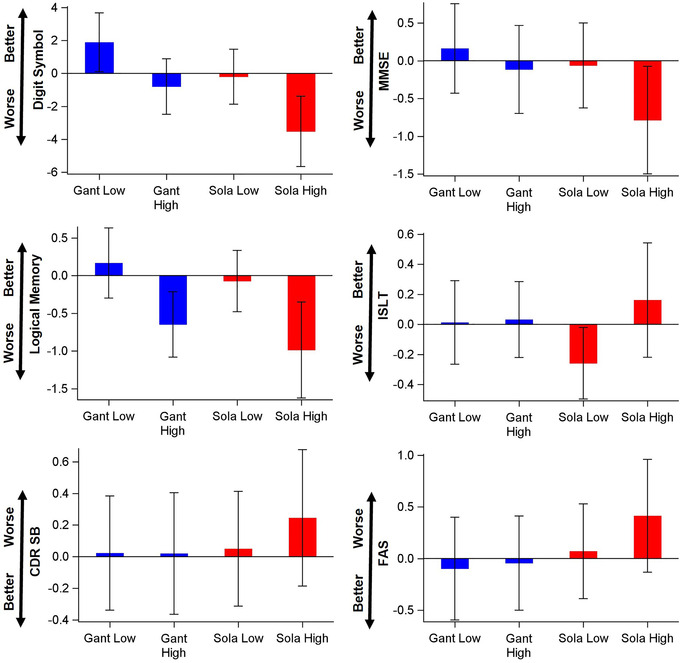
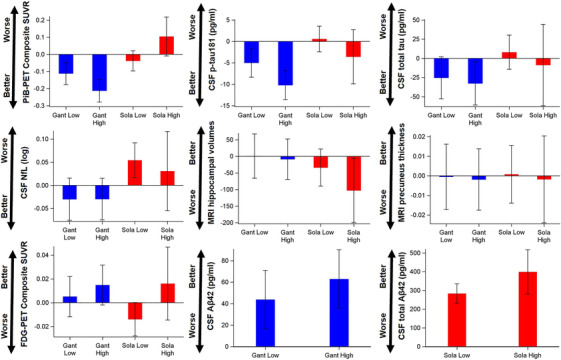
Both gantenerumab and solanezumab demonstrated dose-dependent treatment effects (significant for gantenerumab, non-significant for solanezumab) in their respective target amyloid biomarkers (Pittsburgh compound B positron emission tomography standardized uptake value ratio and cerebrospinal fluid amyloid beta 42), with gantenerumab demonstrating additional treatment effects in some downstream biomarkers. No dose-dependent treatment effects were observed in clinical or cognitive outcomes.
Mid-trial dose escalation can be implemented as a remedy for an insufficient initial dose and can be more cost effective and less burdensome to participants than starting a new trial with higher doses, especially in rare diseases.
We evaluated the dose-dependent treatment effect of two different amyloid-specific immunotherapies.Dose-dependent treatment effects were observed in some biomarkers.No dose-dependent treatment effects were observed in clinical/cognitive outcomes, potentially due to the fact that the modified study may not have been powered to detect such treatment effects in symptomatic subjects at a mild stage of disease exposed to high (or maximal) doses of medication for prolonged durations.
在显性遗传阿尔茨海默病网络试验单元(DIAN-TU)试验进行期间,外部数据表明需要更高剂量才能达到预期效果;因此,甘特单抗的剂量增加了5倍,而索拉苏单抗的剂量增加了4倍。我们评估了试验中期剂量增加在多大程度上产生了剂量依赖性治疗效果。
我们使用广义线性混合效应(LME)模型,估计了临床、认知和生物标志物结局方面的年度低剂量和高剂量治疗效果。
甘特单抗和索拉苏单抗在各自的目标淀粉样蛋白生物标志物(匹兹堡化合物B正电子发射断层扫描标准化摄取值比率和脑脊液淀粉样β42)中均表现出剂量依赖性治疗效果(甘特单抗显著,索拉苏单抗不显著),甘特单抗在一些下游生物标志物中还表现出额外的治疗效果。在临床或认知结局中未观察到剂量依赖性治疗效果。
试验中期剂量递增可作为初始剂量不足的补救措施,与启动更高剂量的新试验相比,它可能更具成本效益,对参与者的负担也更小,尤其是在罕见病中。
我们评估了两种不同淀粉样蛋白特异性免疫疗法的剂量依赖性治疗效果。在一些生物标志物中观察到了剂量依赖性治疗效果。在临床/认知结局中未观察到剂量依赖性治疗效果,这可能是因为修改后的研究可能没有足够的效力来检测在疾病轻度阶段接受高(或最大)剂量药物长期治疗的有症状受试者中的此类治疗效果。