Center for Frontier Oral Science, Osaka University Graduate School of Dentistry, Suita, Osaka, Japan.
Department of Oral and Molecular Microbiology, Osaka University Graduate School of Dentistry, Suita, Osaka, Japan.
PLoS One. 2022 Nov 9;17(11):e0276293. doi: 10.1371/journal.pone.0276293. eCollection 2022.
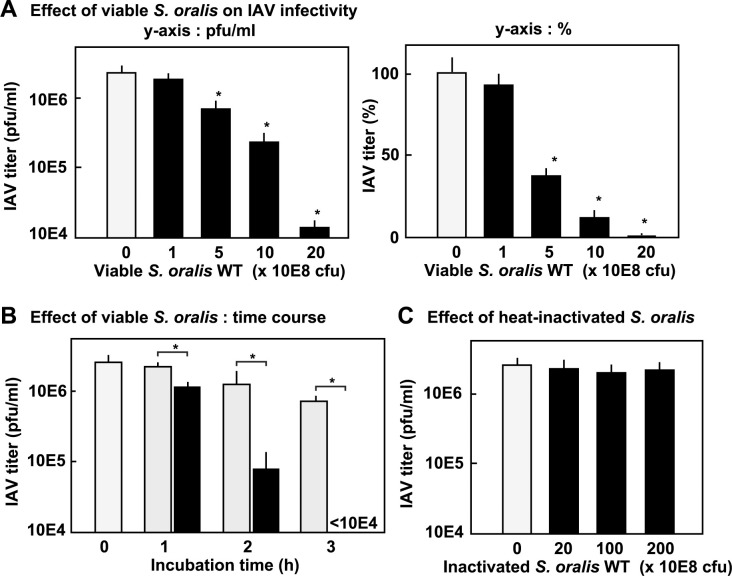
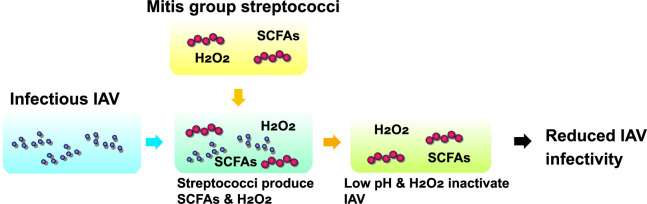
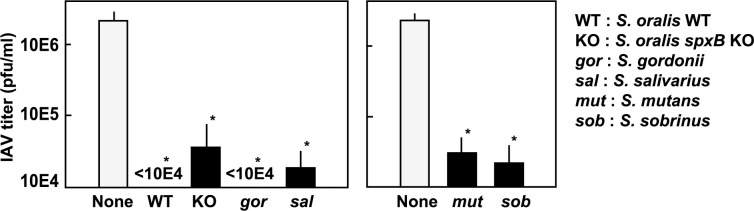
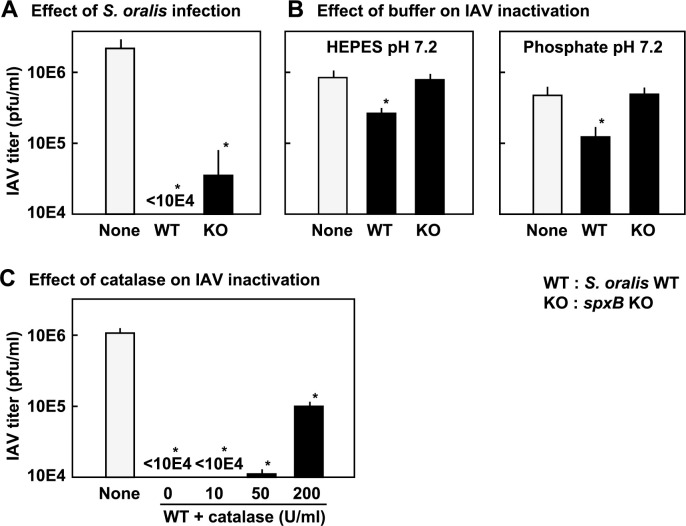
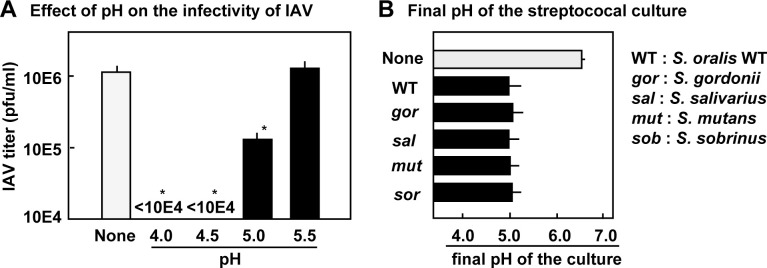
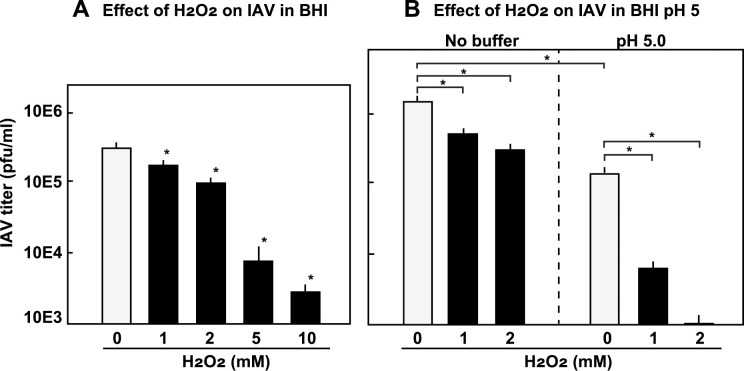
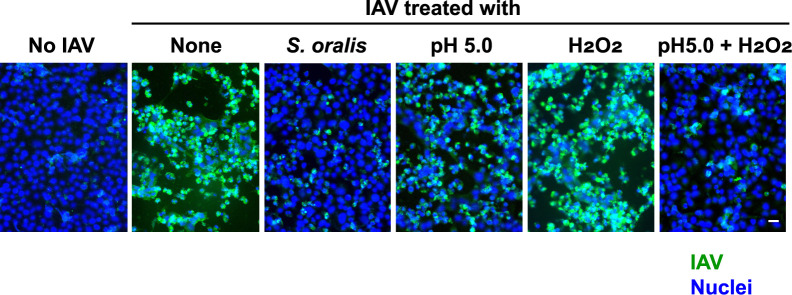
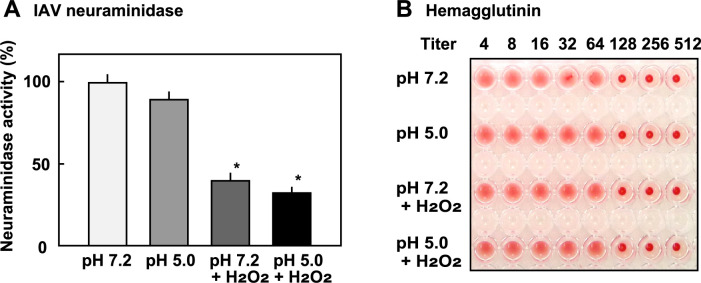
Members of the mitis group streptococci are the most abundant inhabitants of the oral cavity and dental plaque. Influenza A virus (IAV), the causative agent of influenza, infects the upper respiratory tract, and co-infection with Streptococcus pneumoniae is a major cause of morbidity during influenza epidemics. S. pneumoniae is a member of mitis group streptococci and shares many features with oral mitis group streptococci. In this study, we investigated the effect of viable Streptococcus oralis, a representative member of oral mitis group, on the infectivity of H1N1 IAV. The infectivity of IAV was measured by a plaque assay using Madin-Darby canine kidney cells. When IAV was incubated in growing culture of S. oralis, the IAV titer decreased in a time- and dose-dependent manner and became less than 100-fold, whereas heat-inactivated S. oralis had no effect. Other oral streptococci such as Streptococcus mutans and Streptococcus salivarius also reduced the viral infectivity to a lesser extent compared to S. oralis and Streptococcus gordonii, another member of the oral mitis group. S. oralis produces hydrogen peroxide (H2O2) at a concentration of 1-2 mM, and its mutant deficient in H2O2 production showed a weaker effect on the inactivation of IAV, suggesting that H2O2 contributes to viral inactivation. The contribution of H2O2 was confirmed by an inhibition assay using catalase, an H2O2-decomposing enzyme. These oral streptococci produce short chain fatty acids (SCFA) such as acetic acid as a by-product of sugar metabolism, and we also found that the inactivation of IAV was dependent on the mildly acidic pH (around pH 5.0) of these streptococcal cultures. Although inactivation of IAV in buffers of pH 5.0 was limited, incubation in the same buffer containing 2 mM H2O2 resulted in marked inactivation of IAV, which was similar to the effect of growing S. oralis culture. Taken together, these results reveal that viable S. oralis can inactivate IAV via the production of SCFAs and H2O2. This finding also suggests that the combination of mildly acidic pH and H2O2 at low concentrations could be an effective method to inactivate IAV.
口腔和牙菌斑中最丰富的居民是米蒂斯组链球菌成员。甲型流感病毒(IAV)是流感的病原体,感染上呼吸道,肺炎链球菌(Streptococcus pneumoniae)的合并感染是流感大流行期间发病率高的主要原因。肺炎链球菌是米蒂斯组链球菌的成员,与口腔米蒂斯组链球菌有许多共同特征。在这项研究中,我们研究了口腔米蒂斯组的代表性成员口腔链球菌(Streptococcus oralis)对 H1N1 IAV 感染力的影响。通过使用 Madin-Darby 犬肾细胞的噬斑测定法来测量 IAV 的感染力。当 IAV 在生长的口腔链球菌培养物中孵育时,IAV 滴度呈时间和剂量依赖性下降,降至不到 100 倍,而热灭活的口腔链球菌则没有影响。其他口腔链球菌,如变形链球菌(Streptococcus mutans)和唾液链球菌(Streptococcus salivarius)与口腔米蒂斯组的另一个成员戈登链球菌(Streptococcus gordonii)相比,也降低了病毒的感染力。口腔链球菌以 1-2mM 的浓度产生过氧化氢(H2O2),其缺乏 H2O2 产生能力的突变体对 IAV 的失活作用较弱,表明 H2O2 有助于病毒失活。通过使用过氧化氢分解酶过氧化物酶的抑制试验证实了 H2O2 的作用。这些口腔链球菌在糖代谢过程中会产生短链脂肪酸(SCFA)作为副产物,例如乙酸,我们还发现 IAV 的失活依赖于这些链球菌培养物的微酸性 pH(约 pH5.0)。尽管 pH5.0 缓冲液中 IAV 的失活作用有限,但在含有 2mM H2O2 的相同缓冲液中孵育会导致 IAV 的明显失活,这与生长的口腔链球菌培养物的作用相似。总之,这些结果表明,存活的口腔链球菌可以通过产生 SCFA 和 H2O2 来使 IAV 失活。这一发现还表明,低浓度的微酸性 pH 和 H2O2 的组合可能是使 IAV 失活的有效方法。