• 文献检索
  • 文档翻译
  • 深度研究
  • 学术资讯
  • Suppr Zotero 插件Zotero 插件
  • 邀请有礼
  • 套餐&价格
  • 历史记录
应用&插件
Suppr Zotero 插件Zotero 插件浏览器插件Mac 客户端Windows 客户端微信小程序
定价
高级版会员购买积分包购买API积分包
服务
文献检索文档翻译深度研究API 文档MCP 服务
关于我们
关于 Suppr公司介绍联系我们用户协议隐私条款
关注我们

Suppr 超能文献

核心技术专利:CN118964589B侵权必究
粤ICP备2023148730 号-1Suppr @ 2026

文献检索

告别复杂PubMed语法,用中文像聊天一样搜索,搜遍4000万医学文献。AI智能推荐,让科研检索更轻松。

立即免费搜索

文件翻译

保留排版,准确专业,支持PDF/Word/PPT等文件格式,支持 12+语言互译。

免费翻译文档

深度研究

AI帮你快速写综述,25分钟生成高质量综述,智能提取关键信息,辅助科研写作。

立即免费体验

COVID19 和乳腺癌:推特上的定性分析。

#COVID19 and #Breastcancer: A Qualitative Analysis of Tweets.

机构信息

Department of Surgery, University of Toronto, Toronto, ON M5T 1P5, Canada.

Koç University School of Medicine, Istanbul 34450, Turkey.

出版信息

Curr Oncol. 2022 Nov 8;29(11):8483-8500. doi: 10.3390/curroncol29110669.

DOI:10.3390/curroncol29110669
PMID:36354729
原文链接:https://pmc.ncbi.nlm.nih.gov/articles/PMC9689212/
Abstract

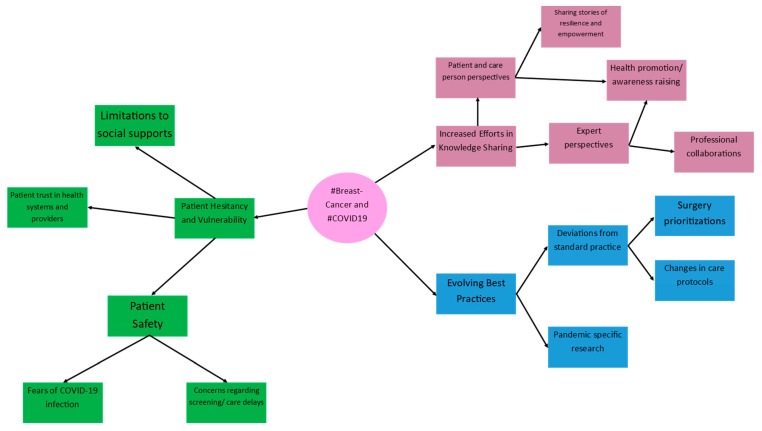
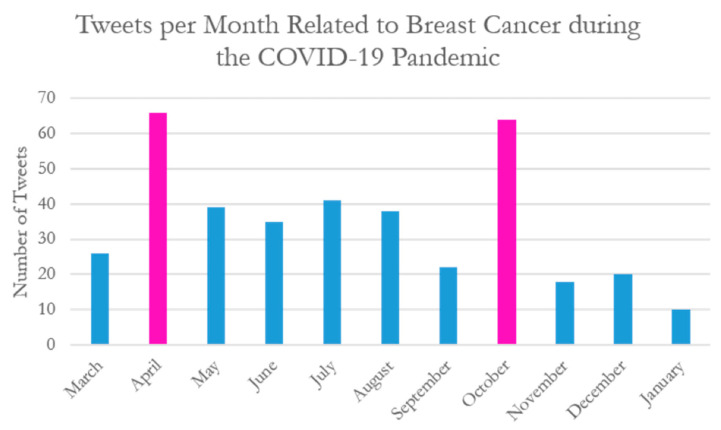
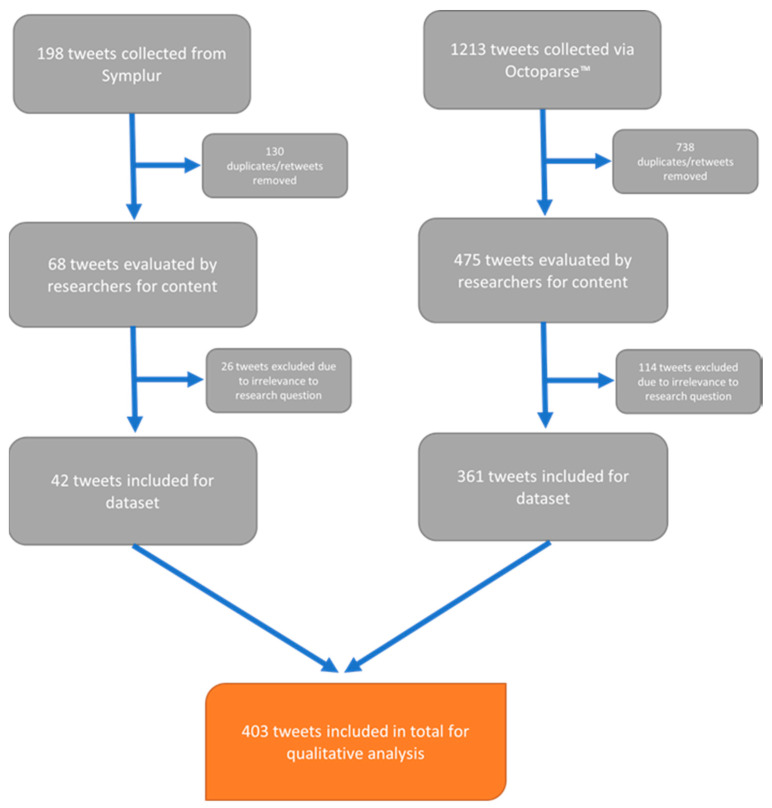
Rapid and efficient communication regarding quickly evolving medical information was paramount for healthcare providers and patients throughout the COVID-19 pandemic. Over the last several years, social media platforms such as Twitter have emerged as important tools for health promotion, virtual learning among healthcare providers, and patient support. We conducted a qualitative thematic content analysis on tweets using the hashtags #BreastSurgery, #BreastCancer, #BreastOncology, #Pandemic, and #COVID19. Advocacy organizations were the most frequent authors of tweets captured in this dataset, and most tweets came from the United States of America (64%). Seventy-three codes were generated from the data, and, through iterative, inductive analysis, three major themes were developed: patient hesitancy and vulnerability, increased efforts in knowledge sharing, and evolving best practices. We found that Twitter was an effective way to share evolving best practices, education, and collective experiences among key stakeholders. As Twitter is increasingly used as a tool for health promotion and knowledge translation, a better understanding of how key stakeholders engage with healthcare-related topics on the platform can help optimize the use of this powerful tool.

摘要

在 COVID-19 大流行期间,快速有效地交流快速演变的医学信息对医疗保健提供者和患者至关重要。在过去的几年中,Twitter 等社交媒体平台已成为促进健康、医疗保健提供者之间的虚拟学习以及患者支持的重要工具。我们使用 #BreastSurgery、#BreastCancer、#BreastOncology、#Pandemic 和 #COVID19 等标签对推文进行了定性主题内容分析。倡导组织是该数据集中推文的最常见作者,而且大多数推文来自美利坚合众国(64%)。从数据中生成了 73 个代码,并通过迭代、归纳分析,得出了三个主要主题:患者的犹豫和脆弱性、知识共享力度的加大以及最佳实践的不断发展。我们发现,Twitter 是在利益相关者之间分享最佳实践、教育和集体经验的有效途径。随着 Twitter 越来越多地被用作促进健康和知识转化的工具,更好地了解关键利益相关者如何在该平台上参与与医疗保健相关的主题,可以帮助优化该强大工具的使用。
https://cdn.ncbi.nlm.nih.gov/pmc/blobs/d66a/9689212/65a8ed4797c7/curroncol-29-00669-g003.jpg
https://cdn.ncbi.nlm.nih.gov/pmc/blobs/d66a/9689212/989bd9a97362/curroncol-29-00669-g001.jpg
https://cdn.ncbi.nlm.nih.gov/pmc/blobs/d66a/9689212/39a1d74f1278/curroncol-29-00669-g002.jpg
https://cdn.ncbi.nlm.nih.gov/pmc/blobs/d66a/9689212/65a8ed4797c7/curroncol-29-00669-g003.jpg
https://cdn.ncbi.nlm.nih.gov/pmc/blobs/d66a/9689212/989bd9a97362/curroncol-29-00669-g001.jpg
https://cdn.ncbi.nlm.nih.gov/pmc/blobs/d66a/9689212/39a1d74f1278/curroncol-29-00669-g002.jpg
https://cdn.ncbi.nlm.nih.gov/pmc/blobs/d66a/9689212/65a8ed4797c7/curroncol-29-00669-g003.jpg

相似文献

1
#COVID19 and #Breastcancer: A Qualitative Analysis of Tweets.COVID19 和乳腺癌:推特上的定性分析。
Curr Oncol. 2022 Nov 8;29(11):8483-8500. doi: 10.3390/curroncol29110669.
2
Comprehending the impact of #Breastcancer, #Breastsurgery and related hashtags on Twitter: A content and social network cross-sectional analysis #Breastcancer#Breastsurgery.理解#乳腺癌、#乳房手术及相关主题标签在推特上的影响:一项内容与社交网络横断面分析#乳腺癌#乳房手术
Eur J Surg Oncol. 2023 Apr;49(4):716-723. doi: 10.1016/j.ejso.2023.01.016. Epub 2023 Jan 18.
3
Using Social Media for Rapid Information Dissemination in a Pandemic: #PedsICU and Coronavirus Disease 2019.利用社交媒体在大流行期间快速传播信息:#儿科 ICU 和 2019 年冠状病毒病。
Pediatr Crit Care Med. 2020 Aug;21(8):e538-e546. doi: 10.1097/PCC.0000000000002474.
4
How Health Care Workers Wield Influence Through Twitter Hashtags: Retrospective Cross-sectional Study of the Gun Violence and COVID-19 Public Health Crises.医疗工作者如何通过推特标签施加影响:枪支暴力和 COVID-19 公共卫生危机的回顾性横断面研究。
JMIR Public Health Surveill. 2021 Jan 6;7(1):e24562. doi: 10.2196/24562.
5
Examining Tweet Content and Engagement of Canadian Public Health Agencies and Decision Makers During COVID-19: Mixed Methods Analysis.研究 COVID-19 期间加拿大公共卫生机构和决策者的推文内容和参与度:混合方法分析。
J Med Internet Res. 2021 Mar 11;23(3):e24883. doi: 10.2196/24883.
6
Emotions and Topics Expressed on Twitter During the COVID-19 Pandemic in the United Kingdom: Comparative Geolocation and Text Mining Analysis.在英国 COVID-19 大流行期间在 Twitter 上表达的情绪和主题:比较地理定位和文本挖掘分析。
J Med Internet Res. 2022 Oct 5;24(10):e40323. doi: 10.2196/40323.
7
The Saudi Ministry of Health's Twitter Communication Strategies and Public Engagement During the COVID-19 Pandemic: Content Analysis Study.沙特卫生部在 COVID-19 大流行期间的 Twitter 传播策略和公众参与:内容分析研究。
JMIR Public Health Surveill. 2021 Jul 12;7(7):e27942. doi: 10.2196/27942.
8
COVID-19 Vaccine Hesitancy on Social Media: Building a Public Twitter Data Set of Antivaccine Content, Vaccine Misinformation, and Conspiracies.社交媒体上对 COVID-19 疫苗的犹豫:构建一个关于反疫苗内容、疫苗错误信息和阴谋论的公共 Twitter 数据集。
JMIR Public Health Surveill. 2021 Nov 17;7(11):e30642. doi: 10.2196/30642.
9
#Covid-19: An exploratory investigation of hashtag usage on Twitter.Covid-19:推特话题标签使用情况的探索性调查。
Health Policy. 2021 Apr;125(4):541-547. doi: 10.1016/j.healthpol.2021.01.001. Epub 2021 Jan 9.
10
Detection of Hate Speech in COVID-19-Related Tweets in the Arab Region: Deep Learning and Topic Modeling Approach.检测阿拉伯地区与 COVID-19 相关推文的仇恨言论:深度学习和主题建模方法。
J Med Internet Res. 2020 Dec 8;22(12):e22609. doi: 10.2196/22609.

引用本文的文献

1
Developing critical thinking and decision-making skills for cancer information: the Informed Health Choice-Cancer online learning resource.培养癌症信息的批判性思维和决策技能:明智健康选择 - 癌症在线学习资源。
J Cancer Surviv. 2025 Aug 7. doi: 10.1007/s11764-025-01874-6.
2
Investigation of the causal relationship between breast cancer and thyroid cancer: a set of two-sample bidirectional Mendelian randomization study.乳腺癌与甲状腺癌因果关系的调查:一组双样本双向孟德尔随机化研究。
Endocrine. 2025 Jan;87(1):196-205. doi: 10.1007/s12020-024-03976-0. Epub 2024 Jul 29.
3
Cancer misinformation on social media.

本文引用的文献

1
A practical guide to reflexivity in qualitative research: AMEE Guide No. 149.质性研究中反思性的实用指南:AMEE指南第149号
Med Teach. 2022 Apr 7:1-11. doi: 10.1080/0142159X.2022.2057287.
2
Social media enabled interactions in healthcare: Towards a taxonomy.社交媒体在医疗保健中的互动:走向分类法。
Soc Sci Med. 2021 Dec;291:114469. doi: 10.1016/j.socscimed.2021.114469. Epub 2021 Oct 19.
3
Impact of the COVID-19 Pandemic on Breast Cancer Mortality in the US: Estimates From Collaborative Simulation Modeling.COVID-19 大流行对美国乳腺癌死亡率的影响:协作模拟建模的估计。
社交媒体上的癌症错误信息。
CA Cancer J Clin. 2024 Sep-Oct;74(5):453-464. doi: 10.3322/caac.21857. Epub 2024 Jun 19.
4
New evidence: Metformin unsuitable as routine adjuvant for breast cancer: a drug-target mendelian randomization analysis.新证据:二甲双胍不适合作为乳腺癌常规辅助药物:药物靶点孟德尔随机分析。
BMC Cancer. 2024 Jun 6;24(1):691. doi: 10.1186/s12885-024-12453-w.
5
Reporting of Ethical Considerations in Qualitative Research Utilizing Social Media Data on Public Health Care: Scoping Review.报告利用社交媒体数据进行公共医疗保健定性研究中的伦理考虑:范围综述。
J Med Internet Res. 2024 May 17;26:e51496. doi: 10.2196/51496.
6
Assessing the needs of patients with breast cancer and their families across various treatment phases using a Latent Dirichlet Allocation model: a text-mining approach to online health communities.使用潜在狄利克雷分配模型评估乳腺癌患者及其家庭在不同治疗阶段的需求:一种在线健康社区的文本挖掘方法。
Support Care Cancer. 2024 Apr 29;32(5):314. doi: 10.1007/s00520-024-08513-3.
7
Global prevalence and content of information about alcohol use as a cancer risk factor on Twitter.Twitter 上关于饮酒致癌风险因素的信息的全球流行率和内容。
Prev Med. 2023 Dec;177:107728. doi: 10.1016/j.ypmed.2023.107728. Epub 2023 Oct 14.
8
Perspectives of patients undergoing neoadjuvant chemotherapy for breast cancer during the COVID-19 pandemic.COVID-19 大流行期间接受新辅助化疗的乳腺癌患者的观点。
Cancer Rep (Hoboken). 2023 Oct;6(10):e1882. doi: 10.1002/cnr2.1882. Epub 2023 Aug 16.
9
Investigating Public Sentiment on Laryngeal Cancer in 2022 Using Machine Learning.2022年使用机器学习调查公众对喉癌的看法
Indian J Otolaryngol Head Neck Surg. 2023 Apr 26;75(3):1-7. doi: 10.1007/s12070-023-03813-2.
10
#TreatmentResistantDepression: A qualitative content analysis of Tweets about difficult-to-treat depression.治疗抵抗性抑郁症:关于难治性抑郁症的推文的定性内容分析。
Health Expect. 2023 Oct;26(5):1986-1996. doi: 10.1111/hex.13807. Epub 2023 Jun 23.
J Natl Cancer Inst. 2021 Nov 2;113(11):1484-1494. doi: 10.1093/jnci/djab097.
4
Evaluating Scholars' Impact and Influence: Cross-sectional Study of the Correlation Between a Novel Social Media-Based Score and an Author-Level Citation Metric.评估学者的影响力:基于社交媒体的新评分与作者级别引文指标的相关性的横断面研究。
J Med Internet Res. 2021 May 31;23(5):e28859. doi: 10.2196/28859.
5
The Effectiveness of Social Media in the Dissemination of Knowledge About Pain in Dementia.社交媒体在传播痴呆症疼痛知识方面的效果。
Pain Med. 2021 Nov 26;22(11):2584-2596. doi: 10.1093/pm/pnab157.
6
The American Society of Breast Surgeons Official Proceedings, Volume XXII 2021 Annual Meeting Scientific Session Abstracts.美国乳腺外科医师学会官方会议记录,第XXII卷 2021年年会科学会议摘要
Ann Surg Oncol. 2021 May;28(Suppl 2):163-400. doi: 10.1245/s10434-021-10068-0.
7
Public Health Education through the Lens of Social Media: Implications in the COVID-19 Era.透过社交媒体视角看公共卫生教育:新冠疫情时代的影响
Sultan Qaboos Univ Med J. 2021 Feb;21(1):e143-e145. doi: 10.18295/squmj.2021.21.01.024. Epub 2021 Mar 15.
8
What Will Be the Impact of the Covid-19 Quarantine on Psychological Distress? Considerations Based on a Systematic Review of Pandemic Outbreaks.新冠疫情隔离措施对心理困扰会产生怎样的影响?基于对大流行疫情的系统综述的思考
Healthcare (Basel). 2021 Jan 19;9(1):101. doi: 10.3390/healthcare9010101.
9
Using a Twitter Chat to Rapidly Identify Barriers and Policy Solutions for Metastatic Breast Cancer Care: Qualitative Study.利用 Twitter 聊天快速识别转移性乳腺癌护理的障碍和政策解决方案:定性研究。
JMIR Public Health Surveill. 2021 Jan 15;7(1):e23178. doi: 10.2196/23178.
10
Impact of Social Media and Virtual Learning on Cardiology During the COVID-19 Pandemic Era and Beyond.社交媒体和虚拟学习在新冠疫情期间及之后对心脏病学的影响
Methodist Debakey Cardiovasc J. 2020 Jul-Sep;16(3):e1-e7. doi: 10.14797/mdcj-16-3-e1.