Center for RNA Nanobiotechnology and Nanomedicine; College of Pharmacy; College of Medicine; Dorothy M. Davis Heart and Lung Research Institute; And Comprehensive Cancer Center. The Ohio State University, Columbus, OH, 43210, USA; Biophysics Graduate Program, The Ohio State University, Columbus, OH, 43210, USA.
Center for RNA Nanobiotechnology and Nanomedicine; College of Pharmacy; College of Medicine; Dorothy M. Davis Heart and Lung Research Institute; And Comprehensive Cancer Center. The Ohio State University, Columbus, OH, 43210, USA.
Biomaterials. 2022 Dec;291:121863. doi: 10.1016/j.biomaterials.2022.121863. Epub 2022 Nov 2.
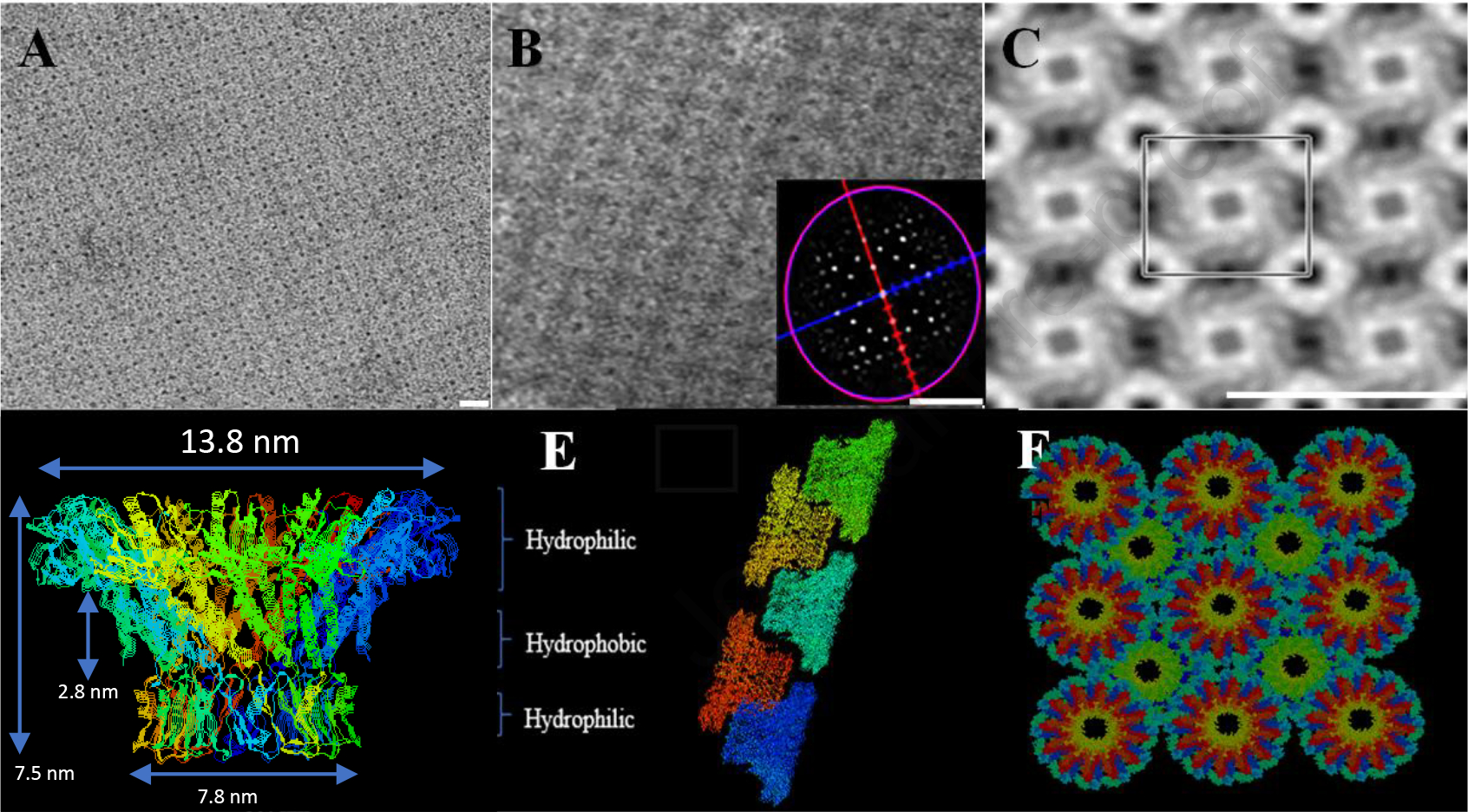
In optical devices such as camera or microscope, an aperture is used to regulate light intensity for imaging. Here we report the discovery and construction of a durable bio-aperture at nanometerscale that can regulate current at the pico-ampere scale. The nano-aperture is made of 12 identical protein subunits that form a 3.6-nm channel with a shutter and "one-way traffic" property. This shutter responds to electrical potential differences across the aperture and can be turned off for double stranded DNA translocation. This voltage enables directional control, and three-step regulation for opening and closing. The nano-aperture was constructed in vitro and purified into homogeneity. The aperture was stable at pH2-12, and a temperature of -85C-60C. When an electrical potential was held, three reproducible discrete steps of current flowing through the channel were recorded. Each step reduced 32% of the channel dimension evident by the reduction of the measured current flowing through the aperture. The current change is due to the change of the resistance of aperture size. The transition between these three distinct steps and the direction of the current was controlled via the polarity of the voltage applied across the aperture. When the C-terminal of the aperture was fused to an antigen, the antibody and antigen interaction resulted in a 32% reduction of the channel size. This phenomenon was used for disease diagnosis since the incubation of the antigen-nano-aperture with a specific cancer antibody resulted in a change of 32% of current. The purified truncated cone-shape aperture automatically self-assembled efficiently into a sheet of the tetragonal array via head-to-tail self-interaction. The nano-aperture discovery with a controllable shutter, discrete-step current regulation, formation of tetragonal sheet, and one-way current traffic provides a nanoscale electrical circuit rectifier for nanodevices and disease diagnosis.
在光学设备(如相机或显微镜)中,孔径用于调节成像的光强。在这里,我们报告了一种持久的生物孔径的发现和构建,该孔径可以在皮安(pico-ampere)范围内调节电流。纳米孔径由 12 个相同的蛋白质亚基组成,形成一个具有快门和“单向交通”特性的 3.6nm 通道。该快门响应孔径两侧的电势差,并且可以关闭双链 DNA 易位。这种电压可实现定向控制,并可进行三步开启和关闭调节。该纳米孔径在体外构建并纯化至均一性。孔径在 pH2-12 和-85°C-60°C 的温度下稳定。当保持电势时,记录到通过通道的电流的三个可重复的离散步骤。每个步骤减少了 32%的通道尺寸,这通过通过孔径流动的测量电流的减少明显看出。电流变化是由于孔径尺寸的电阻变化引起的。通过施加在孔径上的电压的极性来控制这些三个明显步骤之间的转换和电流的方向。当孔径的 C 末端融合到抗原上时,抗体和抗原的相互作用导致通道尺寸减小 32%。这种现象可用于疾病诊断,因为与特定癌症抗体孵育的抗原-纳米孔径导致电流变化 32%。通过头部到尾部的自我相互作用,纯化的截顶锥形孔径自动有效地自组装成四边形阵列的薄片。具有可控快门、离散步电流调节、四边形片形成和单向电流流动的纳米孔径的发现为纳米器件和疾病诊断提供了纳米级电回路整流器。