School of Sport, Exercise and Health Sciences, Loughborough University, Loughborough, UK.
UCL Division of Surgery & Interventional Science, University College London, London, UK.
Int J Obes (Lond). 2023 Jan;47(1):39-50. doi: 10.1038/s41366-022-01237-6. Epub 2022 Nov 10.
We aimed to 1) describe how the UK obesity epidemic reflects a change over time in the proportion of the population demonstrating adverse latent patterns of BMI development and 2) investigate the potential roles of maternal and paternal BMI in this secular process.
We used serial BMI data between 7 and 17 years of age from 13220 boys and 12711 girls. Half the sample was born in 1958 and half in 2001. Sex-specific growth mixture models were developed. The relationships of maternal and paternal BMI and weight status with class membership were estimated using the 3-step BCH approach, with covariate adjustment.
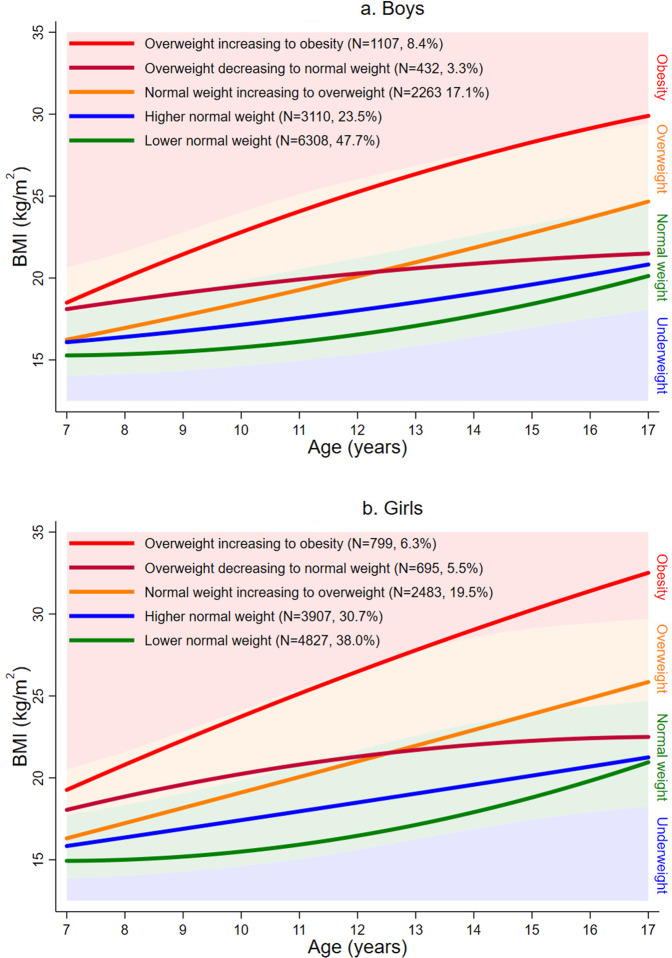
The selected models had five classes. For each sex, in addition to the two largest normal weight classes, there were "normal weight increasing to overweight" (17% of boys and 20% of girls), "overweight increasing to obesity" (8% and 6%), and "overweight decreasing to normal weight" (3% and 6%) classes. More than 1-in-10 children from the 2001 birth cohort were in the "overweight increasing to obesity" class, compared to less than 1-in-30 from the 1958 birth cohort. Approximately 75% of the mothers and fathers of this class had overweight or obesity. When considered together, both maternal and paternal BMI were associated with latent class membership, with evidence of negative departure from additivity (i.e., the combined effect of maternal and paternal BMI was smaller than the sum of the individual effects). The odds of a girl belonging to the "overweight increasing to obesity" class (compared to the largest normal weight class) was 13.11 (8.74, 19.66) times higher if both parents had overweight or obesity (compared to both parents having normal weight); the equivalent estimate for boys was 9.01 (6.37, 12.75).
The increase in obesity rates in the UK over more than 40 years has been partly driven by the growth of a sub-population demonstrating excess BMI gain during adolescence. Our results implicate both maternal and paternal BMI as correlates of this secular process.
本研究旨在 1)描述英国肥胖症的流行如何反映出人群中表现出 BMI 发展不良潜在模式的比例随时间的变化,2)探讨母亲和父亲 BMI 在这一长期过程中的潜在作用。
我们使用了 13220 名男孩和 12711 名女孩在 7 至 17 岁之间的连续 BMI 数据。样本的一半出生于 1958 年,另一半出生于 2001 年。使用性别特异性增长混合模型进行分析。使用 BCH 三步法(包括协变量调整),估计母亲和父亲 BMI 以及体重状况与类别归属的关系。
所选模型有五个类别。对于每个性别,除了两个最大的正常体重类别外,还有“正常体重增加到超重”(男孩占 17%,女孩占 20%)、“超重增加到肥胖”(男孩占 8%,女孩占 6%)和“超重减少到正常体重”(男孩占 3%,女孩占 6%)类别。与 1958 年出生队列的 1/30 相比,2001 年出生队列中超过 1/10 的儿童属于“超重增加到肥胖”类别。该类别的母亲和父亲中约有 75%超重或肥胖。当同时考虑时,母亲和父亲的 BMI 都与潜在类别归属相关,存在负偏离加性的证据(即,母亲和父亲 BMI 的综合效应小于个体效应的总和)。与最大的正常体重类别相比,如果女孩的父母都超重或肥胖,那么女孩属于“超重增加到肥胖”类别的几率(与最大的正常体重类别相比)是 13.11 倍(8.74,19.66);男孩的相应估计值为 9.01 倍(6.37,12.75)。
在 40 多年的时间里,英国肥胖率的上升部分是由于青春期 BMI 增长过多的亚人群增长所致。我们的研究结果表明,母亲和父亲的 BMI 均与这一长期过程有关。