Department of Clinical Laboratory, Biobank, Harbin Medical University Cancer Hospital, 150 Haping Road, Harbin, 150040, Heilongjiang, China.
Department of Clinical Oncology, Harbin Medical University Cancer Hospital, 150 Haping Road, Harbin, 150040, Heilongjiang, China.
Respir Res. 2022 Nov 10;23(1):306. doi: 10.1186/s12931-022-02226-z.
Ubiquitin-conjugating enzyme E2 T (UBE2T) is a potential oncogene. However, Pan-cancer analyses of the functional, prognostic and predictive implications of this gene are lacking.
We first analyzed UBE2T across 33 tumor types in The Cancer Genome Atlas (TCGA) project. We investigated the expression level of UBE2T and its effect on prognosis using the TCGA database. The correlation between UBE2T and cell cycle in pan-cancer was investigated using the single-cell sequencing data in Cancer Single-cell State Atlas (CancerSEA) database. The Weighted Gene Co-expression Network analysis (WGCNA), Univariate Cox and Least absolute shrinkage and selection operator (LASSO) Cox regression models, and receiver operating characteristic (ROC) were applied to assess the prognostic impact of UBE2T-related cell cycle genes (UrCCGs). Furthermore, the consensus clustering (CC) method was adopted to divide TCGA-lung adenocarcinoma (LUAD) patients into subgroups based on UrCCGs. Prognosis, molecular characteristics, and the immune panorama of subgroups were analyzed using Single-sample Gene Set Enrichment Analysis (ssGSEA). Results derived from TCGA-LUAD patients were validated in International Cancer Genome Consortium (ICGC)-LUAD data.
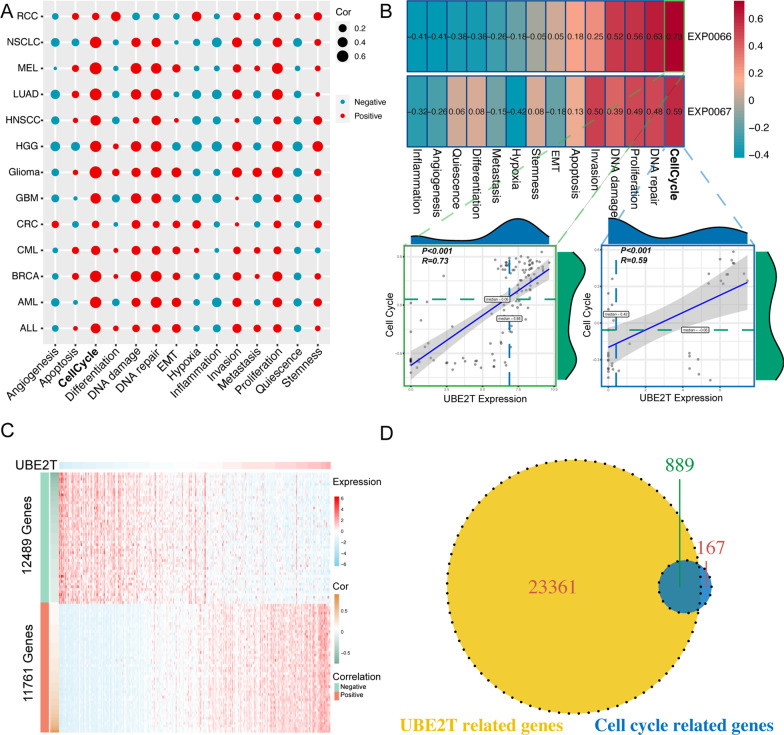
UBE2T is highly expressed and is a prognostic risk factor in most tumors. CancerSEA database analysis revealed that UBE2T was positively associated with the cell cycle in various cancers(r > 0.60, p < 0.001). The risk signature of UrCCGs can reliably predict the prognosis of LUAD (AUC = 0.720, AUC = 0.700, AUC = 0.630). The CC method classified the TCGA-LUAD cohort into 4 UrCCG subtypes (G1-G4). Kaplan-Meier survival analysis demonstrated that G2 and G4 subtypes had worse survival than G3 (Log-rank test P < 0.001, P < 0.001). A comprehensive analysis of immune infiltrates, immune checkpoints, and immunogenic cell death modulators unveiled different immune landscapes for the four subtypes. High immunophenoscore in G3 and G4 tumors suggested that these two subtypes were immunologically "hot," tending to respond to immunotherapy compared to G2 subtypes (p < 0.001).
UBE2T is a critical oncogene in many cancers. Moreover, UrCCG classified the LUAD cohort into four subgroups with significantly different survival, molecular features, immune infiltrates, and immunotherapy responses. UBE2T may be a therapeutic target and predictor of prognosis and immunotherapy sensitivity.
泛素结合酶 E2 T(UBE2T)是一种潜在的癌基因。然而,泛癌中关于该基因的功能、预后和预测意义的分析尚缺乏。
我们首先在癌症基因组图谱(TCGA)项目中分析了 UBE2T 在 33 种肿瘤类型中的表达情况。我们使用 TCGA 数据库来研究 UBE2T 的表达水平及其对预后的影响。使用癌症单细胞状态图谱(CancerSEA)数据库中的单细胞测序数据来研究泛癌中 UBE2T 与细胞周期的相关性。使用加权基因共表达网络分析(WGCNA)、单变量 Cox 和最小绝对收缩和选择算子(LASSO)Cox 回归模型以及受试者工作特征(ROC)来评估 UBE2T 相关细胞周期基因(UrCCGs)的预后影响。此外,采用共识聚类(CC)方法基于 UrCCGs 将 TCGA-肺腺癌(LUAD)患者分为亚组。使用单样本基因集富集分析(ssGSEA)分析亚组的预后、分子特征和免疫全景。从 TCGA-LUAD 患者中获得的结果在国际癌症基因组联盟(ICGC)-LUAD 数据中进行了验证。
UBE2T 在大多数肿瘤中高表达,且是预后的危险因素。CancerSEA 数据库分析显示,UBE2T 与各种癌症的细胞周期呈正相关(r>0.60,p<0.001)。UrCCGs 的风险特征可可靠地预测 LUAD 的预后(AUC=0.720,AUC=0.700,AUC=0.630)。CC 方法将 TCGA-LUAD 队列分为 4 个 UrCCG 亚型(G1-G4)。Kaplan-Meier 生存分析表明,G2 和 G4 亚型的生存情况比 G3 差(对数秩检验 P<0.001,P<0.001)。对免疫浸润、免疫检查点和免疫原性细胞死亡调节剂进行综合分析,揭示了四个亚型的不同免疫景观。G3 和 G4 肿瘤的高免疫表型评分表明,与 G2 亚型相比,这两个亚型的免疫状态为“热”,倾向于对免疫治疗有反应(p<0.001)。
UBE2T 是许多癌症中的关键癌基因。此外,UrCCG 将 LUAD 队列分为四个具有显著不同生存、分子特征、免疫浸润和免疫治疗反应的亚组。UBE2T 可能是一种治疗靶点和预后及免疫治疗敏感性的预测因子。