• 文献检索
  • 文档翻译
  • 深度研究
  • 学术资讯
  • Suppr Zotero 插件Zotero 插件
  • 邀请有礼
  • 套餐&价格
  • 历史记录
应用&插件
Suppr Zotero 插件Zotero 插件浏览器插件Mac 客户端Windows 客户端微信小程序
定价
高级版会员购买积分包购买API积分包
服务
文献检索文档翻译深度研究API 文档MCP 服务
关于我们
关于 Suppr公司介绍联系我们用户协议隐私条款
关注我们

Suppr 超能文献

核心技术专利:CN118964589B侵权必究
粤ICP备2023148730 号-1Suppr @ 2026

文献检索

告别复杂PubMed语法,用中文像聊天一样搜索,搜遍4000万医学文献。AI智能推荐,让科研检索更轻松。

立即免费搜索

文件翻译

保留排版,准确专业,支持PDF/Word/PPT等文件格式,支持 12+语言互译。

免费翻译文档

深度研究

AI帮你快速写综述,25分钟生成高质量综述,智能提取关键信息,辅助科研写作。

立即免费体验

以色列医疗保健消费的全景:一项全国性人口横断面研究。

The landscape of medical care consumption in Israel: a nationwide population cross-sectional study.

机构信息

Israel Defense Forces, Medical Corps, Jerusalem, Israel.

Clalit Health Services, Jerusalem, Israel.

出版信息

Isr J Health Policy Res. 2022 Nov 10;11(1):38. doi: 10.1186/s13584-022-00542-9.

DOI:10.1186/s13584-022-00542-9
PMID:36357912
原文链接:https://pmc.ncbi.nlm.nih.gov/articles/PMC9650793/
Abstract

BACKGROUND

The Ecology of medical care was first published in 1961. The graphical square model showed that 75% of the population in the US and England experience a feeling of illness during a given month, 25% seek medical help and only one percent are hospitalized. In 2001, Green and colleagues found the same findings despite the many changes that occurred over the past decades. The frequency of illness, the desire for assistance and the frequency of seeking and getting medical assistance may differ in different populations due to cultural, economic, social, demographic background and local Health policy. This work describes the ecology of medical care consumption in Israel for the first time and examines the socio-demographic effects on consumption.

METHODS

This is a Nationwide cross-sectional study. A telephone survey was conducted among a representative sample of the adult population (> 15 years) in Israel. Subjective morbidity rate in the preceding month, the rate of those considering medical assistance and those who got assistance were calculated. Correlation between socio-demographic variables and patterns of morbidity and medical care consumption was examined using a t-test and chi square for continuous quantitative and categorical variables. Logistic regression was used for multivariate analysis.

RESULTS

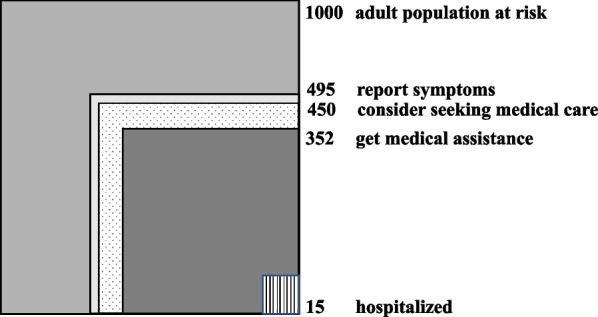
A total of 1862 people participated; 49.5% reported having symptoms in the previous month, 45% considered seeking medical advice, 35.2% sought out medical assistance and only 1.5% were hospitalized. The vast majority chose to contact their family physician (58%) and the primary care setting provided their needs in 80% of the cases; Subjective morbidity and medical care consumption differed significantly between Israeli Jews and Arabs. Gaps in the availability of medical services were observed as residents of the periphery forewent medical services significantly more than others (OR = 1.42, p = 0.026).

CONCLUSIONS

Subjective morbidity is less common in Israel than in other countries, but paradoxically consumption of medical services is higher. An Israeli who feels ill will usually consider receiving assistance and will indeed receive assistance in most cases. However, a greater tendency to forego medical services in the periphery indicates barriers and inequality in the provision of health services. Different cultural perceptions, lack of knowledge and low accessibility to medical services in the periphery probably contribute to the contrast shown between low consumption of medical services and high prevalence of chronic illness in Arab society. The prevailing preference for family medicine and its ability to deal with most requests for assistance suggest that strengthening family medicine in the periphery may reduce those barriers and inequalities.
https://cdn.ncbi.nlm.nih.gov/pmc/blobs/4612/9650793/a2b546fe5a1b/13584_2022_542_Fig5_HTML.jpg
https://cdn.ncbi.nlm.nih.gov/pmc/blobs/4612/9650793/ffc9c8b116c7/13584_2022_542_Fig1_HTML.jpg
https://cdn.ncbi.nlm.nih.gov/pmc/blobs/4612/9650793/5660ebf5d78b/13584_2022_542_Fig2_HTML.jpg
https://cdn.ncbi.nlm.nih.gov/pmc/blobs/4612/9650793/781114895754/13584_2022_542_Fig3_HTML.jpg
https://cdn.ncbi.nlm.nih.gov/pmc/blobs/4612/9650793/e3e5f548e1fa/13584_2022_542_Fig4_HTML.jpg
https://cdn.ncbi.nlm.nih.gov/pmc/blobs/4612/9650793/a2b546fe5a1b/13584_2022_542_Fig5_HTML.jpg
https://cdn.ncbi.nlm.nih.gov/pmc/blobs/4612/9650793/ffc9c8b116c7/13584_2022_542_Fig1_HTML.jpg
https://cdn.ncbi.nlm.nih.gov/pmc/blobs/4612/9650793/5660ebf5d78b/13584_2022_542_Fig2_HTML.jpg
https://cdn.ncbi.nlm.nih.gov/pmc/blobs/4612/9650793/781114895754/13584_2022_542_Fig3_HTML.jpg
https://cdn.ncbi.nlm.nih.gov/pmc/blobs/4612/9650793/e3e5f548e1fa/13584_2022_542_Fig4_HTML.jpg
https://cdn.ncbi.nlm.nih.gov/pmc/blobs/4612/9650793/a2b546fe5a1b/13584_2022_542_Fig5_HTML.jpg
摘要

背景

《医疗保健生态学》于 1961 年首次出版。图形方形模型显示,在美国和英国,75%的人口在给定的一个月内会感到不适,25%的人会寻求医疗帮助,只有 1%的人会住院。2001 年,Green 及其同事发现,尽管过去几十年发生了许多变化,但仍有同样的发现。由于文化、经济、社会、人口背景和当地卫生政策的不同,疾病的发生频率、寻求帮助的愿望以及寻求和获得医疗帮助的频率在不同人群中可能有所不同。这项工作首次描述了以色列医疗保健消费的生态,并研究了社会人口统计学对消费的影响。

方法

这是一项全国性的横断面研究。在以色列成年人(>15 岁)中进行了一项代表性样本的电话调查。计算了前一个月的主观发病率、考虑寻求医疗帮助的人数和获得帮助的人数。使用 t 检验和卡方检验连续定量和分类变量,研究社会人口统计学变量与发病率和医疗保健消费模式之间的相关性。多变量分析采用逻辑回归。

结果

共有 1862 人参与;49.5%的人报告在前一个月有症状,45%的人考虑寻求医疗建议,35.2%的人寻求医疗帮助,只有 1.5%的人住院。绝大多数人选择联系他们的家庭医生(58%),初级保健机构满足了 80%的需求;主观发病率和医疗保健消费在以色列犹太人(Jews)和阿拉伯人之间存在显著差异。观察到医疗服务提供方面的差距,因为边缘地区的居民明显比其他人更不愿意接受医疗服务(OR=1.42,p=0.026)。

结论

与其他国家相比,以色列的主观发病率较低,但医疗服务的消费却较高。一个感到不适的以色列人通常会考虑接受帮助,而且在大多数情况下确实会得到帮助。然而,边缘地区更倾向于放弃医疗服务,表明在提供卫生服务方面存在障碍和不平等。不同的文化观念、缺乏知识以及边缘地区医疗服务的低可及性,可能导致阿拉伯社会中医疗服务低消费和慢性病高患病率之间的反差。家庭医学的普遍偏好及其处理大多数援助请求的能力表明,在边缘地区加强家庭医学可能会减少这些障碍和不平等。

相似文献

1
The landscape of medical care consumption in Israel: a nationwide population cross-sectional study.以色列医疗保健消费的全景:一项全国性人口横断面研究。
Isr J Health Policy Res. 2022 Nov 10;11(1):38. doi: 10.1186/s13584-022-00542-9.
2
Use and barriers to the use of telehealth services in the Arab population in Israel: a cross sectional survey.以色列阿拉伯人群中远程医疗服务的使用情况及使用障碍:一项横断面调查。
Isr J Health Policy Res. 2023 May 23;12(1):21. doi: 10.1186/s13584-023-00569-6.
3
Inequalities in use of health services among Jews and Arabs in Israel.以色列犹太人和阿拉伯人在医疗服务使用方面的不平等。
Health Serv Res. 2007 Jun;42(3 Pt 1):1008-19. doi: 10.1111/j.1475-6773.2006.00645.x.
4
A comparison of Israeli Jewish and Arab women's birth perceptions.以色列犹太女性与阿拉伯女性生育观念的比较。
Midwifery. 2014 Jul;30(7):853-61. doi: 10.1016/j.midw.2013.11.003. Epub 2013 Nov 15.
5
Social and structural determinants of emergency department use among Arab and Jewish patients in Jerusalem.耶路撒冷的阿拉伯和犹太患者使用急诊部的社会和结构性决定因素。
Int J Equity Health. 2022 Nov 7;21(1):156. doi: 10.1186/s12939-022-01698-1.
6
Help seeking in school by Israeli Arab minority adolescents with emotional and behavioral problems: results from the Galilee Study.以色列阿拉伯少数族裔有情绪和行为问题的青少年在学校寻求帮助的情况:加利利研究的结果
Isr J Health Policy Res. 2016 Dec 1;5:49. doi: 10.1186/s13584-016-0109-0. eCollection 2016.
7
Changes in Quality of Life Following SARS-CoV-2 Infection Among Jewish and Arab Populations in Israel: A Cross-Sectional Study.SARS-CoV-2 感染对以色列犹太人群和阿拉伯人群生活质量的影响:一项横断面研究。
Int J Public Health. 2023 Jun 12;68:1605970. doi: 10.3389/ijph.2023.1605970. eCollection 2023.
8
Achieving ethnic equality in the Israel trauma healthcare system: the case of the elderly population.在以色列创伤医疗系统中实现种族平等:老年人群体的案例
Isr J Health Policy Res. 2019 Feb 13;8(1):25. doi: 10.1186/s13584-019-0294-8.
9
Determinants of health behavior inequalities: a cross-sectional study from Israel.健康行为不平等的决定因素:一项来自以色列的横断面研究。
Health Promot Int. 2019 Oct 1;34(5):941-952. doi: 10.1093/heapro/day054.
10
Low Response to the COVID-19 Vaccine Among the Arab Population in Israel: Is It a Cultural Background, or a Systemic Failure, or Maybe Both?以色列阿拉伯人群对 COVID-19 疫苗的低反应:是文化背景的原因,还是系统故障的原因,或者两者兼而有之?
J Racial Ethn Health Disparities. 2023 Feb;10(1):296-305. doi: 10.1007/s40615-021-01220-3. Epub 2022 Jan 4.

引用本文的文献

1
Spatial patterns of childhood obesity clusters linked to socioeconomic inequalities.与社会经济不平等相关的儿童肥胖聚集区的空间模式。
Front Public Health. 2025 Aug 19;13:1497090. doi: 10.3389/fpubh.2025.1497090. eCollection 2025.
2
Exploring ethnic disparities in pediatric molluscum contagiosum in Southern Israel.探讨以色列南部儿童传染性软疣的种族差异。
Sci Rep. 2024 Sep 10;14(1):21139. doi: 10.1038/s41598-024-72332-z.
3
Medication use and risk of amyotrophic lateral sclerosis: using machine learning for an exposome-wide screen of a large clinical database.

本文引用的文献

1
Determinants of health behavior inequalities: a cross-sectional study from Israel.健康行为不平等的决定因素:一项来自以色列的横断面研究。
Health Promot Int. 2019 Oct 1;34(5):941-952. doi: 10.1093/heapro/day054.
2
Inequalities in non-communicable diseases between the major population groups in Israel: achievements and challenges.以色列主要人群间非传染性疾病的不平等:成就与挑战。
Lancet. 2017 Jun 24;389(10088):2531-2541. doi: 10.1016/S0140-6736(17)30574-3. Epub 2017 May 8.
3
Strengthening the capacities of a national health authority in the effort to mitigate health inequity-the Israeli model.
药物使用与肌萎缩侧索硬化症风险:利用机器学习对大型临床数据库进行暴露组全筛检
Amyotroph Lateral Scler Frontotemporal Degener. 2024 May;25(3-4):367-375. doi: 10.1080/21678421.2024.2320878. Epub 2024 Mar 1.
4
Evaluation of Telephone Visits in Primary Care: Satisfaction of Pediatricians and Family Physicians and Their Perceptions of Quality of Care and Safety.基层医疗中电话问诊的评估:儿科医生和家庭医生的满意度及其对医疗质量和安全性的看法。
Healthcare (Basel). 2024 Jan 15;12(2):212. doi: 10.3390/healthcare12020212.
5
Healthcare utilization is increased in children living in urban areas, with ethnicity-related disparities: A big data analysis study.城市地区儿童的医疗保健利用率增加,存在与种族相关的差异:一项大数据分析研究。
Eur J Pediatr. 2024 Apr;183(4):1585-1594. doi: 10.1007/s00431-023-05373-7. Epub 2024 Jan 6.
6
Studies on the ecology of medical care: a comparative analysis in historical perspective, 1928-2018.医疗保健生态学研究:历史视角的比较分析,1928-2018 年。
Salud Colect. 2023 Nov 22;19:e4549. doi: 10.18294/sc.2023.4549.
加强国家卫生当局在减轻健康不平等方面的能力——以色列模式。
Isr J Health Policy Res. 2016 Aug 15;5:19. doi: 10.1186/s13584-016-0077-4. eCollection 2016.
4
Ecology of health care in Canada.加拿大的医疗保健生态
Can Fam Physician. 2015 May;61(5):449-53.
5
The Ecology of Medical Care in Norway: Wide Use of General Practitioners may not Necessarily Keep Patients out of Hospitals.挪威医疗保健的生态:广泛使用全科医生未必能使患者不进医院。
J Public Health Res. 2012 Jul 31;1(2):177-83. doi: 10.4081/jphr.2012.e28. eCollection 2012 Jun 15.
6
Health, cultural and socioeconomic factors related to self-rated health of long-term Jewish residents, immigrants, and Arab women in midlife in Israel.与以色列中年长期犹太居民、移民及阿拉伯女性自评健康状况相关的健康、文化和社会经济因素。
Women Health. 2014;54(5):402-24. doi: 10.1080/03630242.2014.897679.
7
Immigrating to a universal health care system: utilization of hospital services by immigrants in Israel.移民到全民医疗保健系统:以色列移民对医院服务的利用。
Health Place. 2013 Mar;20:13-8. doi: 10.1016/j.healthplace.2012.11.005. Epub 2012 Dec 8.
8
Adult-onset diabetes among Arabs and Jews in Israel: a population-based study.以色列阿拉伯裔和犹太裔成年人中的糖尿病:一项基于人群的研究。
Diabet Med. 2012 Jun;29(6):748-54. doi: 10.1111/j.1464-5491.2011.03516.x.
9
Trends in the gap in life expectancy between Arabs and Jews in Israel between 1975 and 2004.1975 年至 2004 年间以色列阿拉伯人和犹太人之间预期寿命差距的趋势。
Int J Epidemiol. 2010 Oct;39(5):1324-32. doi: 10.1093/ije/dyq073. Epub 2010 Jun 9.
10
Growing cell-phone population and noncoverage bias in traditional random digit dial telephone health surveys.手机使用人数不断增加以及传统随机数字拨号电话健康调查中的未覆盖偏差。
Health Serv Res. 2010 Aug;45(4):1121-39. doi: 10.1111/j.1475-6773.2010.01120.x. Epub 2010 May 24.