Garcês Andreia, Lopes Ricardo, Silva Augusto, Sampaio Filipe, Duque Daniela, Brilhante-Simões Paula
Inno-Serviços Especializados em Veterinária, R. Cândido de Sousa 15, 4710-300 Braga, Portugal.
Centre for the Research and Technology of Agro-Environmental and Biological Sciences (CITAB), University of Trás-os-Montes and Alto Douro, Quinta de Prados, 5000-801 Vila Real, Portugal.
Antibiotics (Basel). 2022 Oct 31;11(11):1520. doi: 10.3390/antibiotics11111520.
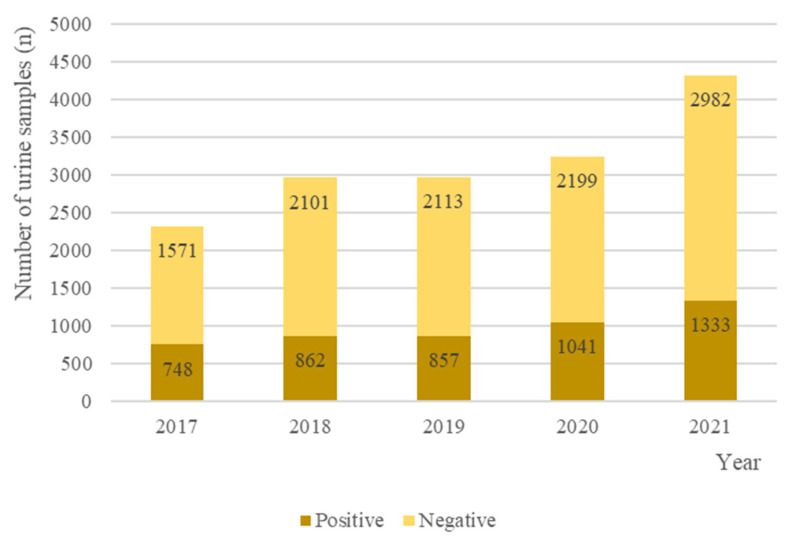
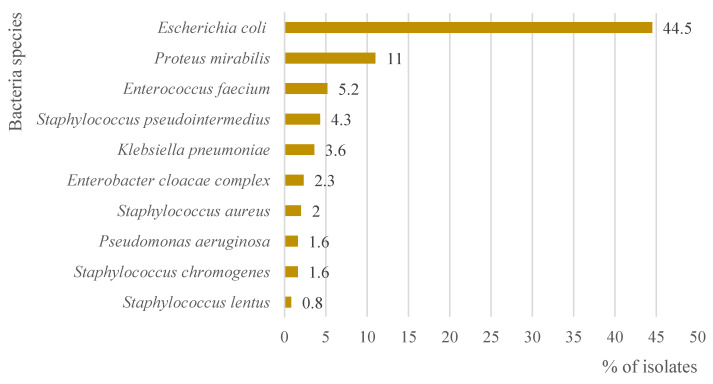
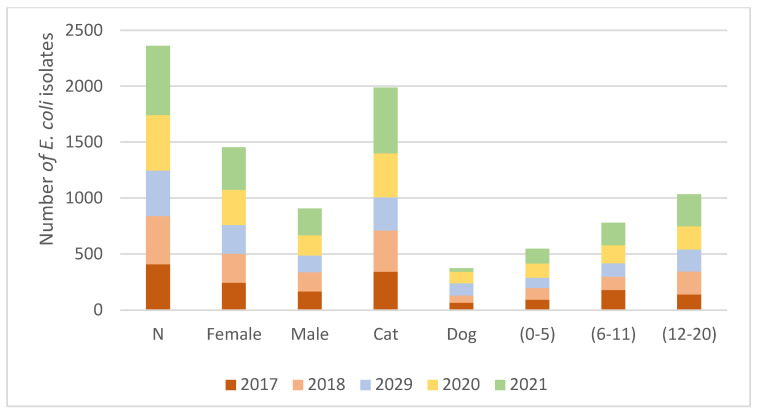
There are growing concerns regarding the rise of antimicrobial-resistant bacteria in companion animals. This study aimed to bring new insights into the current scenario of Portugal's antimicrobial resistance bacteria isolated from companion animals with urinary tract infections and is the first to be performed during a long period on a large scale. Of a total of 17472 urine samples analyzed, 12,166 (69.6%) (CI 12,200-12,200) were negative for bacterial growth, and 5306 (30.4%) (95% CI 5310-5310) had bacterial growth. Of the culture-positive samples, 5224 (96.6%) (95% CI 5220-5220) were pure cultures and 82 (3.2%) (95% CI 81.9-82.1) had mixed growth. was the most frequently isolated bacteria (=2360, 44.5%) (95% CI 2360-2360), followed by (=585, 11%) (95% CI 583-583), (=277, 5.2%) (95% CI 277-277) and (=226, 4.3%) (95% CI 226-226). The overall susceptibility rates were low for erythromycin (45.3%) and clindamycin (51.3%), and high for aminoglycosides (96.3%), carbapenems (92.4%), trimethoprim-sulfamethoxazole (81.2%), and quinolones (79.9%). also showed considerable resistance to amoxicillin-clavulanic acid. The rates of multidrug-resistant bacteria are still high compared to the northern countries of Europe. This study's findings show the emergence of antibiotic resistance in the antibiotic agents commonly used in the treatment of UTIs in dogs and cats in Portugal.
人们越来越关注伴侣动物中抗菌药物耐药性细菌的增加。本研究旨在为葡萄牙从患有尿路感染的伴侣动物中分离出的抗菌药物耐药性细菌的当前情况带来新的见解,并且是长期以来首次大规模开展的此类研究。在总共分析的17472份尿液样本中,12166份(69.6%)(置信区间12200 - 12200)细菌生长呈阴性,5306份(30.4%)(95%置信区间5310 - 5310)有细菌生长。在培养阳性样本中,5224份(96.6%)(95%置信区间5220 - 5220)为纯培养物,82份(3.2%)(95%置信区间81.9 - 82.1)为混合生长。大肠埃希菌是最常分离出的细菌(=2360,44.5%)(95%置信区间2360 - 2360),其次是葡萄球菌(=585,11%)(95%置信区间583 - 583)、肠球菌(=277,5.2%)(95%置信区间277 - 277)和克雷伯菌(=226,4.3%)(95%置信区间226 - 226)。红霉素(45.3%)和克林霉素(51.3%)的总体药敏率较低,而氨基糖苷类(96.3%)、碳青霉烯类(92.4%)、甲氧苄啶 - 磺胺甲恶唑(81.2%)和喹诺酮类(79.9%)的总体药敏率较高。大肠埃希菌对阿莫西林 - 克拉维酸也表现出相当高的耐药性。与欧洲北部国家相比,多重耐药菌的比例仍然很高。这项研究的结果表明,在葡萄牙用于治疗猫和狗尿路感染的常用抗生素中出现了抗生素耐药性。