Farizqi M Thoriq Ihza, Effendi Mustofa Helmi, Adikara R Tatang Santanu, Yudaniayanti Ira Sari, Putra Giovanni Dwi Syahni, Khairullah Aswin Rafif, Kurniawan Shendy Canadya, Silaen Otto Sahat Martua, Ramadhani Safira, Millannia Saumi Kirey, Kaben Sergius Erikson, Waruwu Yusac Kristanto Khoda
Department of Veterinary Medicine, Faculty of Veterinary Medicine, Universitas Airlangga. Jl. Dr. Ir. H. Soekarno, Kampus C Mulyorejo, Surabaya, 60115, East Java, Indonesia.
Division of Veterinary Public Health, Faculty of Veterinary Medicine, Universitas Airlangga. Jl. Dr. Ir. H. Soekarno, Kampus C Mulyorejo, Surabaya, 60115, East Java, Indonesia.
Vet World. 2023 Sep;16(9):1917-1925. doi: 10.14202/vetworld.2023.1917-1925. Epub 2023 Sep 21.
causes a bacterial illness that frequently affects cats. Diseases caused by are treated using antibiotics. Because of their proximity to humans, cats possess an extremely high risk of contracting antibiotic resistance genes when their owners touch cat feces containing that harbor resistance genes. This study was conducted to identify multidrug-resistant and extended-spectrum β-lactamase (ESBL)-producing genes from cat rectal swabs collected at Surabaya City Veterinary Hospital to determine antibiotic sensitivity.
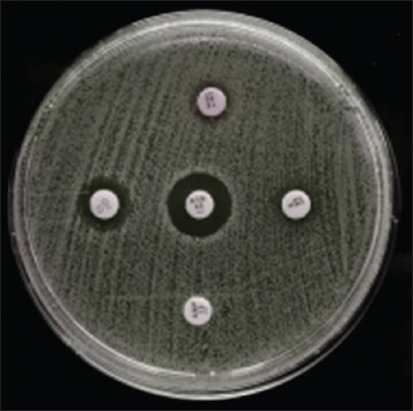
Samples of cat rectal swabs were cultured in Brilliant Green Bile Lactose Broth medium and then streaked on eosin methylene blue agar medium for bacterial isolation, whereas Gram-staining and IMViC tests were conducted to confirm the identification results. The Kirby-Bauer diffusion test was used to determine antibiotic sensitivity, and the double-disk synergy test was used to determine ESBL-producing bacteria. Molecular detection of the genes and was performed using a polymerase chain reaction.
Based on morphological culture, Gram-staining, and biochemical testing, the results of sample inspection showed that of the 100 cat rectal swab samples isolated, 71 (71%) were positive for . Furthermore, 23 isolates (32.39%) demonstrated the highest resistance to ampicillin. Four isolates were confirmed to be multidurg-resistant and ESBL-producing strains. Molecular examination revealed that three isolates harbored and .
In conclusion, pet owners must be educated on the use of antibiotics to improve their knowledge about the risks of antibiotic resistance.
[细菌名称]引发一种常感染猫的细菌性疾病。由该细菌引起的疾病使用抗生素进行治疗。由于猫与人类亲近,当猫主人接触含有携带耐药基因的[细菌名称]的猫粪便时,猫感染抗生素耐药基因的风险极高。本研究旨在从泗水市兽医医院采集的猫直肠拭子中鉴定出耐多药的[细菌名称]和产超广谱β-内酰胺酶(ESBL)的基因,以确定抗生素敏感性。
猫直肠拭子样本在煌绿胆汁乳糖肉汤培养基中培养,然后划线接种在伊红美蓝琼脂培养基上进行细菌分离,同时进行革兰氏染色和IMViC试验以确认鉴定结果。采用 Kirby-Bauer 扩散试验确定抗生素敏感性,采用双碟协同试验确定产 ESBL 细菌。使用聚合酶链反应对[细菌名称]和[基因名称]进行分子检测。
基于形态学培养、革兰氏染色和生化检测,样本检查结果显示,在分离的100份猫直肠拭子样本中,71份(71%)[细菌名称]检测呈阳性。此外,23株[细菌名称]分离株(32.39%)对氨苄西林耐药性最高。4株分离株被确认为耐多药且产ESBL的菌株。分子检测显示,3株[细菌名称]分离株携带[基因名称]和[基因名称]。
总之,必须对宠物主人进行抗生素使用方面的教育,以提高他们对抗生素耐药性风险的认识。