Tayade Kundan, Yeom Gyu-Seong, Sahoo Suban K, Puschmann Horst, Nimse Satish Balasaheb, Kuwar Anil
School of Chemical Sciences, North Maharashtra University, Jalgaon 425001, India.
Department of Chemistry and Analytical Chemistry, Rajarshi Shahu Mahavidyalaya, Latur 413512, India.
Antioxidants (Basel). 2022 Oct 28;11(11):2138. doi: 10.3390/antiox11112138.
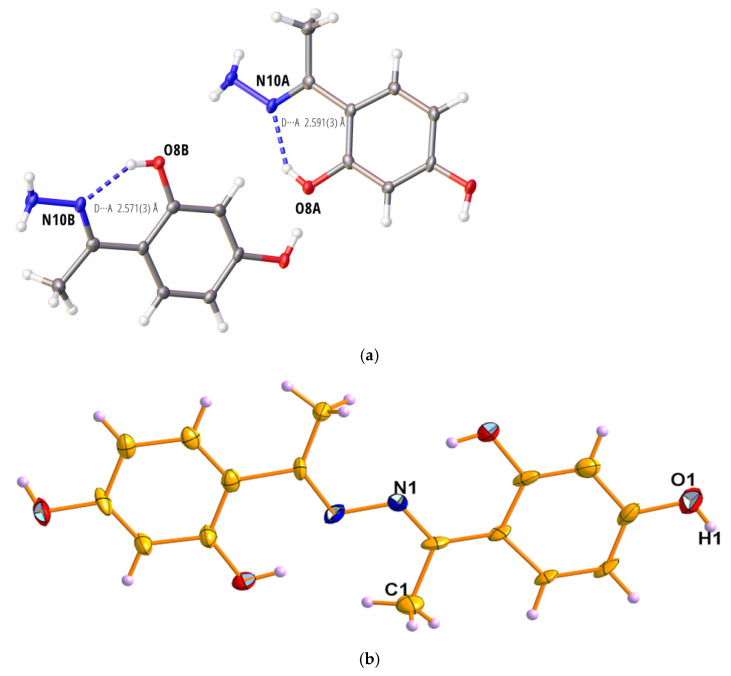
The hydrazine derivatives are known to possess several biological activities including anticancer, antibacterial and anti-fungal, anticonvulsant, and antioxidant. This communication presents the synthesis, X-ray crystal structure analysis, DFT calculations, cell cytotoxicity, and antioxidant activity of the Schiff base 4,4'-((1E,1'E)-hydrazine-1,2-diylidenebis(ethan-1-yl-1-ylidene))bis(benzene-1,3-diol) (compound ). We have also isolated the side product compound and characterized it using single X-ray crystallography. The crystal structure of compound depicts that the ensuing C-H···N hydrogen bonding interaction is presented and discussed herein. In addition, the calculations using density functional theory (DFT) approximation supported by experimental H and C NMR studies on the key compound are reported. The results of theoretical and experimental H and C NMR were concordant. The antioxidant activity of compound was determined by using 2,2'-azinobis(3-ethylbenzthiazoline-6-sulfonic acid) (ABTS) radical cation assays and 2,2-diphenyl-1-picrylhydrazyl (DPPH) radical assay. Compound demonstrated excellent antioxidant activity in ABTS assay (IC = 4.30 ± 0.21 µM) and DPPH assay (IC = 81.06 ± 0.72 µM) with almost no cytotoxicity below 25 µM.
已知肼衍生物具有多种生物活性,包括抗癌、抗菌和抗真菌、抗惊厥以及抗氧化活性。本通讯介绍了席夫碱4,4'-((1E,1'E)-肼-1,2-二亚基双(乙烷-1,1-二亚基))双(苯-1,3-二醇)(化合物)的合成、X射线晶体结构分析、密度泛函理论(DFT)计算、细胞毒性和抗氧化活性。我们还分离出了副产物化合物,并使用单晶X射线晶体学对其进行了表征。化合物的晶体结构表明存在并在此讨论了随后的C-H···N氢键相互作用。此外,报告了在关键化合物上进行的实验性H和C NMR研究支持的使用密度泛函理论(DFT)近似的计算。理论和实验性H和C NMR的结果是一致的。通过使用2,2'-偶氮双(3-乙基苯并噻唑啉-6-磺酸)(ABTS)自由基阳离子测定法和2,2-二苯基-1-苦基肼基(DPPH)自由基测定法来测定化合物的抗氧化活性。化合物在ABTS测定(IC = 4.30±0.21μM)和DPPH测定(IC = 81.06±0.72μM)中表现出优异的抗氧化活性,在25μM以下几乎没有细胞毒性。