Bernardo Lucas Salvador, Damaševičius Robertas, Ling Sai Ho, de Albuquerque Victor Hugo C, Tavares João Manuel R S
Department of Software Engineering, Kaunas University of Technology, 51368 Kaunas, Lithuania.
Department of Electrical and Data Engineering, University of Technology Sydney, Sydney 2007, Australia.
Biomedicines. 2022 Oct 28;10(11):2746. doi: 10.3390/biomedicines10112746.
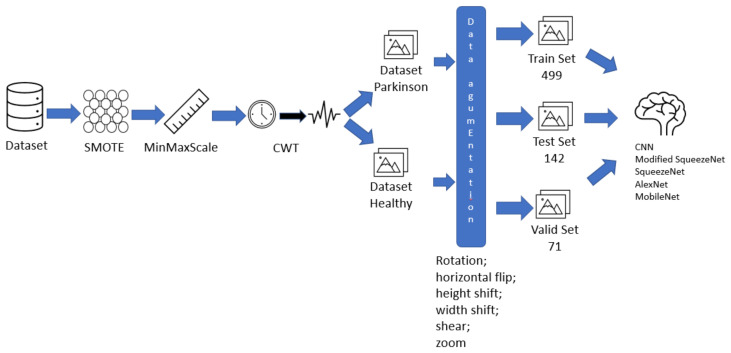
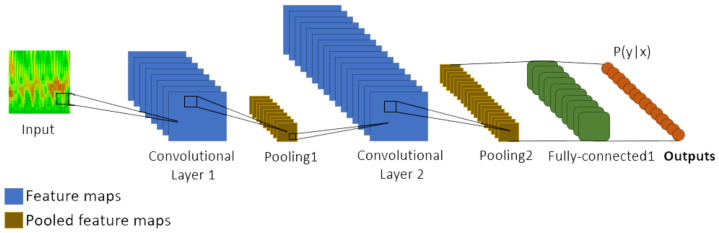
Parkinson's disease (PD) is the most common form of Parkinsonism, which is a group of neurological disorders with PD-like motor impairments. The disease affects over 6 million people worldwide and is characterized by motor and non-motor symptoms. The affected person has trouble in controlling movements, which may affect simple daily-life tasks, such as typing on a computer. We propose the application of a modified SqueezeNet convolutional neural network (CNN) for detecting PD based on the subject's key-typing patterns. First, the data are pre-processed using data standardization and the Synthetic Minority Oversampling Technique (SMOTE), and then a Continuous Wavelet Transformation is applied to generate spectrograms used for training and testing a modified SqueezeNet model. The modified SqueezeNet model achieved an accuracy of 90%, representing a noticeable improvement in comparison to other approaches.
帕金森病(PD)是帕金森综合征最常见的形式,帕金森综合征是一组具有类似帕金森病运动障碍的神经疾病。该疾病在全球影响着超过600万人,其特征为运动和非运动症状。患者在控制运动方面存在困难,这可能会影响诸如在电脑上打字等简单的日常生活任务。我们提出应用一种经过改进的挤压网络卷积神经网络(CNN),基于受试者的按键打字模式来检测帕金森病。首先,使用数据标准化和合成少数类过采样技术(SMOTE)对数据进行预处理,然后应用连续小波变换来生成用于训练和测试改进型挤压网络模型的频谱图。改进后的挤压网络模型达到了90%的准确率,与其他方法相比有显著提高。