Cellina Michaela, Cè Maurizio, Irmici Giovanni, Ascenti Velio, Khenkina Natallia, Toto-Brocchi Marco, Martinenghi Carlo, Papa Sergio, Carrafiello Gianpaolo
Radiology Department, Fatebenefratelli Hospital, ASST Fatebenefratelli Sacco, Milano, Piazza Principessa Clotilde 3, 20121 Milan, Italy.
Postgraduation School in Radiodiagnostics, Università degli Studi di Milano, Via Festa del Perdono, 7, 20122 Milan, Italy.
Diagnostics (Basel). 2022 Oct 31;12(11):2644. doi: 10.3390/diagnostics12112644.
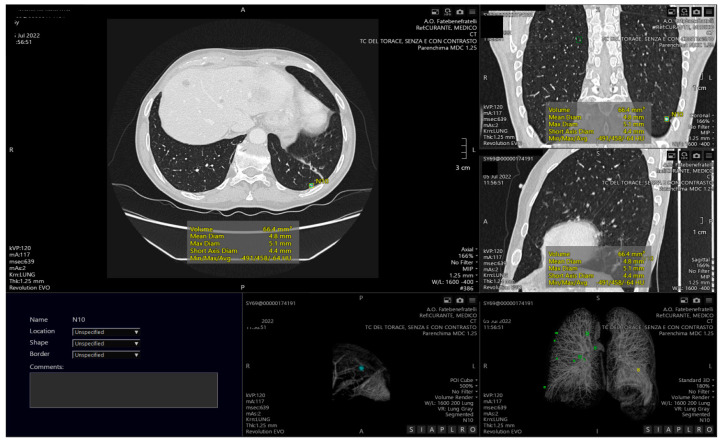
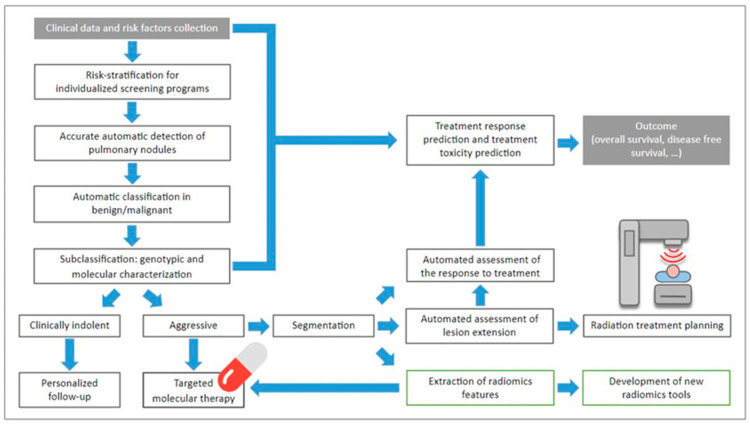
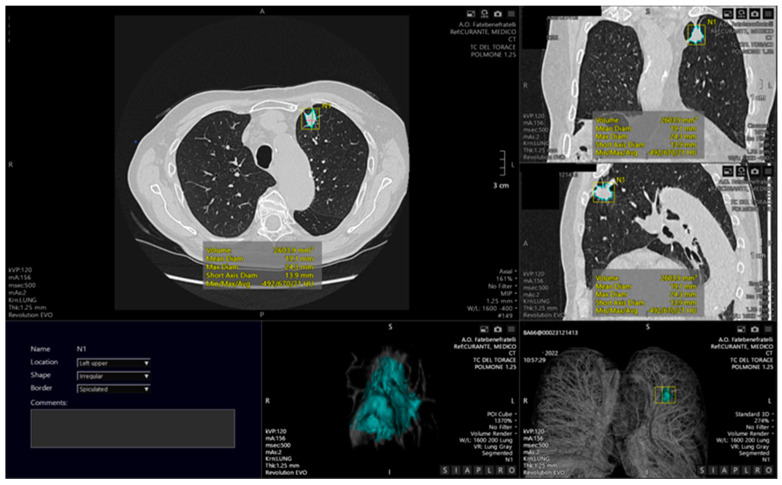
Lung cancer is one of the malignancies with higher morbidity and mortality. Imaging plays an essential role in each phase of lung cancer management, from detection to assessment of response to treatment. The development of imaging-based artificial intelligence (AI) models has the potential to play a key role in early detection and customized treatment planning. Computer-aided detection of lung nodules in screening programs has revolutionized the early detection of the disease. Moreover, the possibility to use AI approaches to identify patients at risk of developing lung cancer during their life can help a more targeted screening program. The combination of imaging features and clinical and laboratory data through AI models is giving promising results in the prediction of patients' outcomes, response to specific therapies, and risk for toxic reaction development. In this review, we provide an overview of the main imaging AI-based tools in lung cancer imaging, including automated lesion detection, characterization, segmentation, prediction of outcome, and treatment response to provide radiologists and clinicians with the foundation for these applications in a clinical scenario.
肺癌是发病率和死亡率较高的恶性肿瘤之一。影像学在肺癌治疗的各个阶段都起着至关重要的作用,从肺癌的检测到治疗反应的评估。基于影像学的人工智能(AI)模型的发展有可能在早期检测和个性化治疗规划中发挥关键作用。在筛查项目中,计算机辅助检测肺结节彻底改变了该疾病的早期检测方式。此外,利用人工智能方法识别一生中患肺癌风险的可能性有助于开展更具针对性的筛查项目。通过人工智能模型将影像学特征与临床和实验室数据相结合,在预测患者预后、对特定治疗的反应以及发生毒性反应的风险方面取得了令人鼓舞的成果。在本综述中,我们概述了肺癌影像学中主要的基于人工智能的成像工具,包括自动病变检测、特征描述、分割、预后预测和治疗反应,为放射科医生和临床医生在临床场景中应用这些技术提供基础。