Nyame Solomon, Cheung Po-Yin, Lee Tez-Fun, O'Reilly Megan, Schmölzer Georg M
Faculty of Medicine and Dentistry, Monash University, Melbourne, VIC 3000, Australia.
Centre for the Studies of Asphyxia and Resuscitation, Neonatal Research Unit, Royal Alexandra Hospital, Edmonton, AB T5H 3V9, Canada.
Children (Basel). 2022 Oct 22;9(11):1601. doi: 10.3390/children9111601.
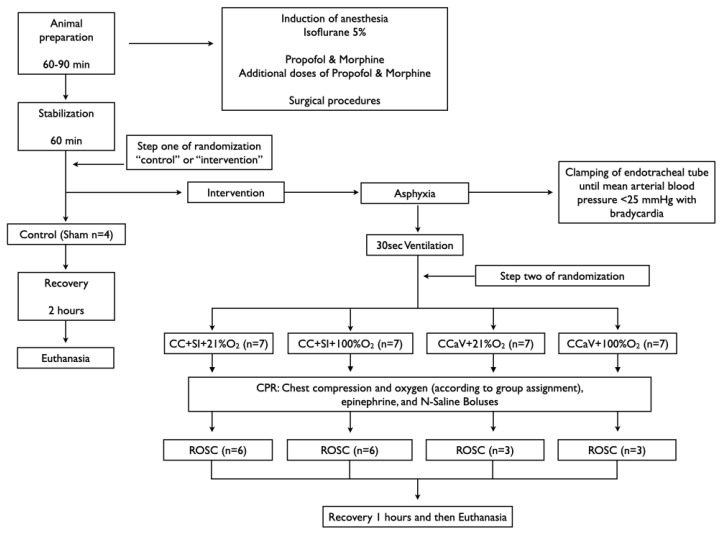
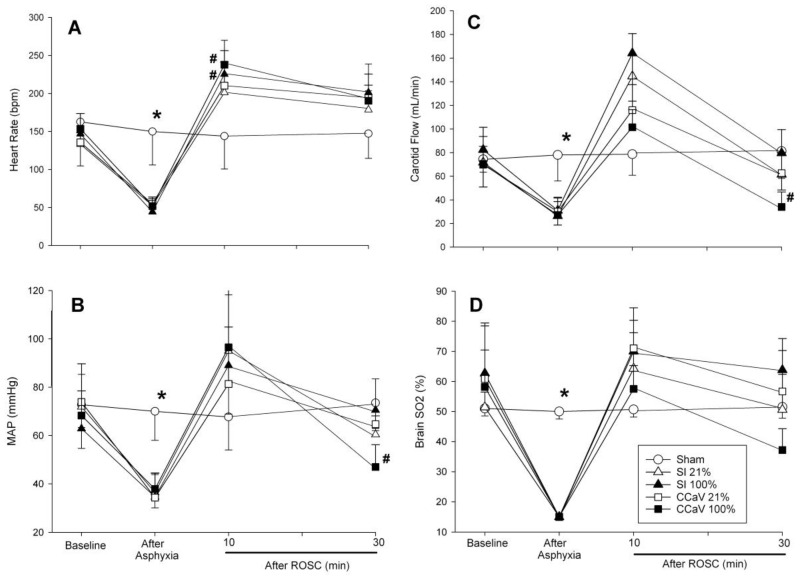
Background: During pediatric cardiopulmonary resuscitation (CPR), resuscitation guidelines recommend 100% oxygen (O2); however, the most effective O2 concentration for infants unknown. Aim: We aimed to determine if 21% O2 during CPR with either chest compression (CC) during sustained inflation (SI) (CC + SI) or continuous chest compression with asynchronized ventilation (CCaV) will reduce time to return of spontaneous circulation (ROSC) compared to 100% O2 in infant piglets with asphyxia-induced cardiac arrest. Methods: Piglets (20−23 days of age, weighing 6.2−10.2 kg) were anesthetized, intubated, instrumented, and exposed to asphyxia. Cardiac arrest was defined as mean arterial blood pressure < 25 mmHg with bradycardia. After cardiac arrest, piglets were randomized to CC + SI or CCaV with either 21% or 100% O2 or the sham. Heart rate, arterial blood pressure, carotid blood flow, and respiratory parameters were continuously recorded. Main results: Baseline parameters, duration, and degree of asphyxiation were not different. Median (interquartile range) time to ROSC was 107 (90−440) and 140 (105−200) s with CC + SI 21% and 100% O2, and 600 (50−600) and 600 (95−600) s with CCaV 21% and 100% O2 (p = 0.27). Overall, six (86%) and six (86%) piglets with CC + SI 21% and 100% O2, and three (43%) and three (43%) piglets achieved ROSC with CCaV 21% and 100% O2 (p = 0.13). Conclusions: In infant piglets resuscitated with CC + SI, time to ROSC reduced and survival improved compared to CCaV. The use of 21% O2 had similar time to ROSC, short-term survival, and hemodynamic recovery compared to 100% oxygen. Clinical studies comparing 21% with 100% O2 during infant CPR are warranted.
在儿科心肺复苏(CPR)期间,复苏指南推荐使用100%氧气(O₂);然而,婴儿最有效的氧气浓度尚不清楚。目的:我们旨在确定在窒息诱导心脏骤停的幼猪中,与100% O₂相比,在持续充气(SI)时进行胸外按压(CC)(CC + SI)或同步通气持续胸外按压(CCaV)期间使用21% O₂是否会缩短自主循环恢复(ROSC)时间。方法:将幼猪(20 - 23日龄,体重6.2 - 10.2 kg)麻醉、插管、安装监测仪器并使其窒息。心脏骤停定义为平均动脉血压<25 mmHg且伴有心动过缓。心脏骤停后,将幼猪随机分为CC + SI组或CCaV组,分别给予21%或100% O₂或假手术组。持续记录心率、动脉血压、颈动脉血流和呼吸参数。主要结果:窒息的基线参数、持续时间和程度无差异。CC + SI组使用21%和100% O₂时,ROSC的中位(四分位间距)时间分别为107(90 - 440)秒和140(105 - 200)秒;CCaV组使用21%和100% O₂时,ROSC的中位(四分位间距)时间分别为600(50 - 600)秒和600(95 - 600)秒(p = 0.27)。总体而言,CC + SI组使用21%和100% O₂时,分别有6只(86%)和6只(86%)幼猪实现ROSC;CCaV组使用21%和100% O₂时,分别有3只(43%)和3只(43%)幼猪实现ROSC(p = 0.13)。结论:与CCaV相比,采用CC + SI复苏的幼猪ROSC时间缩短且生存率提高。与100%氧气相比,使用21% O₂的ROSC时间、短期生存率和血流动力学恢复情况相似。有必要开展临床研究比较婴儿CPR期间21% O₂与100% O₂的效果。