Department of Psychological and Brain Sciences, George Washington University, Washington, DC 20052, USA.
Int J Environ Res Public Health. 2022 Oct 27;19(21):13954. doi: 10.3390/ijerph192113954.
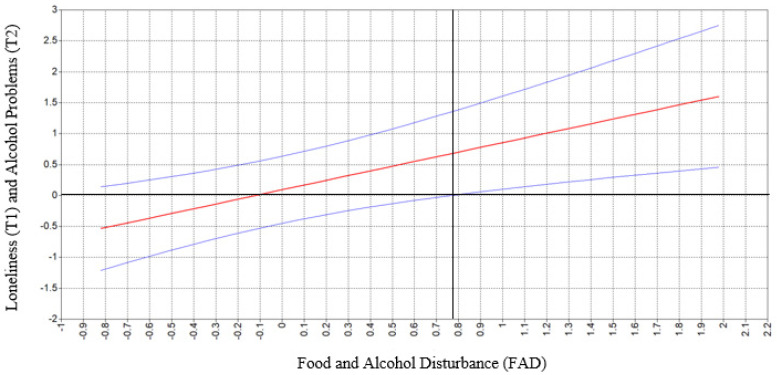
Loneliness and alcohol misuse are common among college students and pose a threat to public health. To better understand the longitudinal association between these public health concerns we examined food and alcohol disturbance (FAD; i.e., restricting one's caloric intake prior to drinking) as a moderator in the association between loneliness and alcohol-related problems. Participants were 456 college students from a mid-sized university who engaged in past 30-day binge drinking. The majority of participants identified as being White (67.1%), female (78.1%), and reported a mean age of 19.61 (SD = 1.54) years. Participants completed two surveys (3 weeks apart) over the course of an academic semester. Analyses revealed a significant interaction between loneliness and FAD, such that loneliness (T1) significantly and positively predicted alcohol-related problems (T2), but only among individuals who engaged in relatively higher levels of FAD (T1). FAD may be an appropriate target for interventions aimed at reducing alcohol-related problems among college students experiencing loneliness.
孤独和酗酒在大学生中很常见,对公众健康构成威胁。为了更好地了解这些公共卫生问题之间的纵向关联,我们研究了食物和酒精紊乱(FAD;即,在饮酒前限制热量摄入)作为孤独和与酒精相关问题之间关联的调节剂。参与者是来自一所中型大学的 456 名大学生,他们在过去 30 天内有过 binge drinking 行为。大多数参与者被认定为白人(67.1%),女性(78.1%),平均年龄为 19.61 岁(SD=1.54)。参与者在一个学术学期内完成了两次相隔 3 周的调查。分析显示,孤独和 FAD 之间存在显著的相互作用,即孤独(T1)显著且积极地预测了与酒精相关的问题(T2),但仅在那些相对较高水平的 FAD(T1)的个体中。FAD 可能是针对孤独的大学生中减少与酒精相关问题的干预措施的一个合适目标。