Science and Research Center, Seoul National University College of Medicine, 103 Daehak-ro, Jongno-gu, Seoul 03080, Korea.
Department of Intensive Care Unit and Neonatal Intensive Care, Hunt Regional Hospital, Greenville, 75401 TX, USA.
Int J Mol Sci. 2022 Oct 31;23(21):13260. doi: 10.3390/ijms232113260.
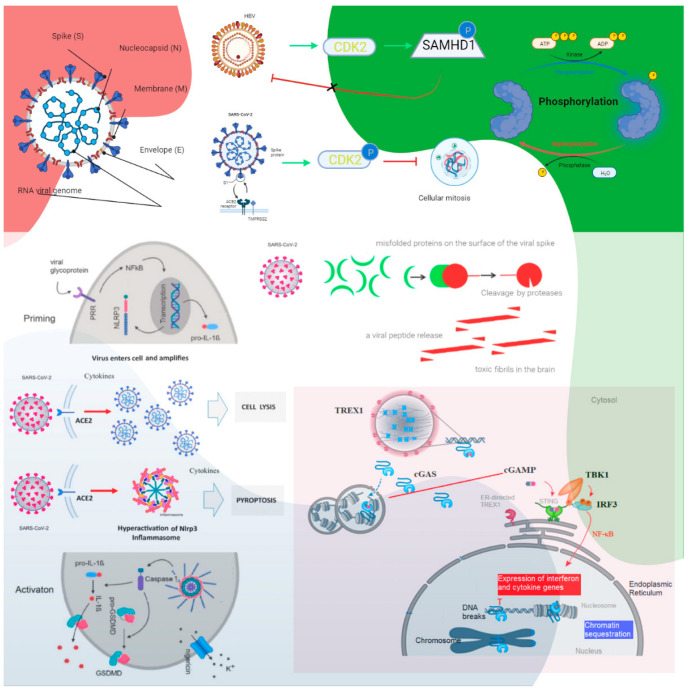
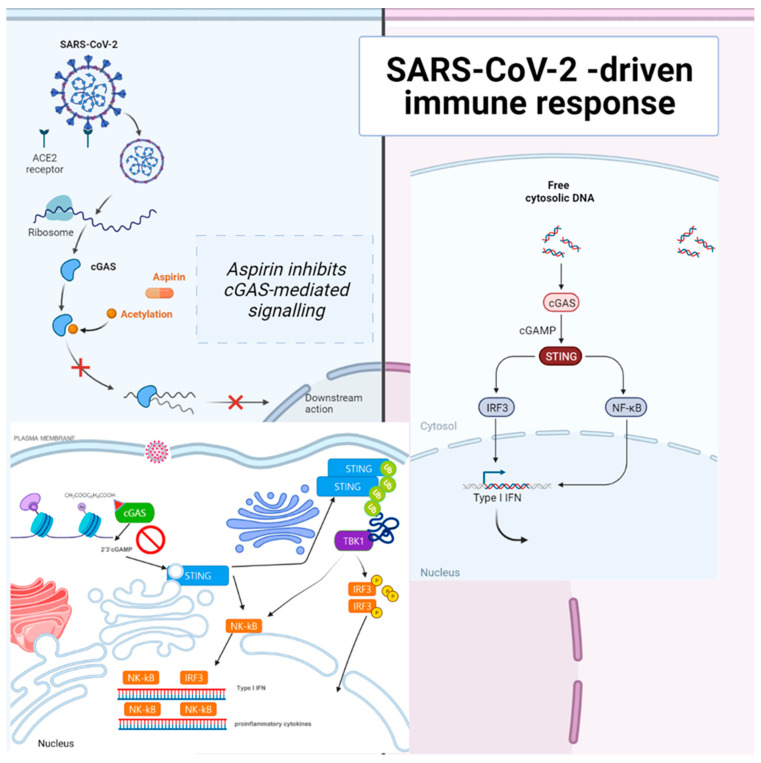
Severe acute respiratory syndrome coronavirus 2 (SARS-CoV-2) induces immune-mediated type 1 interferon (IFN-1) production, the pathophysiology of which involves sterile alpha motif and histidine-aspartate domain-containing protein 1 (SAMHD1) tetramerization and the cytosolic DNA sensor cyclic-GMP-AMP synthase (cGAS)-stimulator of interferon genes (STING) signaling pathway. As a result, type I interferonopathies are exacerbated. Aspirin inhibits cGAS-mediated signaling through cGAS acetylation. Acetylation contributes to cGAS activity control and activates IFN-1 production and nuclear factor-κB (NF-κB) signaling via STING. Aspirin and dapsone inhibit the activation of both IFN-1 and NF-κB by targeting cGAS. We define these as anticatalytic mechanisms. It is necessary to alleviate the pathologic course and take the lag time of the odds of achieving viral clearance by day 7 to coordinate innate or adaptive immune cell reactions.
严重急性呼吸综合征冠状病毒 2(SARS-CoV-2)诱导免疫介导的 I 型干扰素(IFN-1)产生,其病理生理学涉及无酶活性的α基序和组氨酸-天冬氨酸域包含蛋白 1(SAMHD1)四聚化和胞质 DNA 传感器环鸟苷酸-腺苷酸合酶(cGAS)-干扰素基因刺激物(STING)信号通路。因此,I 型干扰素病加剧。阿司匹林通过 cGAS 乙酰化抑制 cGAS 介导的信号转导。乙酰化有助于 cGAS 活性的控制,并通过 STING 激活 IFN-1 的产生和核因子-κB(NF-κB)信号转导。阿司匹林和氨苯砜通过靶向 cGAS 抑制 IFN-1 和 NF-κB 的激活。我们将这些定义为催化抑制机制。有必要减轻病理过程,并通过将第 7 天实现病毒清除的几率的滞后时间来协调先天或适应性免疫细胞反应。