Vaneev Alexander N, Timoshenko Roman V, Gorelkin Petr V, Klyachko Natalia L, Korchev Yuri E, Erofeev Alexander S
Research Laboratory of Biophysics, National University of Science and Technology "MISiS", 119049 Moscow, Russia.
Chemistry Department, Lomonosov Moscow State University, 119991 Moscow, Russia.
Nanomaterials (Basel). 2022 Oct 25;12(21):3736. doi: 10.3390/nano12213736.
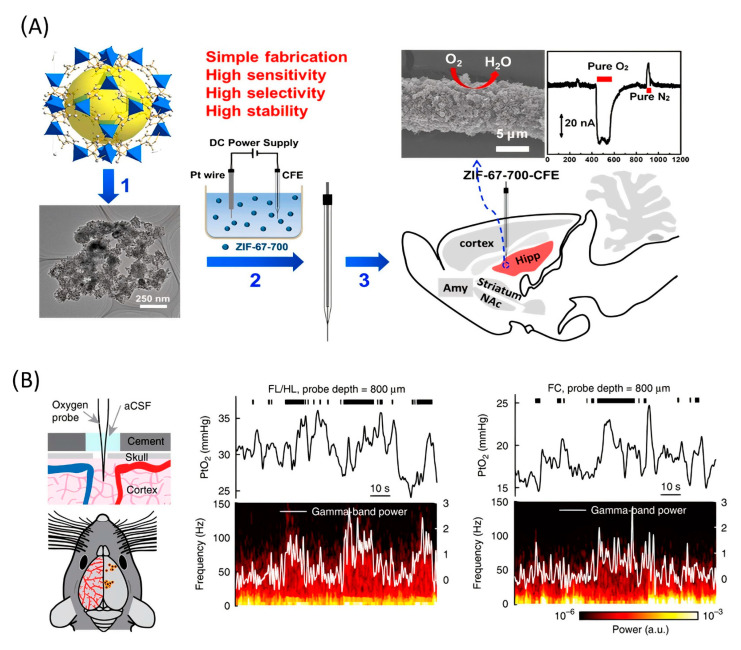
Electrochemical nano- and microsensors have been a useful tool for measuring different analytes because of their small size, sensitivity, and favorable electrochemical properties. Using such sensors, it is possible to study physiological mechanisms at the cellular, tissue, and organ levels and determine the state of health and diseases. In this review, we highlight recent advances in the application of electrochemical sensors for measuring neurotransmitters, oxygen, ascorbate, drugs, pH values, and other analytes in vivo. The evolution of electrochemical sensors is discussed, with a particular focus on the development of significant fabrication schemes. Finally, we highlight the extensive applications of electrochemical sensors in medicine and biological science.
电化学纳米和微传感器因其尺寸小、灵敏度高以及良好的电化学特性,一直是测量不同分析物的有用工具。使用此类传感器,可以在细胞、组织和器官水平上研究生理机制,并确定健康和疾病状态。在这篇综述中,我们重点介绍了电化学传感器在体内测量神经递质、氧气、抗坏血酸、药物、pH值和其他分析物方面的最新进展。讨论了电化学传感器的发展历程,特别关注了重要制造方案的开发。最后,我们强调了电化学传感器在医学和生物科学中的广泛应用。