College of Medical and Dental Sciences, University of Birmingham, Birmingham, UK.
Institute of Metabolism and Systems Research, University of Birmingham, Birmingham, UK.
BMJ Glob Health. 2022 Nov;7(11). doi: 10.1136/bmjgh-2022-010060.
The prevalence of COVID-19 and its impact varied between countries and regions. Pregnant women are at high risk of COVID-19 complications compared with non-pregnant women. The magnitude of variations, if any, in SARS-CoV-2 infection rates and its health outcomes among pregnant women by geographical regions and country's income level is not known.
We performed a random-effects meta-analysis as part of the ongoing PregCOV-19 living systematic review (December 2019 to April 2021). We included cohort studies on pregnant women with COVID-19 reporting maternal (mortality, intensive care admission and preterm birth) and offspring (mortality, stillbirth, neonatal intensive care admission) outcomes and grouped them by World Bank geographical region and income level. We reported results as proportions with 95% confidence intervals (CI).
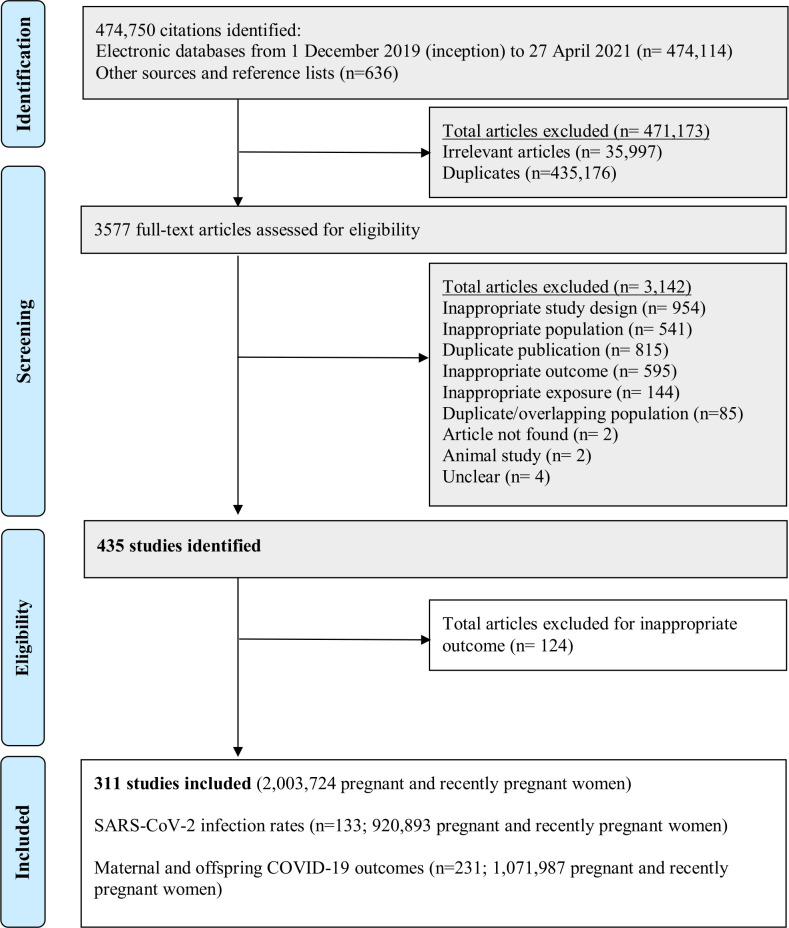
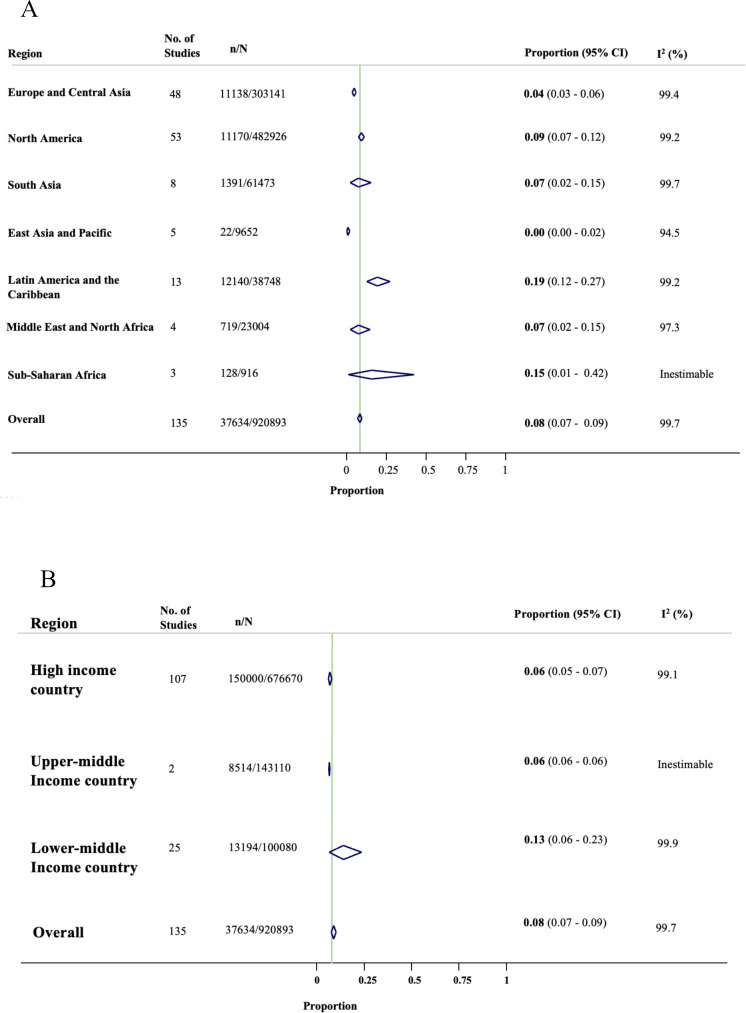
We included 311 studies (2 003 724 pregnant women, 57 countries). The rates of SARS-CoV-2 infection in pregnant women varied significantly by region (p<0.001) and income level (p<0.001), with the highest rates observed in Latin America and the Caribbean (19%, 95% CI 12% to 27%; 13 studies, 38 748 women) and lower-middle-income countries (13%, 95% CI 6% to 23%; 25 studies, 100 080 women). We found significant differences in maternal and offspring outcomes by region and income level. Lower-middle-income countries reported significantly higher rates of maternal mortality (0.68%, 95% CI 0.24% to 1.27%; 3 studies, 31 136 women), intensive care admission (4.53%, 95% CI 2.57% to 6.91%; 54 studies, 23 420 women) and stillbirths (1.09%, 95% CI 0.48% to 1.88%; 41 studies, 4724 women) than high-income countries. COVID-19 complications disproportionately affected South Asia, which had the highest maternal mortality rate (0.88%, 95% CI 0.16% to 1.95%; 17 studies, 2023 women); Latin America and the Caribbean had the highest stillbirth rates (1.97%, 95% CI 0.9% to 3.33%; 10 studies, 1750 women).
The rates of SARS-CoV-2 infection in pregnant women vary globally, and its health outcomes mirror the COVID-19 burden and global maternal and offspring inequalities.
CRD42020178076.
COVID-19 的流行及其影响在不同国家和地区存在差异。与非孕妇相比,孕妇患 COVID-19 并发症的风险更高。然而,我们并不清楚在地理位置和国家收入水平方面,孕妇中 SARS-CoV-2 感染率及其健康结果的变化幅度。
我们进行了一项随机效应荟萃分析,作为正在进行的 PregCOV-19 实时系统综述(2019 年 12 月至 2021 年 4 月)的一部分。我们纳入了关于 COVID-19 孕妇的队列研究,这些研究报告了产妇(死亡率、重症监护入院和早产)和后代(死亡率、死产、新生儿重症监护入院)结局,并按世界银行地理位置和收入水平对其进行了分组。我们以 95%置信区间(CI)报告结果为比例。
我们纳入了 311 项研究(203724 名孕妇,来自 57 个国家)。孕妇中 SARS-CoV-2 感染率因地区(p<0.001)和收入水平(p<0.001)而异,其中拉丁美洲和加勒比地区(19%,95%CI 12%至 27%;13 项研究,38748 名妇女)和中低收入国家(13%,95%CI 6%至 23%;25 项研究,100080 名妇女)的感染率最高。我们还发现,产妇和后代结局在地区和收入水平上存在显著差异。中低收入国家报告的产妇死亡率(0.68%,95%CI 0.24%至 1.27%;3 项研究,31136 名妇女)、重症监护入院率(4.53%,95%CI 2.57%至 6.91%;54 项研究,23420 名妇女)和死产率(1.09%,95%CI 0.48%至 1.88%;41 项研究,4724 名妇女)显著高于高收入国家。南亚 COVID-19 并发症的影响不成比例,南亚的产妇死亡率最高(0.88%,95%CI 0.16%至 1.95%;17 项研究,2023 名妇女);拉丁美洲和加勒比地区的死产率最高(1.97%,95%CI 0.9%至 3.33%;10 项研究,1750 名妇女)。
孕妇中 SARS-CoV-2 感染率在全球范围内存在差异,其健康结果反映了 COVID-19 的负担以及全球产妇和后代的不平等。
CRD42020178076。