Department of Chemistry, University of Fribourg, Chemin du Musée 9, 1700 Fribourg, Switzerland.
Chem Soc Rev. 2022 Nov 28;51(23):9831-9852. doi: 10.1039/d2cs00727d.
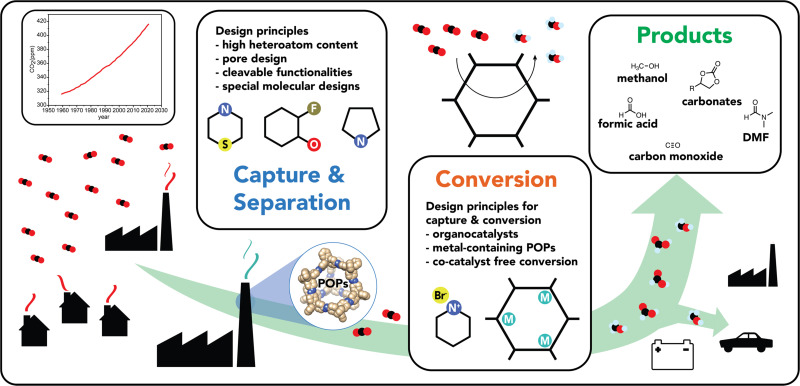
Porous organic polymers (POPs) have long been considered as prime candidates for carbon dioxide (CO) capture, separation, and conversion. Especially their permanent porosity, structural tunability, stability and relatively low cost are key factors in such considerations. Whereas heteratom-rich microporous networks as well as their amine impregnation/functionalization have been actively exploited to boost the CO affinity of POPs, recently, the focus has shifted to engineering the pore environment, resulting in a new generation of highly microporous POPs rich in heteroatoms and featuring abundant catalytic sites for the capture and conversion of CO into value-added products. In this review, we aim to provide key insights into structure-property relationships governing the separation, capture and conversion of CO using POPs and highlight recent advances in the field.
多孔有机聚合物(POPs)长期以来一直被认为是二氧化碳(CO)捕获、分离和转化的首选材料。它们的永久孔隙率、结构可调性、稳定性和相对较低的成本是这些考虑的关键因素。富杂原子的微孔网络以及它们的胺浸渍/功能化已经被积极地开发,以提高 POPs 对 CO 的亲和力,最近,人们的注意力转向了工程化孔环境,从而产生了新一代富含杂原子且具有丰富催化位点的高度微孔 POPs,用于捕获和转化 CO 成高附加值产品。在这篇综述中,我们旨在提供关于使用 POPs 分离、捕获和转化 CO 的结构-性能关系的关键见解,并强调该领域的最新进展。