Catholic High-Performance Cell Therapy Center & Department of Medical Life Science, College of Medicine, The Catholic University of Korea, Seoul, Korea.
Department of Oral Anatomy, Dental Research Institute & School of Dentistry, Seoul National University, Seoul, Korea.
Exp Mol Med. 2022 Nov;54(11):1955-1966. doi: 10.1038/s12276-022-00880-3. Epub 2022 Nov 14.
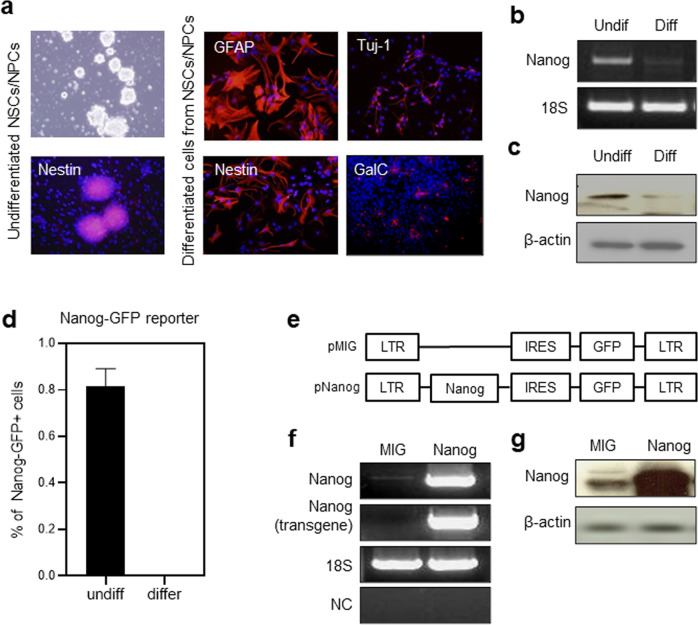
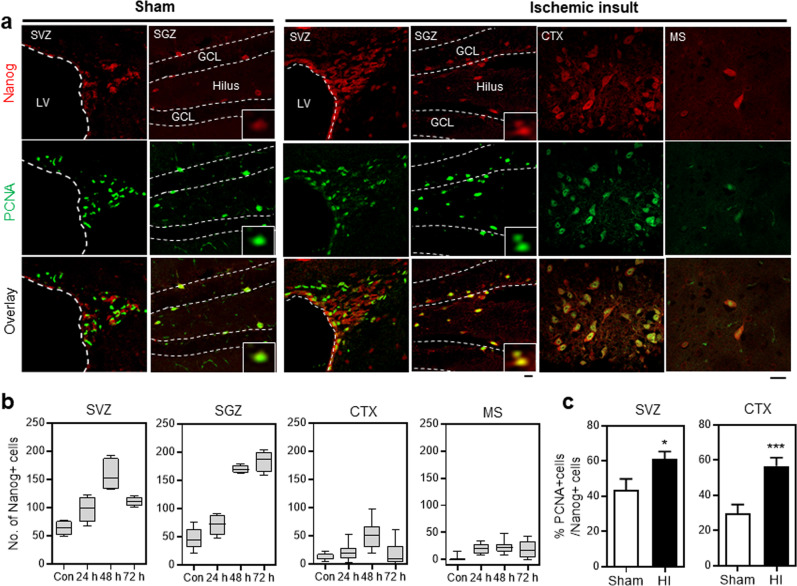
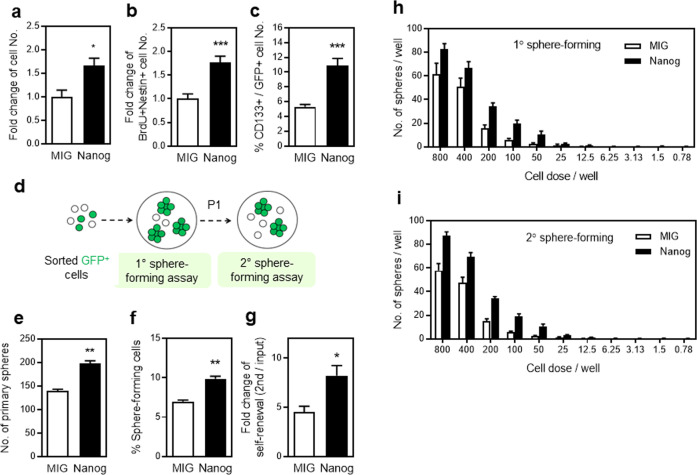
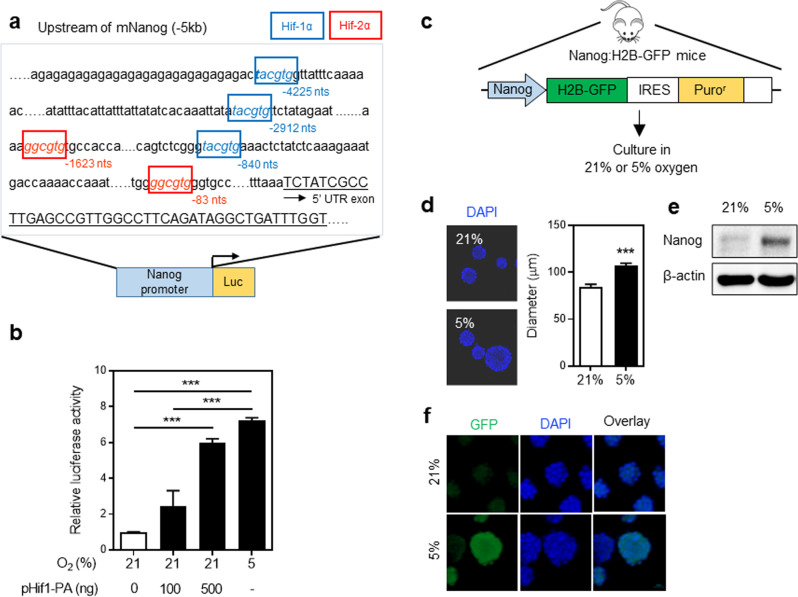
NANOG plays a key role in cellular plasticity and the acquisition of the stem cell state during reprogramming, but its role in the regenerative process remains unclear. Here, we show that the induction of NANOG in neuronal cells is necessary for the physiological initiation of neuronal regeneration in response to ischemic stress. Specifically, we found that NANOG was preferentially expressed in undifferentiated neuronal cells, and forced expression of Nanog in neural progenitor cells (NPCs) promoted their self-renewing expansion both in ex-vivo slice cultures and in vitro limiting dilution analysis. Notably, the upstream region of the Nanog gene contains sequence motifs for hypoxia-inducible factor-1 alpha (HIF-1α). Therefore, cerebral neurons exposed to hypoxia significantly upregulated NANOG expression selectively in primitive (CD133) cells, but not in mature cells, leading to the expansion of NPCs. Notably, up to 80% of the neuronal expansion induced by hypoxia was attributed to NANOG-expressing neuronal cells, whereas knockdown during hypoxia abolished this expansion and was accompanied by the downregulation of other pluripotency-related genes. Moreover, the number of NANOG-expressing neuronal cells were transiently increased in response to ischemic insult, predominantly in the infarct area of brain regions undergoing neurogenesis, but not in non-neurogenic loci. Together, these findings reveal a functional effect of NANOG-induction for the initiation of adaptive neuronal regeneration among heterogeneous NPC subsets, pointing to cellular plasticity as a potential link between regeneration and reprogramming processes.
NANOG 在细胞可塑性和重编程过程中获得干细胞状态方面发挥着关键作用,但它在再生过程中的作用尚不清楚。在这里,我们表明,在神经元细胞中诱导 NANOG 的表达对于响应缺血应激而进行的生理性神经元再生的起始是必需的。具体而言,我们发现 NANOG 在未分化的神经元细胞中优先表达,并且在神经祖细胞(NPC)中强制表达 Nanog 促进了它们在体外切片培养和体外有限稀释分析中的自我更新扩展。值得注意的是,Nanog 基因的上游区域包含缺氧诱导因子-1α(HIF-1α)的序列基序。因此,暴露于缺氧的大脑神经元选择性地在原始(CD133)细胞中显著上调 NANOG 的表达,但在成熟细胞中没有上调,导致 NPC 的扩增。值得注意的是,高达 80%的由缺氧诱导的神经元扩增归因于表达 NANOG 的神经元细胞,而在缺氧期间进行的敲低则消除了这种扩增,并且伴随着其他多能性相关基因的下调。此外,在受到缺血性损伤后,NANOG 表达的神经元细胞的数量会短暂增加,主要集中在经历神经发生的脑区的梗塞区,但不在非神经发生部位。总之,这些发现揭示了 NANOG 诱导对异质 NPC 亚群中适应性神经元再生的起始的功能影响,表明细胞可塑性是再生和重编程过程之间的潜在联系。