Nanomedicine Lab, Faculty of Biology, Medicine and Health, The University of Manchester, Manchester, UK.
Division of Cell Matrix Biology & Regenerative Medicine, Faculty of Biology, Medicine and Health, The University of Manchester, Manchester, UK.
EMBO Mol Med. 2017 Jun;9(6):733-736. doi: 10.15252/emmm.201707650.
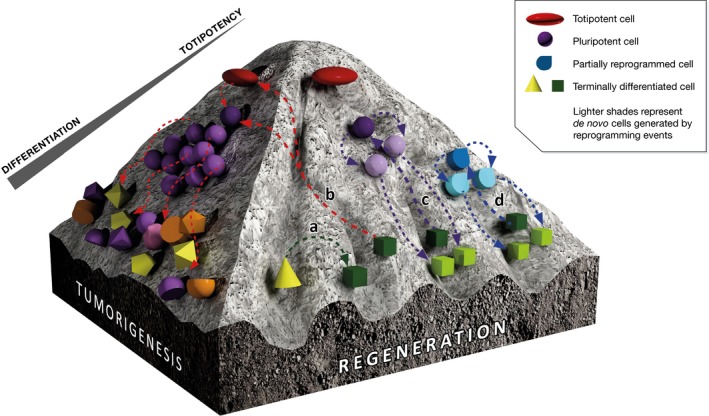
Reprogramming adult, fully differentiated cells to pluripotency via , , and (OSKM) overexpression has proved feasible in various independent studies and could be used to induce tissue regeneration owing to the proliferative capacity and differentiation potential of the reprogrammed cells. However, a number of these reports have described the generation of teratomas caused by sustained reprogramming, which precludes the therapeutic translation of this technology. A recent study by the Izpisúa-Belmonte laboratory described a cyclic regime for short-term OSKM expression that prevents complete reprogramming to the pluripotent state as well as tumorigenesis. We comment here on this and other studies that provide evidence that OSKM induction can enhance tissue regeneration, while avoiding the feared formation of teratomas. These results could inspire more research to explore the potential of reprogramming in regenerative medicine.
通过,, 和 (OSKM) 的过表达将成人完全分化的细胞重编程为多能性已在多项独立研究中得到证实,并且由于重编程细胞的增殖能力和分化潜能,可用于诱导组织再生。然而,这些报告中的一些描述了持续重编程引起的畸胎瘤的产生,这排除了该技术的治疗转化。Izpisúa-Belmonte 实验室的一项最近研究描述了一种用于短期 OSKM 表达的循环方案,该方案可防止完全重编程为多能状态以及肿瘤发生。我们在此对这一研究以及其他提供证据表明 OSKM 诱导可以增强组织再生,同时避免形成令人恐惧的畸胎瘤的研究进行了评论。这些结果可能会激发更多的研究来探索 重编程在再生医学中的潜力。