GGZ inGeest Specialized Mental Health Care, Old Age Psychiatry, Amsterdam, The Netherlands.
Amsterdam UMC location Vrije Universiteit Amsterdam, Psychiatry, Amsterdam, The Netherlands.
Bipolar Disord. 2023 Feb;25(1):43-55. doi: 10.1111/bdi.13271. Epub 2022 Nov 23.
The distinction between bipolar I disorder (BD-I) and bipolar II disorder (BD-II) has been a topic of long-lasting debate. This study examined differences between BD-I and BD-II in a large, global sample of OABD, focusing on general functioning, cognition and somatic burden as these domains are often affected in OABD.
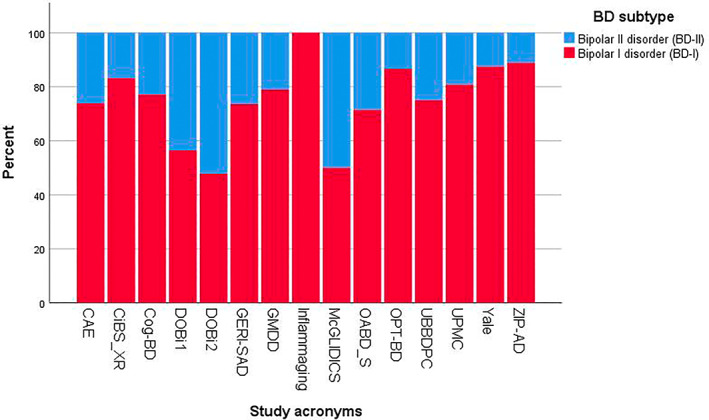
Cross-sectional analyses were conducted with data from the Global Aging and Geriatric Experiments in Bipolar Disorder (GAGE-BD) database. The sample included 963 participants aged ≥50 years (714 BD-I, 249 BD-II). Sociodemographic and clinical factors were compared between BD subtypes including adjustment for study cohort. Multivariable analyses were conducted with generalized linear mixed models (GLMMs) and estimated associations between BD subtype and (1) general functioning (GAF), (2) cognitive performance (g-score) and (3) somatic burden, with study cohort as random intercept.
After adjustment for study cohort, BD-II patients more often had a late onset ≥50 years (p = 0.008) and more current severe depression (p = 0.041). BD-I patients were more likely to have a history of psychiatric hospitalization (p < 0.001) and current use of anti-psychotics (p = 0.003). Multivariable analyses showed that BD subtype was not related to GAF, cognitive g-score or somatic burden.
BD-I and BD-II patients did not differ in terms of general functioning, cognitive impairment or somatic burden. Some clinical differences were observed between the groups, which could be the consequence of diagnostic definitions. The distinction between BD-I and BD-II is not the best way to subtype OABD patients. Future research should investigate other disease specifiers in this population.
双相情感障碍 I 型(BD-I)和双相情感障碍 II 型(BD-II)之间的区别一直是一个长期存在的争议话题。本研究在一个大型的、全球性的 OABD 样本中,考察了 BD-I 和 BD-II 之间的差异,重点关注这些领域在 OABD 中经常受到影响的一般功能、认知和躯体负担。
使用来自全球老龄化和双相情感障碍实验(GAGE-BD)数据库的数据进行横断面分析。该样本包括 963 名年龄≥50 岁的参与者(714 名 BD-I,249 名 BD-II)。比较了 BD 亚型之间的社会人口统计学和临床因素,包括对研究队列的调整。使用广义线性混合模型(GLMM)进行多变量分析,并估计了 BD 亚型与(1)一般功能(GAF)、(2)认知表现(g 评分)和(3)躯体负担之间的关联,以研究队列为随机截距。
调整研究队列后,BD-II 患者更常出现晚发性(≥50 岁)(p=0.008)和当前重度抑郁(p=0.041)。BD-I 患者更有可能有精神科住院史(p<0.001)和当前使用抗精神病药物(p=0.003)。多变量分析显示,BD 亚型与 GAF、认知 g 评分或躯体负担无关。
BD-I 和 BD-II 患者在一般功能、认知障碍或躯体负担方面没有差异。两组之间观察到一些临床差异,这可能是诊断定义的结果。BD-I 和 BD-II 的区别不是对 OABD 患者进行亚型分类的最佳方法。未来的研究应该在这一人群中研究其他疾病特征。