Department of Mental Health, University Regional Hospital of Málaga, Institute of Biomedicine of Málaga (IBIMA), Málaga, Spain.
Department of Genetic Epidemiology in Psychiatry, Central Institute of Mental Health, Medical Faculty Mannheim, Heidelberg University, Mannheim, Germany.
Transl Psychiatry. 2021 Jan 11;11(1):31. doi: 10.1038/s41398-020-01146-0.
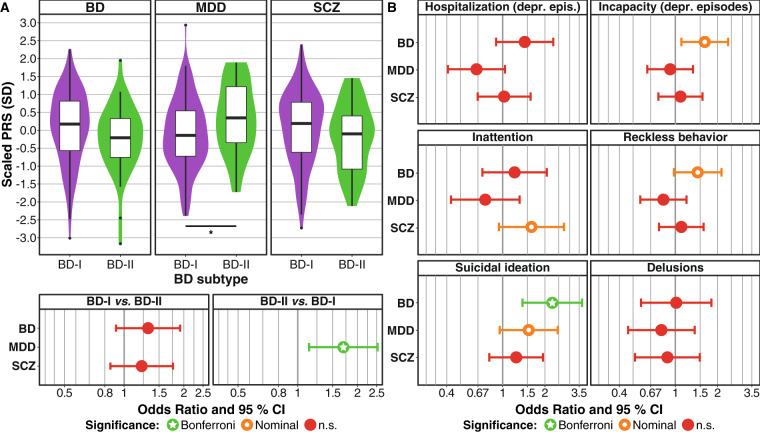
The two major subtypes of bipolar disorder (BD), BD-I and BD-II, are distinguished based on the presence of manic or hypomanic episodes. Historically, BD-II was perceived as a less severe form of BD-I. Recent research has challenged this concept of a severity continuum. Studies in large samples of unrelated patients have described clinical and genetic differences between the subtypes. Besides an increased schizophrenia polygenic risk load in BD-I, these studies also observed an increased depression risk load in BD-II patients. The present study assessed whether such clinical and genetic differences are also found in BD patients from multiplex families, which exhibit reduced genetic and environmental heterogeneity. Comparing 252 BD-I and 75 BD-II patients from the Andalusian Bipolar Family (ABiF) study, the clinical course, symptoms during depressive and manic episodes, and psychiatric comorbidities were analyzed. Furthermore, polygenic risk scores (PRS) for BD, schizophrenia, and depression were assessed. BD-I patients not only suffered from more severe symptoms during manic episodes but also more frequently showed incapacity during depressive episodes. A higher BD PRS was significantly associated with suicidal ideation. Moreover, BD-I cases exhibited lower depression PRS. In line with a severity continuum from BD-II to BD-I, our results link BD-I to a more pronounced clinical presentation in both mania and depression and indicate that the polygenic risk load of BD predisposes to more severe disorder characteristics. Nevertheless, our results suggest that the genetic risk burden for depression also shapes disorder presentation and increases the likelihood of BD-II subtype development.
双相情感障碍 (BD) 的两个主要亚型,BD-I 和 BD-II,是基于躁狂或轻躁狂发作的存在来区分的。历史上,BD-II 被认为是 BD-I 较轻的一种形式。最近的研究挑战了这种严重程度连续体的概念。对大量无关联患者样本的研究描述了亚型之间的临床和遗传差异。除了 BD-I 中精神分裂症多基因风险负荷增加外,这些研究还观察到 BD-II 患者的抑郁风险负荷增加。本研究评估了在具有遗传和环境异质性降低的多基因家族性 BD 患者中是否也存在这些临床和遗传差异。在来自安达卢西亚双相情感障碍家族(ABiF)研究的 252 名 BD-I 和 75 名 BD-II 患者中比较了临床病程、抑郁和躁狂发作期间的症状以及精神共病情况。此外,还评估了 BD、精神分裂症和抑郁的多基因风险评分(PRS)。BD-I 患者不仅在躁狂发作期间症状更严重,而且在抑郁发作期间更频繁地出现能力丧失。较高的 BD PRS 与自杀意念显著相关。此外,BD-I 病例的抑郁 PRS 较低。与从 BD-II 到 BD-I 的严重程度连续体一致,我们的结果将 BD-I 与躁狂和抑郁发作中更明显的临床表现联系起来,并表明 BD 的多基因风险负荷导致更严重的疾病特征。然而,我们的结果表明,抑郁的遗传风险负担也会影响疾病表现,并增加 BD-II 亚型发展的可能性。