Department of Psychology, Emory University, Atlanta, Georgia, United States of America.
PLoS One. 2022 Nov 15;17(11):e0276897. doi: 10.1371/journal.pone.0276897. eCollection 2022.
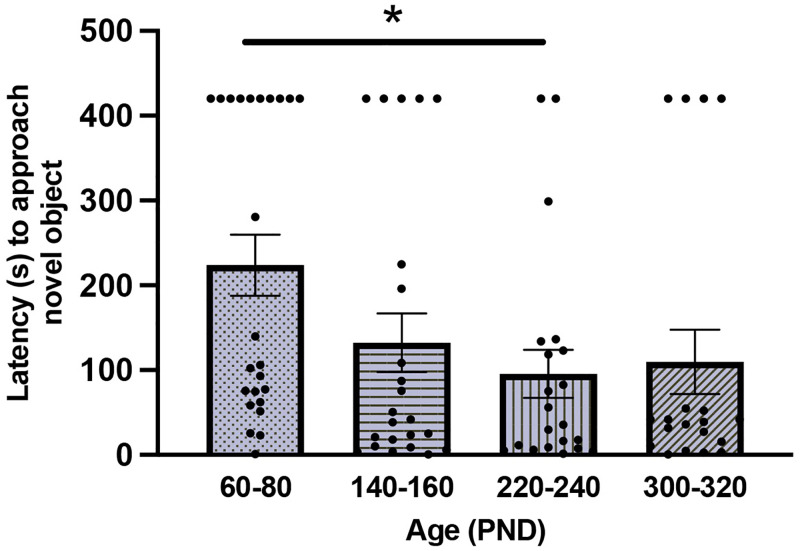
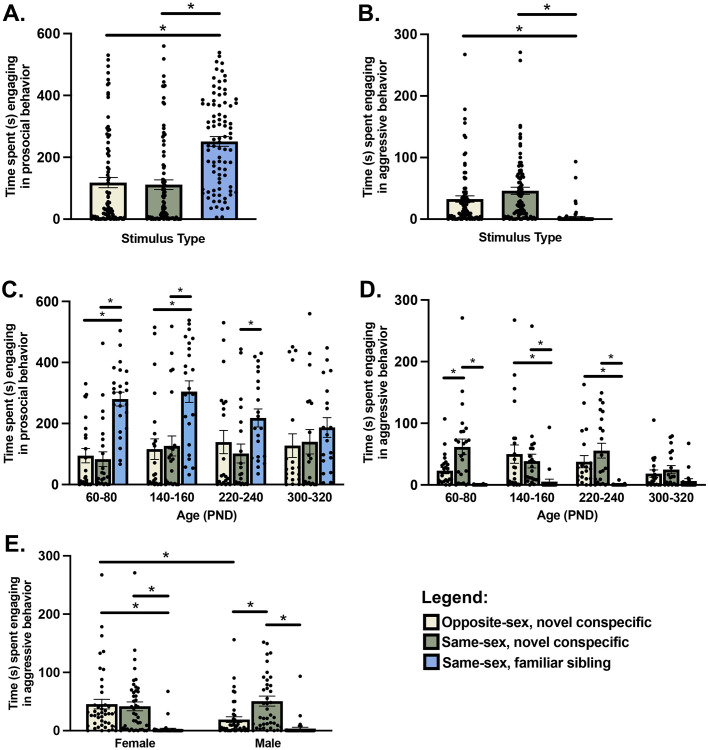
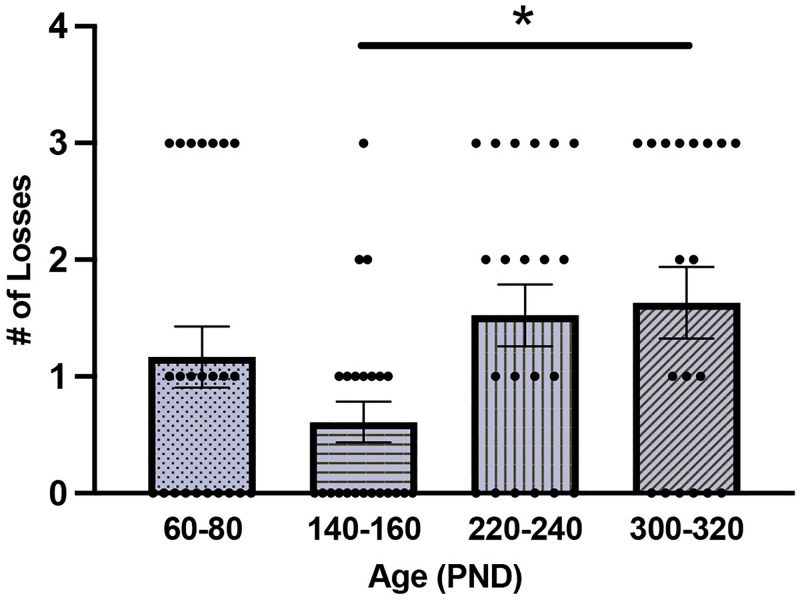
Several studies using mice have examined the effects of aging on cognitive tasks, as well as sensory and motor functions. However, few studies have examined the influence of aging on social behavior. Prairie voles (Microtus ochrogaster) are a socially monogamous and biparental rodent that live in small family groups and are now among the most popular rodent models for studies examining social behavior. Although the social behavioral trajectories of early-life development in prairie voles have been well-studied, how social behavior may change throughout adulthood remains unknown. Here we examined behavior in virgin male and female prairie voles in four different age groups: postnatal day (PND) 60-80, 140-160, 220-240, and 300-320. All animals underwent testing in a novel object task, a dominance test, a resident-intruder test, and several iterations of social approach and social interaction tests with varying types of social stimuli (i.e., novel same-sex conspecific, novel opposite-sex conspecific, familiar same-sex sibling/cagemate, small group of novel same-sex conspecifics). We found that age influenced neophobia and dominance, but not social approach behavior. Further, we found that young adult, but not older adult, prairie voles adapt prosocial and aggressive behavior relative to social context, and that selective aggression occurs in relation to age even in the absence of a pair bond. Our results suggest that prairie voles calibrate social phenotype in a context-dependent manner in young adulthood and stop adjusting behavior to social context in advanced age, demonstrating that social behavior is plastic not only throughout early development, but also well into adulthood. Together, this study provides insight into age-related changes in social behavior in prairie voles and shows that prairie voles may be a viable model for studying the cognitive and physiological benefits of social relationships and social engagement in advanced age.
几项使用老鼠的研究考察了衰老对认知任务以及感觉和运动功能的影响。然而,很少有研究考察衰老对社会行为的影响。草原田鼠(Microtus ochrogaster)是一种社会性一夫一妻制和双亲制的啮齿动物,生活在小家庭群体中,现在是研究社会行为最受欢迎的啮齿动物模型之一。尽管草原田鼠早期生命发展的社会行为轨迹已经得到了很好的研究,但社会行为在整个成年期如何变化仍然未知。在这里,我们检查了四个不同年龄组的 virgin 雄性和雌性草原田鼠的行为:产后第 60-80 天、140-160 天、220-240 天和 300-320 天。所有动物都在一个新物体任务、一个优势测试、一个居住者入侵者测试以及几个具有不同类型社会刺激(即新的同性同种、新的异性同种、熟悉的同性同种兄弟姐妹/笼伴侣、新的同性同种小群体)的社交接近和社交互动测试中进行了测试。我们发现年龄会影响新恐惧症和优势,但不会影响社交接近行为。此外,我们发现年轻的成年草原田鼠,但不是老年成年草原田鼠,会根据社会环境调整亲社会和攻击行为,并且即使没有伴侣关系,选择性攻击也会随着年龄的增长而发生。我们的结果表明,草原田鼠在年轻成年期以依赖于情境的方式校准社会表型,并且在老年期停止根据社会情境调整行为,这表明社会行为不仅在早期发育过程中具有可塑性,而且在成年期也具有可塑性。总之,这项研究提供了对草原田鼠社会行为与年龄相关变化的深入了解,并表明草原田鼠可能是研究社会关系和社会参与在老年期认知和生理益处的可行模型。