Division of Maternal Fetal Medicine, Department of Obstetrics and Gynecology, David Geffen School of Medicine at UCLA, Los Angeles, California, United States of America.
Dalton Bioanalytics Inc., Los Angeles, California, United States of America.
PLoS One. 2022 Nov 16;17(11):e0276766. doi: 10.1371/journal.pone.0276766. eCollection 2022.
Pregnancies complicated by Coronavirus Disease 2019 (COVID-19) are at an increased risk of severe morbidity due to physiologic changes in immunologic, cardiovascular, and respiratory function. There is little is known about how severity of COVID-19 changes protein and metabolite expression in pregnancy.
This study aims to investigate the pathophysiology behind various clinical trajectories in pregnant patients diagnosed with COVID-19 using multi-omics profiling.
This is a prospective cohort study of 30 pregnant patients at a single tertiary care center. Participants were categorized by severity of COVID-19 disease (control, asymptomatic, mild/moderate, or severe). Maternal serum samples underwent LC-MS-based multiomics analysis for profiling of proteins, lipids, electrolytes, and metabolites. Linear regression models were used to assess how disease severity related to analyte levels. Reactome pathway enrichment analysis was conducted on differential analytes.
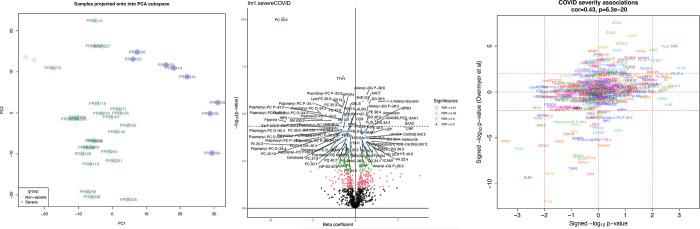
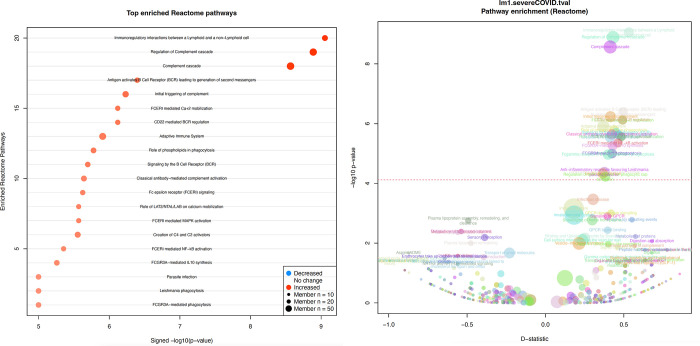
Of 30 participants, 25 had confirmed diagnosis of COVID-19 (6 asymptomatic (one post-infection), 13 mild/moderate (all post-infection), 6 severe), and 5 participants were controls. Severe COVID-19 was associated with distinct profiles demonstrating significant proteomic and lipidomic signatures which were enriched for annotations related to complement and antibody activity. (FDR < 0.05). Downregulated analytes were not significantly enriched but consisted of annotation terms related to lipoprotein activity (FDR > 0.2). Post-infection mild/moderate COVID-19 did not have significantly altered serum protein, metabolite, or lipid metabolite levels compared to controls.
Pregnancies with severe COVID-19 demonstrate greater inflammation and complement activation and dysregulation of serum lipids. This altered multiomic expression provides insight into the pathophysiology of severe COVID-19 in pregnancy and may serve as potential indicators for adverse pregnancy outcomes.
由于免疫、心血管和呼吸功能的生理变化,COVID-19 合并妊娠的严重发病率增加。关于 COVID-19 严重程度如何改变妊娠蛋白和代谢物表达,知之甚少。
本研究旨在通过多组学分析研究诊断为 COVID-19 的妊娠患者各种临床轨迹背后的病理生理学。
这是一项对单家三级保健中心的 30 名妊娠患者的前瞻性队列研究。根据 COVID-19 疾病的严重程度(对照、无症状、轻度/中度或重度)对参与者进行分类。对母体血清样本进行基于 LC-MS 的多组学分析,以对蛋白质、脂质、电解质和代谢物进行分析。线性回归模型用于评估疾病严重程度与分析物水平的关系。对差异分析物进行 Reactome 途径富集分析。
30 名参与者中,25 名确诊 COVID-19(6 名无症状(1 名感染后),13 名轻度/中度(均感染后),6 名重度),5 名参与者为对照组。重度 COVID-19 具有独特的特征,表现出显著的蛋白质组学和脂质组学特征,这些特征与补体和抗体活性的注释相关。(FDR < 0.05)。下调的分析物没有显著富集,但包含与脂蛋白活性相关的注释术语(FDR > 0.2)。与对照组相比,感染后轻度/中度 COVID-19 的血清蛋白、代谢物或脂质代谢物水平没有明显改变。
严重 COVID-19 妊娠表现出更高的炎症和补体激活以及血清脂质失调。这种改变的多组学表达为妊娠严重 COVID-19 的病理生理学提供了深入了解,并可能成为不良妊娠结局的潜在指标。