Khesali Aghtaei Hoda, Püttker Sebastian, Maus Irena, Heyer Robert, Huang Liren, Sczyrba Alexander, Reichl Udo, Benndorf Dirk
Bioprocess Engineering, Max Planck Institute for Dynamics of Complex Technical Systems, Sandtorstraße 1, 39106, Magdeburg, Germany.
Bioprocess Engineering, Otto Von Guericke University Magdeburg, Universitätsplatz 2, 39106, Magdeburg, Germany.
Biotechnol Biofuels Bioprod. 2022 Nov 16;15(1):125. doi: 10.1186/s13068-022-02207-w.
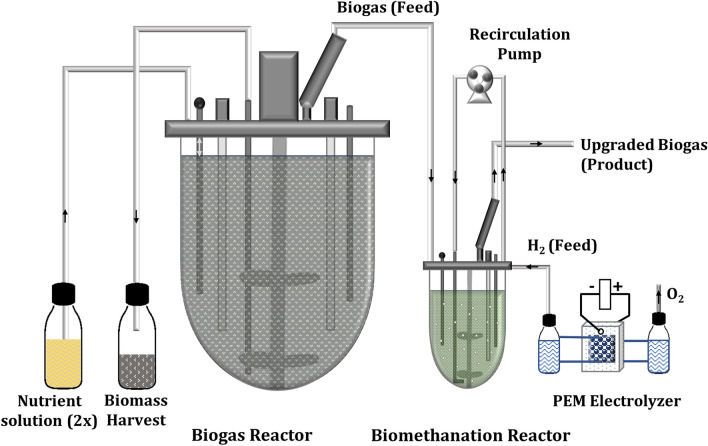
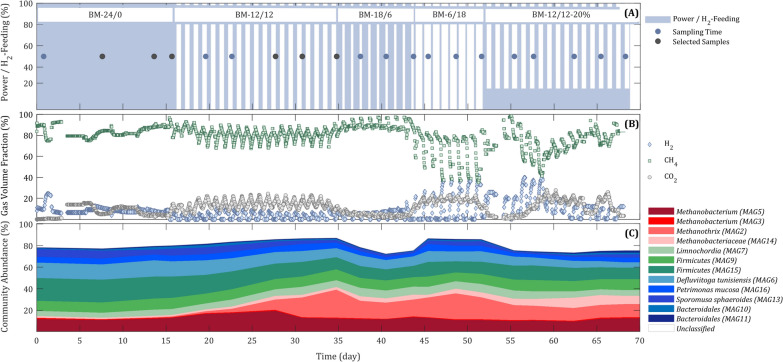
Biological conversion of the surplus of renewable electricity and carbon dioxide (CO) from biogas plants to biomethane (CH) could support energy storage and strengthen the power grid. Biological methanation (BM) is linked closely to the activity of biogas-producing Bacteria and methanogenic Archaea. During reactor operations, the microbiome is often subject to various changes, e.g., substrate limitation or pH-shifts, whereby the microorganisms are challenged to adapt to the new conditions. In this study, various process parameters including pH value, CH production rate, conversion yields and final gas composition were monitored for a hydrogenotrophic-adapted microbial community cultivated in a laboratory-scale BM reactor. To investigate the robustness of the BM process regarding power oscillations, the biogas microbiome was exposed to five hydrogen (H)-feeding regimes lasting several days.
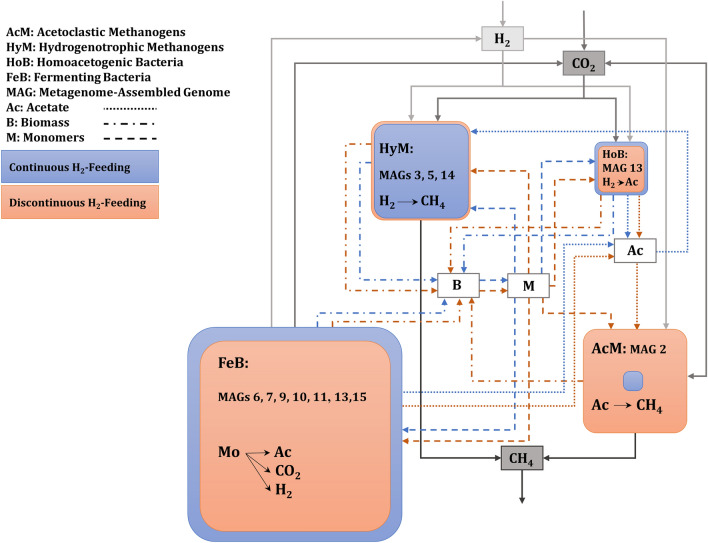
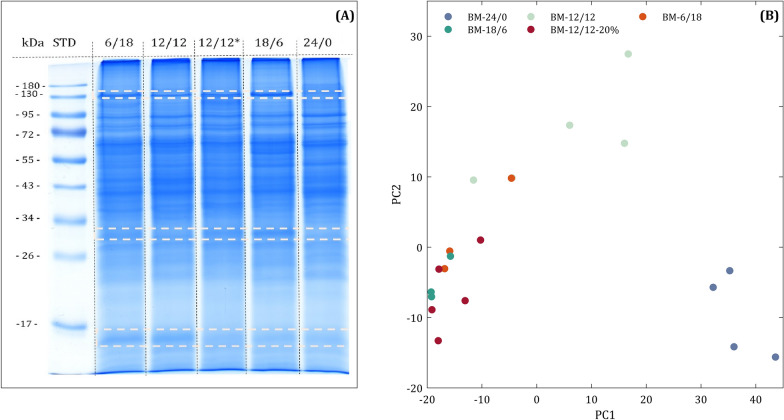
Applying various "on-off" H-feeding regimes, the CH production rate recovered quickly, demonstrating a significant resilience of the microbial community. Analyses of the taxonomic composition of the microbiome revealed a high abundance of the bacterial phyla Firmicutes, Bacteroidota and Thermotogota followed by hydrogenotrophic Archaea of the phylum Methanobacteriota. Homo-acetogenic and heterotrophic fermenting Bacteria formed a complex food web with methanogens. The abundance of the methanogenic Archaea roughly doubled during discontinuous H-feeding, which was related mainly to an increase in acetoclastic Methanothrix species. Results also suggested that Bacteria feeding on methanogens could reduce overall CH production. On the other hand, using inactive biomass as a substrate could support the growth of methanogenic Archaea. During the BM process, the additional production of H by fermenting Bacteria seemed to support the maintenance of hydrogenotrophic methanogens at non-H-feeding phases. Besides the elusive role of Methanothrix during the H-feeding phases, acetate consumption and pH maintenance at the non-feeding phase can be assigned to this species.
Taken together, the high adaptive potential of microbial communities contributes to the robustness of BM processes during discontinuous H-feeding and supports the commercial use of BM processes for energy storage. Discontinuous feeding strategies could be used to enrich methanogenic Archaea during the establishment of a microbial community for BM. Both findings could contribute to design and improve BM processes from lab to pilot scale.
将沼气厂多余的可再生电力和二氧化碳(CO₂)生物转化为生物甲烷(CH₄)有助于能量存储并加强电网。生物甲烷化(BM)与产沼气细菌和产甲烷古菌的活性密切相关。在反应器运行期间,微生物群落经常会发生各种变化,例如底物限制或pH值变化,微生物需要应对这些变化以适应新条件。在本研究中,对在实验室规模的BM反应器中培养的适应氢营养的微生物群落监测了各种工艺参数,包括pH值、CH₄产率、转化率和最终气体组成。为了研究BM过程对功率振荡的稳健性,将沼气微生物群落暴露于五种持续数天的氢气(H₂)进料模式下。
应用各种“开-关”式H₂进料模式时,CH₄产率迅速恢复,表明微生物群落具有显著的恢复力。对微生物群落分类组成的分析显示,厚壁菌门、拟杆菌门和栖热袍菌门细菌丰度很高,其次是甲烷杆菌门的氢营养古菌。同型产乙酸菌和异养发酵细菌与产甲烷菌形成了复杂的食物网。在间歇性H₂进料期间,产甲烷古菌的丰度大约增加了一倍,这主要与乙酸裂解型的甲烷鬃菌属物种增加有关。结果还表明,以产甲烷菌为食的细菌会降低整体CH₄产量。另一方面,使用无活性生物质作为底物可以支持产甲烷古菌的生长。在BM过程中,发酵细菌额外产生的H₂似乎有助于在非H₂进料阶段维持氢营养型产甲烷菌。除了甲烷鬃菌在H₂进料阶段难以捉摸的作用外,非进料阶段的乙酸消耗和pH值维持可归因于该物种。
综上所述,微生物群落的高适应潜力有助于BM过程在间歇性H₂进料期间的稳健性,并支持BM过程用于能量存储的商业应用。在为BM建立微生物群落的过程中,间歇性进料策略可用于富集产甲烷古菌。这两个发现都有助于从实验室规模到中试规模设计和改进BM过程。