National Data Management Center for Health, Ethiopian Public Health Institute, Addis Ababa, Ethiopia.
School of Public Health, Faculty of Health Sciences, Curtin University, Kent St, Bentley, WA, 6102, Australia.
Sci Rep. 2022 Nov 16;12(1):19722. doi: 10.1038/s41598-022-24024-9.
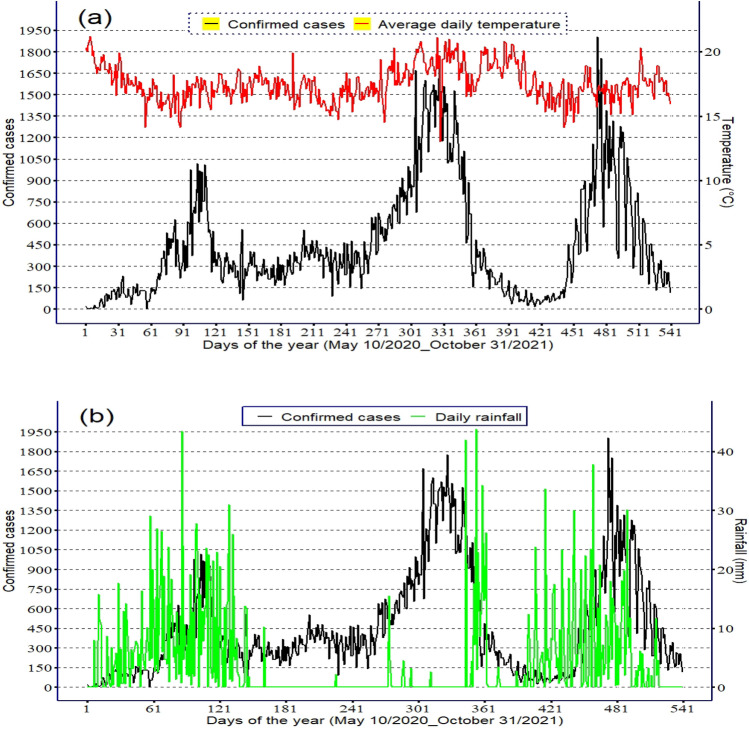
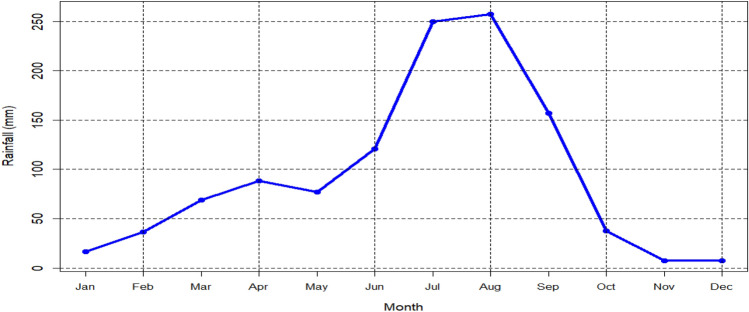
Climatic conditions play a key role in the transmission and pathophysiology of respiratory tract infections, either directly or indirectly. However, their impact on the COVID-19 pandemic propagation is yet to be studied. This study aimed to evaluate the effects of climatic factors such as temperature, rainfall, relative humidity, sunshine duration, and wind speed on the number of daily COVID-19 cases in Addis Ababa, Ethiopia. Data on confirmed COVID-19 cases were obtained from the National Data Management Center at the Ethiopian Public Health Institute for the period 10th March 2020 to 31st October 2021. Data for climatic factors were obtained from the Ethiopia National Meteorology Agency. The correlation between daily confirmed COVID-19 cases and climatic factors was measured using the Spearman rank correlation test. The log-link negative binomial regression model was used to fit the effect of climatic factors on COVID-19 transmission, from lag 0 to lag 14 days. During the study period, a total of 245,101 COVID-19 cases were recorded in Addis Ababa, with a median of 337 new cases per day and a maximum of 1903 instances per day. A significant correlation between COVID-19 cases and humidity was observed with a 1% increase in relative humidity associated with a 1.1% [IRRs (95%CI) 0.989, 95% (0.97-0.99)] and 1.2% [IRRs (95%CI) 0.988, (0.97-0.99)] decrease in COVID-19 cases for 4 and 5 lag days prior to detection, respectively. The highest increase in the effect of wind speed and rainfall on COVID-19 was observed at 14 lag days prior to detection with IRRs of 1.85 (95%CI 1.26-2.74) and 1.078 (95%CI 1.04-1.12), respectively. The lowest IRR was 1.109 (95%CI 0.93-1.31) and 1.007 (95%CI 0.99-1.02) both in lag 0, respectively. The findings revealed that none of the climatic variables influenced the number of COVID-19 cases on the day of case detection (lag 0), and that daily average temperature and sunshine duration were not significantly linked with COVID-19 risk across the full lag period (p > 0.05). Climatic factors such as humidity, rainfall, and wind speed influence the transmission of COVID-19 in Addis Ababa, Ethiopia. COVID-19 cases have shown seasonal variations with the highest number of cases reported during the rainy season and the lowest number of cases reported during the dry season. These findings suggest the need to design strategies for the prevention and control of COVID-19 before the rainy seasons.
气候条件在呼吸道感染的传播和病理生理学中起着关键作用,无论是直接的还是间接的。然而,它们对 COVID-19 大流行传播的影响尚未得到研究。本研究旨在评估温度、降雨量、相对湿度、日照时间和风速等气候因素对埃塞俄比亚亚的斯亚贝巴每日 COVID-19 病例数的影响。COVID-19 确诊病例数据来自埃塞俄比亚公共卫生研究所国家数据管理中心,时间为 2020 年 3 月 10 日至 2021 年 10 月 31 日。气候因素数据来自埃塞俄比亚国家气象局。使用 Spearman 等级相关检验测量每日确诊 COVID-19 病例与气候因素之间的相关性。使用滞后 0 至滞后 14 天的对数链接负二项回归模型拟合气候因素对 COVID-19 传播的影响。在研究期间,亚的斯亚贝巴共记录了 245101 例 COVID-19 病例,中位数为每天 337 例新病例,最高每天 1903 例。COVID-19 病例与湿度之间存在显著相关性,相对湿度每增加 1%,COVID-19 病例分别减少 1.1%[IRRs(95%CI)0.989,95%(0.97-0.99)]和 1.2%[IRRs(95%CI)0.988,(0.97-0.99)],分别为 4 和 5 天前的检测。在检测前 14 天,风速和降雨量对 COVID-19 的影响最大,IRR 分别为 1.85(95%CI 1.26-2.74)和 1.078(95%CI 1.04-1.12)。滞后 0 时的最低 IRR 分别为 1.109(95%CI 0.93-1.31)和 1.007(95%CI 0.99-1.02)。发现没有气候变量影响检测日(滞后 0)COVID-19 病例的数量,日平均温度和日照时间与整个滞后期(p > 0.05)的 COVID-19 风险无显著关联。湿度、降雨和风速等气候因素影响 COVID-19 在埃塞俄比亚亚的斯亚贝巴的传播。COVID-19 病例显示出季节性变化,雨季报告的病例最多,旱季报告的病例最少。这些发现表明需要在雨季前制定 COVID-19 的预防和控制策略。