Bielinski Laura Luisa, Bur Oliver Thomas, Wälchli Gwendolyn, Suter Jeannine Michelle, Walsh Nathalie, Kley Marijke Amanda, Krieger Tobias, Berger Thomas
Department of Clinical Psychology and Psychotherapy, University of Bern, Fabrikstrasse 8, 3012 Bern, Switzerland.
Internet Interv. 2022 Nov 10;30:100586. doi: 10.1016/j.invent.2022.100586. eCollection 2022 Dec.
The combination of internet-based intervention and psychotherapy, commonly termed blended therapy (BT), has gained popularity in recent years. While advantages and disadvantages of BT have been identified from the patient and therapist perspective, the two perspectives have rarely been examined within the same treatment. Moreover, almost all available research on patient and therapist experiences with BT is disorder-specific. This study aimed to investigate patient and therapist experiences within the same transdiagnostic BT.
A qualitative analysis of semi-structured interviews with eight patients and eight therapists taking part in a transdiagnostic blended intervention focusing on the topic of emotion regulation was conducted. A qualitative content analysis approach was used. Category frequencies were calculated and similarities and differences between the patient and therapist experience were explored.
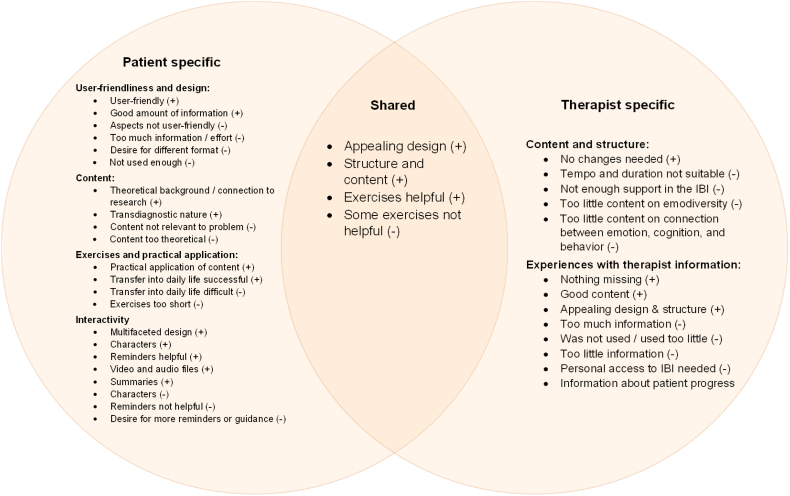
Ten main themes and 59 subthemes were identified in the category system for patient interviews and ten main themes and 50 subthemes were identified in the category system for therapist interviews. Similarities and differences between the two perspectives were reported with regard to 1) expectations toward the intervention, 2) the internet-based intervention, 3) symptomatology and emotion regulation, 4) the therapeutic relationship and 5) the blended format.
This study provides first insights on the experiences with transdiagnostic BT focusing on emotion regulation. Based on the results, different recommendations for the improvement of transdiagnostic BT are made. Future research on patient and therapist experiences with transdiagnostic BT is necessary, in order to further improve the experience of those involved.
基于互联网的干预与心理治疗相结合,通常称为混合疗法(BT),近年来越来越受欢迎。虽然已经从患者和治疗师的角度确定了BT的优缺点,但很少在同一治疗中对这两个角度进行研究。此外,几乎所有关于患者和治疗师对BT体验的现有研究都是针对特定疾病的。本研究旨在调查在同一跨诊断BT中患者和治疗师的体验。
对八名患者和八名治疗师进行了半结构化访谈的定性分析,他们参与了一项以情绪调节为主题的跨诊断混合干预。采用定性内容分析方法。计算类别频率,并探讨患者和治疗师体验之间的异同。
在患者访谈的类别系统中确定了10个主要主题和59个子主题,在治疗师访谈的类别系统中确定了10个主要主题和50个子主题。报告了两个角度在以下方面的异同:1)对干预的期望,2)基于互联网的干预,3)症状学和情绪调节,4)治疗关系,5)混合形式。
本研究首次提供了关于以情绪调节为重点的跨诊断BT体验的见解。根据研究结果,提出了改进跨诊断BT的不同建议。有必要对患者和治疗师在跨诊断BT方面的体验进行进一步研究,以进一步改善相关人员的体验。