Wan Mingyu, Ding Yongfeng, Mao Chenyu, Ma Xiaolu, Li Ning, Xiao Cheng, Qian Jiong, Jiang Haiping, Zheng Yulong, Wu Luntao, Teng Lisong, Xu Nong
Department of Medical Oncology, The First Affiliated Hospital of Zhejiang University, Hangzhou, China.
Department of Surgical Oncology, The First Affiliated Hospital of Zhejiang University, Hangzhou, China.
Front Oncol. 2022 Oct 28;12:1029960. doi: 10.3389/fonc.2022.1029960. eCollection 2022.
The emergence of immune checkpoint inhibitors has changed the landscape of first-line treatment of patients with advanced gastric cancer. Currently, the prognostic significance of inflammatory markers in first-line immunotherapy combined with chemotherapy for gastric cancer is currently unclear. This study aimed to identify inflammatory markers with potential to predict treatment outcome in advanced gastric cancer patients receiving immunotherapy combined with chemotherapy.
This retrospective study enrolled untreated advanced or metastatic gastric or gastro-esophageal junction cancer patients from 5 clinical trials (the clinical trial cohort) and the real world (the real-word cohort). Inflammatory markers included in the analysis included neutrophil-to-lymphocyte ratio (NLR), monocyte-to-lymphocyte ratio (MLR), platelet-to-lymphocyte ratio (PLR), systemic inflammation index (SII), and derived neutrophil-to-lymphocyte ratio (dNLR). Receiver operating characteristic (ROC) curves were constructed to identify optimal cut-off values. The prognostic potential of the markers was determined using Kaplan-Meier analysis, univariate and multivariate Cox-regression analyses in the clinical trial cohort and the findings were validated in the real-world cohort.
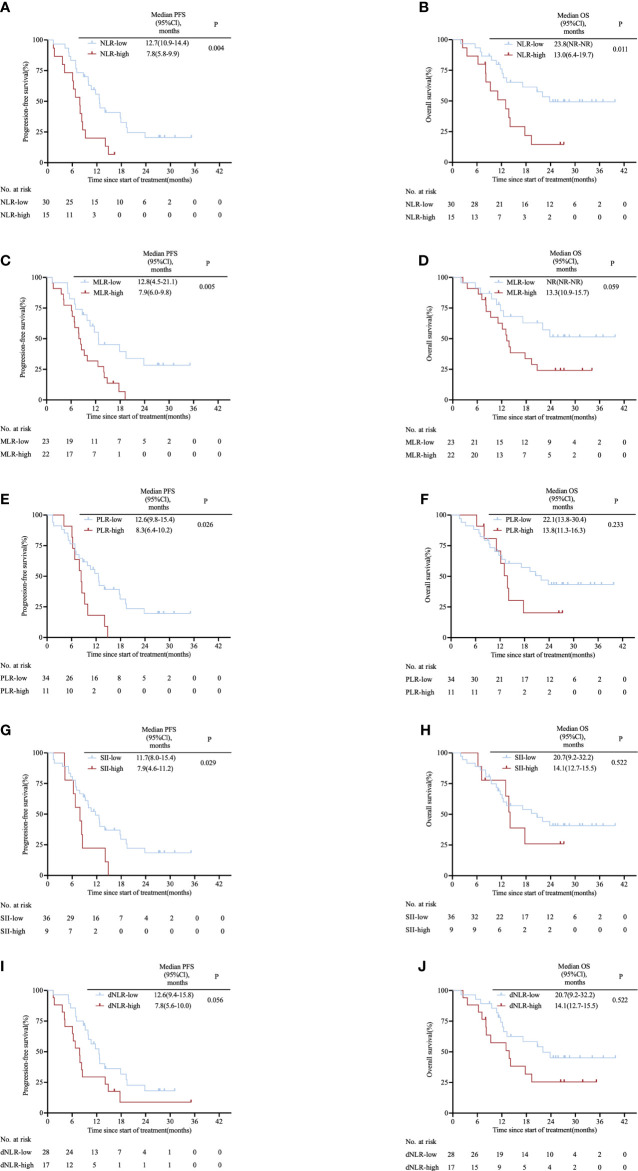
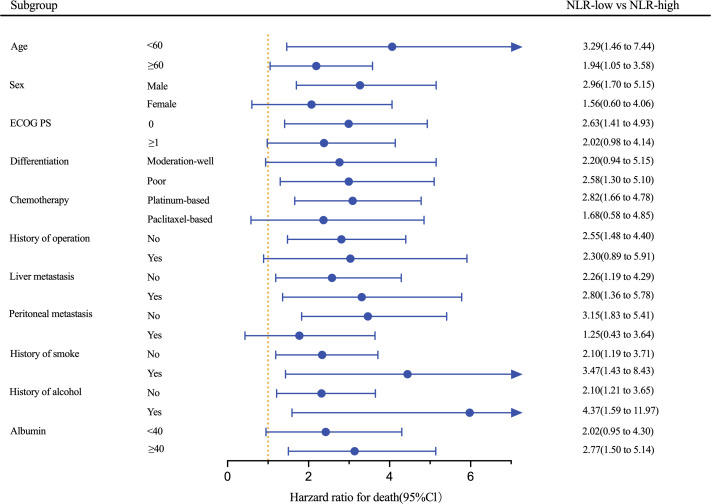
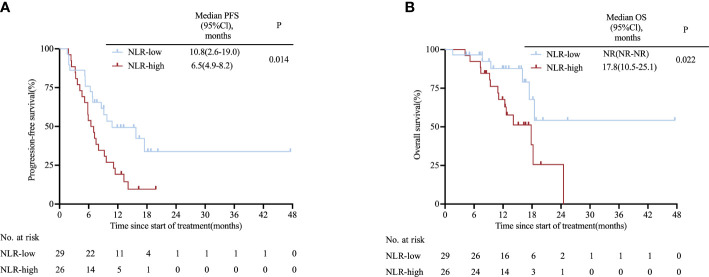
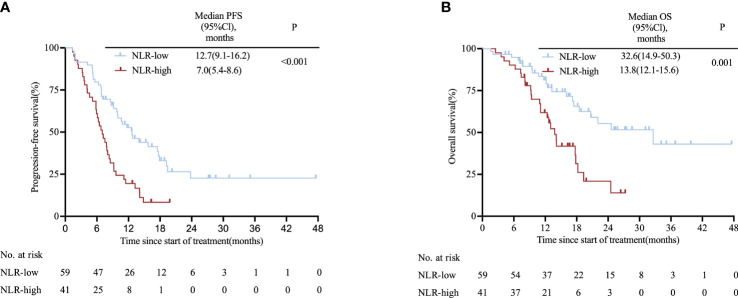
In the clinical trial cohort (n=45), MLR, PLR and SII were associated with PFS but not OS (All P<0.05), while dNLR was not correlated with PFS or OS. Only NLR was associated with PFS and OS and identified as an independent prognostic predictor in the univariate and multivariate analyses. The prognostic value of NLR was validated in the real-world cohort (n=55).
NLR was a strong predictor of PFS and OS in patients with advanced gastric cancer receiving immune checkpoint inhibitors combined with chemotherapy. Further prospective studies are required to validate our results.
免疫检查点抑制剂的出现改变了晚期胃癌患者一线治疗的格局。目前,炎症标志物在胃癌一线免疫治疗联合化疗中的预后意义尚不清楚。本研究旨在确定在接受免疫治疗联合化疗的晚期胃癌患者中具有预测治疗结果潜力的炎症标志物。
这项回顾性研究纳入了来自5项临床试验(临床试验队列)和真实世界(真实世界队列)的未经治疗的晚期或转移性胃癌或胃食管交界癌患者。分析中纳入的炎症标志物包括中性粒细胞与淋巴细胞比值(NLR)、单核细胞与淋巴细胞比值(MLR)、血小板与淋巴细胞比值(PLR)、全身炎症指数(SII)和衍生中性粒细胞与淋巴细胞比值(dNLR)。构建受试者工作特征(ROC)曲线以确定最佳临界值。使用Kaplan-Meier分析、单因素和多因素Cox回归分析确定标志物的预后潜力,并在真实世界队列中验证临床试验队列中的研究结果。
在临床试验队列(n = 45)中,MLR、PLR和SII与无进展生存期(PFS)相关,但与总生存期(OS)无关(所有P < 0.05),而dNLR与PFS或OS均无相关性。只有NLR与PFS和OS相关,并在单因素和多因素分析中被确定为独立的预后预测指标。NLR的预后价值在真实世界队列(n = 55)中得到验证。
NLR是接受免疫检查点抑制剂联合化疗的晚期胃癌患者PFS和OS的有力预测指标。需要进一步的前瞻性研究来验证我们的结果。