School of Medicine and Health Management, Tongji Medical College, Huazhong University of Science and Technology, Wuhan, China.
School of Information Resource Management, Renmin University of China, Beijing, China.
Front Public Health. 2022 Oct 25;10:1000504. doi: 10.3389/fpubh.2022.1000504. eCollection 2022.
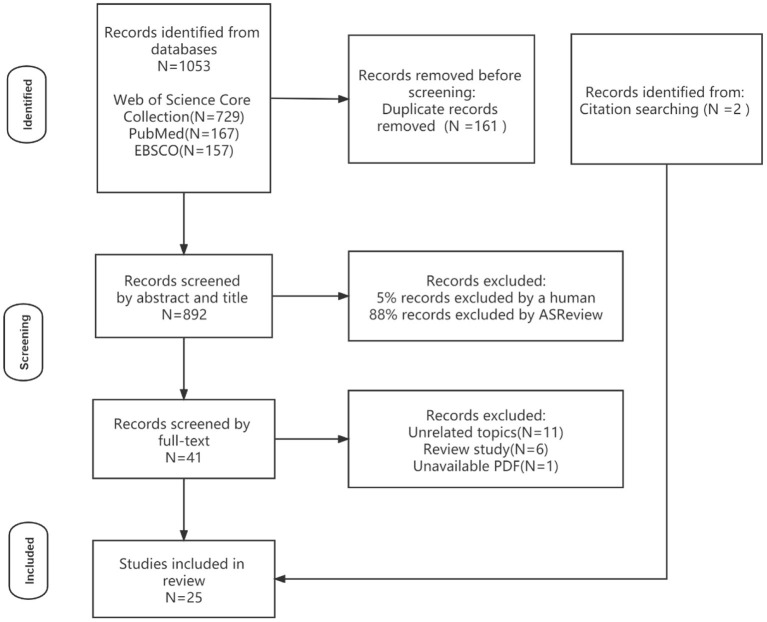
Despite numerous instruments existing to assist in the measurement of specific cyberbullying behaviors or cyberbullying in general, it is still unclear their purpose, corresponding scenarios, and their effectiveness. This study, therefore, aims to provide a comprehensive review of academic efforts on cyberbullying definitions, measurements, and their effectiveness in children and adolescents in the past two decades. A systematic review was performed using ASReview, an open source machine learning systematic review system. Three bibliographic citation databases, including Web of Science core collection, PubMed, and EBSCO were adopted for all relevant literature published from January 2001 to August 2021. In total, twenty-five studies, mentioning seventeen cyberbullying measurement scales, met the study collection criteria. The results found that most failed to provide a clear definition of cyberbullying, often providing unclear and inconsistent descriptions for the youth. Similarly, studies found it difficult to clearly reflect the three key elements of bullying, namely: harmfulness, repetitiveness, and the power imbalance between bullies and victims. With regard to cyberbullying types, most presented two or three categories, including victimization, perpetration, and bystanding, while some suggested four types based on the nature of the cyberbullying behavior, including written or verbal, visual or sexual, character impersonation, and exclusion. If characteristics are considered, cyberbullying becomes more specific with multiple categories being proposed, including flaming (or roasting), harassment, denigration, defamation, outing, jokes, online sexual harassment, and cyberstalking. With regard to measurements, many scales have been proposed and frequently refined to capture specific cyberbullying experience of the youth. This study emphasizes the value and importance of providing clear cyberbullying definitions and helps scholars in youth cyberbullying choose appropriate measurement scales.
尽管存在许多工具可以帮助测量特定的网络欺凌行为或一般的网络欺凌,但它们的目的、对应场景和有效性仍不清楚。因此,本研究旨在全面回顾过去二十年中关于儿童和青少年网络欺凌定义、测量及其有效性的学术研究。本研究使用 ASReview(一种开源机器学习系统评价系统)进行了系统评价。该研究从三个文献引文数据库(包括 Web of Science 核心合集、PubMed 和 EBSCO)中检索了 2001 年 1 月至 2021 年 8 月发表的所有相关文献,共纳入 25 项研究,涉及 17 种网络欺凌测量量表。研究结果发现,大多数研究未能对网络欺凌给出明确的定义,往往对青少年提供了不清晰和不一致的描述。同样,研究发现难以清楚反映欺凌的三个关键要素,即伤害性、重复性和欺凌者与受害者之间的权力失衡。关于网络欺凌类型,大多数研究提出了两种或三种类型,包括受害、施害和旁观,而有些研究则根据网络欺凌行为的性质提出了四种类型,包括书面或口头、视觉或性、角色模仿和排斥。如果考虑到特征,网络欺凌变得更加具体,提出了多种类别,包括辱骂(或嘲讽)、骚扰、诋毁、诽谤、曝光、恶作剧、在线性骚扰和网络跟踪。在测量方面,已经提出了许多量表,并经常进行修订,以捕捉青少年特定的网络欺凌经历。本研究强调了提供明确的网络欺凌定义的价值和重要性,并帮助青年网络欺凌领域的学者选择合适的测量量表。