Li Jiaxin, Wang Huan, Cao Fangli, Cheng Yufeng
Department of Medical Oncology, Qilu Hospital (Qingdao), Cheeloo College of Medicine, Shandong University, Qingdao, China.
Department of Radiation Oncology, Qilu Hospital, Cheeloo College of Medicine, Shandong University, Jinan, China.
J Gastrointest Oncol. 2022 Oct;13(5):2115-2131. doi: 10.21037/jgo-22-855.
Esophageal cancer (EC) is the eighth most commonly occurring cancer worldwide and the sixth leading cause of cancer-related deaths. The therapeutic effect of EC patients is not ideal, and new biomarkers are needed to guide diagnosis and prognosis of EC patients. family transcription factors are among the most important links in the cell cycle regulatory network. dysregulation not only promotes the early stages of tumor development but also the progression of benign tumors to malignant tumors. is expected to be a new biomarker. The prognostic significance of the family in EC requires further research.
We analyzed The Cancer Genome Atlas (TCGA), Gene Expression Profiling Interactive Analysis (GEPIA), and GeneMANIA databases to obtain RNA-sequencing data and clinical data. The clinical data included age, gender, race, stage, type, status, etc. The prognosis outcome included overall survival (OS) and progression-free interval (PFI). Subsequently, we conducted further research on gene expressions, enrichment analysis, interaction network, and prognostic values by R software, containing ggplot2, ComplexHeatmap, DESeq2, pROC R package, based on -test, Wilcoxon rank sum test, Spearman rank correlation analysis, log-rank test and COX model.
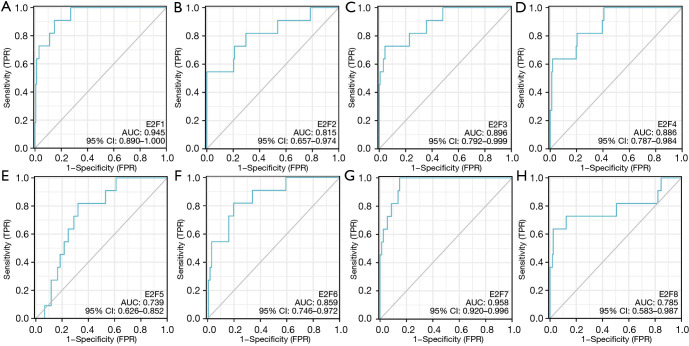
We found that mRNA transcription levels of , were more highly expressed in esophageal carcinoma (ESCA) tissues than in normal tissues. expression was correlated with tumor stage [Pr(>F)=0.00856]. -related genes played a role in development and differentiation, and were prevalent in the endoplasmic reticulum lumen, Golgi lumen, and lipoprotein particle, catalyzing translation activities and lipid metabolism. Each gene was found to be related to each other to some degree. The GeneMANIA network analysis revealed links between E2Fs and other genes. We compared the correlations between 24 kinds of tumor-infiltrating immune cells and . (AUC =0.945, CI: 0.890-1.000) and (AUC =0.958, CI: 0.920-0.996) exhibited higher predictive power accuracy. However, only was closely related to OS [HR =1.91 (1.16-3.16), P=0.011].
We discover that is a prognostic biomarker. family may take part in the development of EC through lipid metabolism pathways, which is helpful to predict the prognosis of EC patients and guide accurate diagnosis and treatment.
食管癌(EC)是全球第八大常见癌症,也是癌症相关死亡的第六大主要原因。EC患者的治疗效果不理想,需要新的生物标志物来指导EC患者的诊断和预后。E2F家族转录因子是细胞周期调控网络中最重要的环节之一。其失调不仅促进肿瘤发展的早期阶段,还促进良性肿瘤向恶性肿瘤的进展。E2F有望成为一种新的生物标志物。E2F家族在EC中的预后意义需要进一步研究。
我们分析了癌症基因组图谱(TCGA)、基因表达谱交互式分析(GEPIA)和GeneMANIA数据库,以获取RNA测序数据和临床数据。临床数据包括年龄、性别、种族、分期、类型、状态等。预后结果包括总生存期(OS)和无进展生存期(PFI)。随后,我们使用R软件(包含ggplot2、ComplexHeatmap、DESeq2、pROC R包)基于t检验、Wilcoxon秩和检验、Spearman秩相关分析、对数秩检验和COX模型,对基因表达、富集分析、相互作用网络和预后价值进行了进一步研究。
我们发现,E2F1、E2F2、E2F3的mRNA转录水平在食管癌(ESCA)组织中比在正常组织中表达更高。E2F3的表达与肿瘤分期相关[Pr(>F)=0.00856]。E2F相关基因在发育和分化中起作用,并且在内质网腔、高尔基体腔和脂蛋白颗粒中普遍存在,催化翻译活动和脂质代谢。发现每个基因在某种程度上相互关联。GeneMANIA网络分析揭示了E2Fs与其他基因之间的联系。我们比较了24种肿瘤浸润免疫细胞与E2F的相关性。E2F1(AUC =0.945,CI:0.890 - 1.000)和E2F2(AUC =0.958,CI:0.920 - 0.996)表现出更高的预测能力准确性。然而,只有E2F3与OS密切相关[HR =1.91(1.16 - 3.16),P =0.011]。
我们发现E2F3是一种预后生物标志物。E2F家族可能通过脂质代谢途径参与EC的发展,这有助于预测EC患者的预后并指导准确的诊断和治疗。