Department of Thoracic Surgery, National Cancer Center/National Clinical Research Center for Cancer/Cancer Hospital and Shenzhen Hospital, Chinese Academy of Medical Sciences and Peking Union Medical College, Shenzhen, China.
Translational Medicine Collaborative Innovation Center, Shenzhen People's Hospital (The Second Clinical Medical College, Jinan University; The First Affifiliated Hospital, Southern University of Science and Technology), Shenzhen, China.
Medicine (Baltimore). 2024 Jan 19;103(3):e34342. doi: 10.1097/MD.0000000000034342.
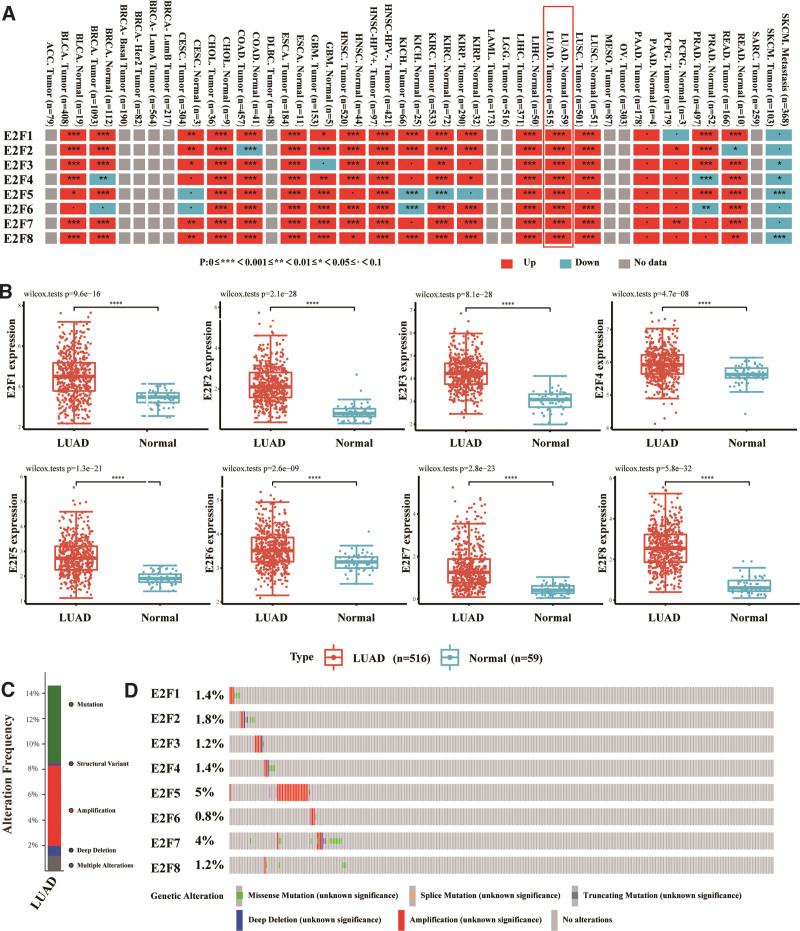
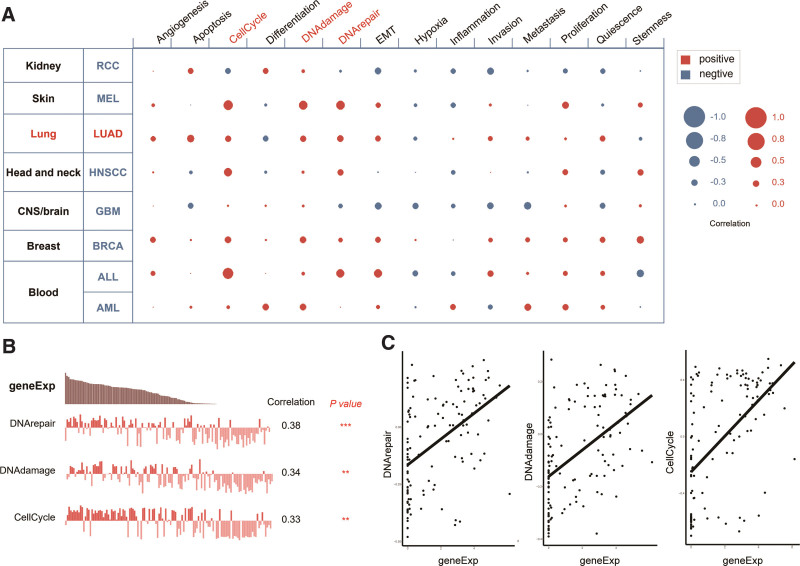
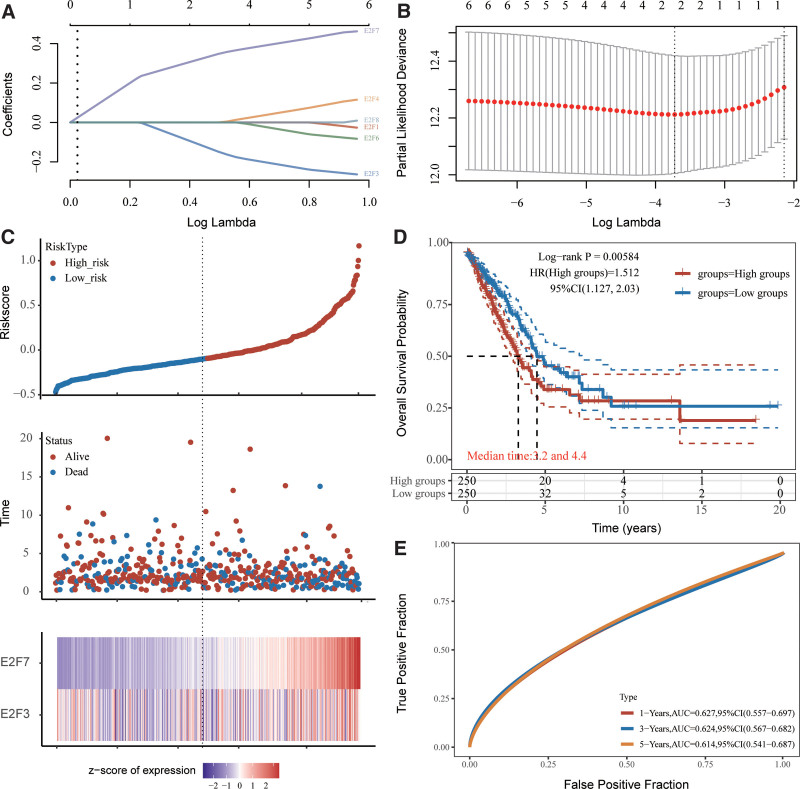
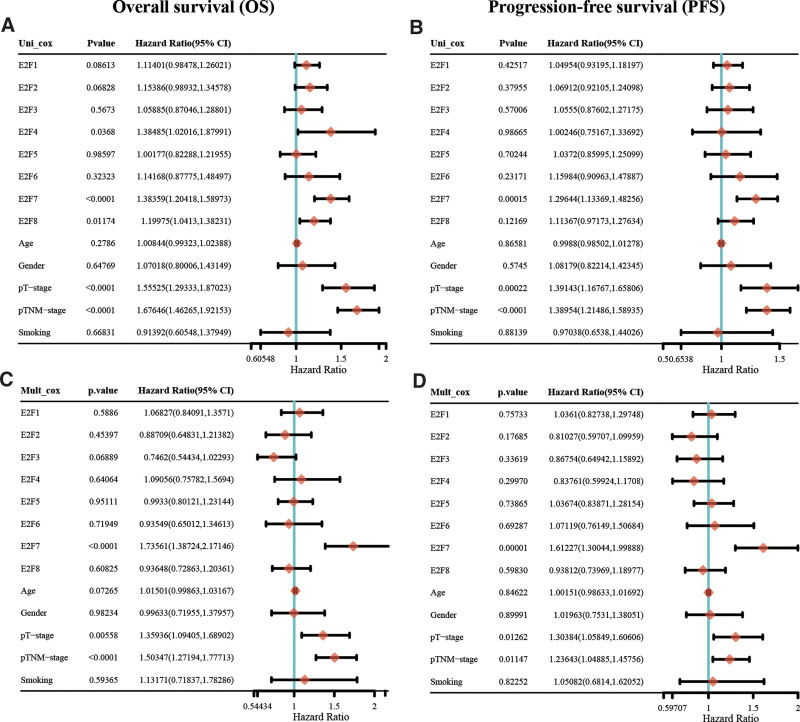
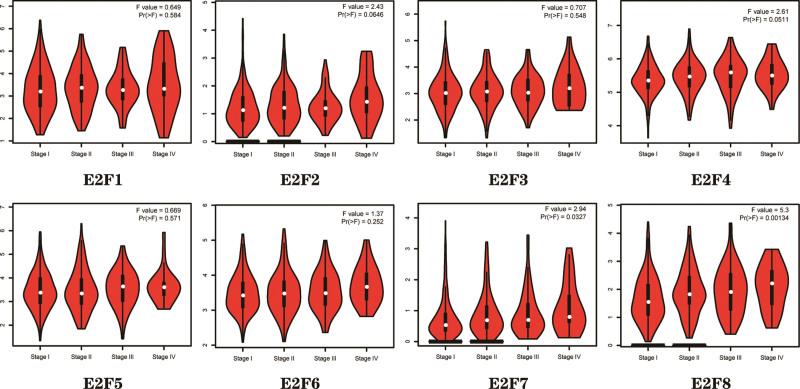
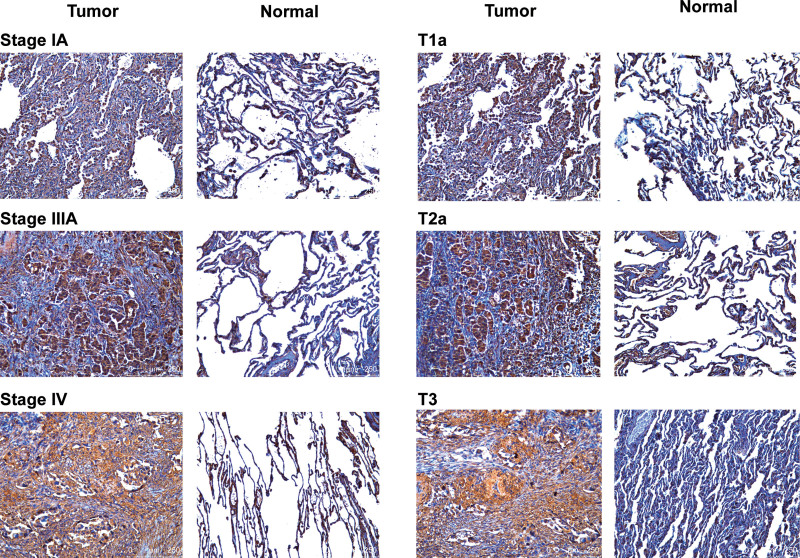
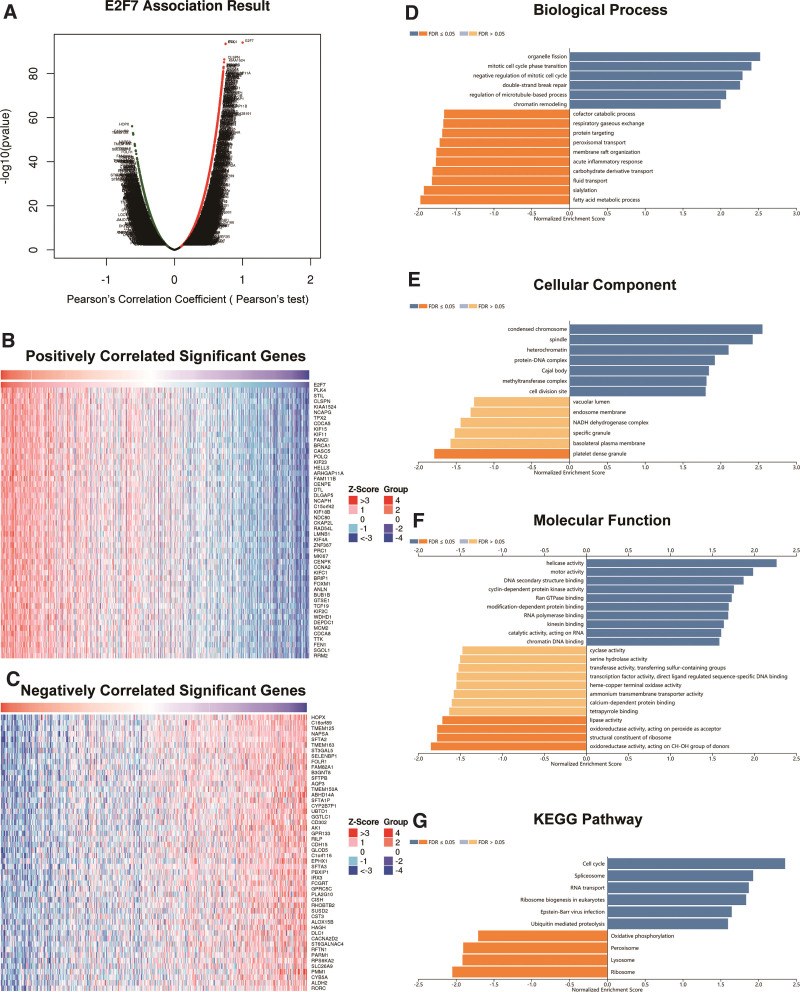
E2F transcription factors (E2Fs) are a family of transcription factors critical regulators of the cell cycle, apoptosis, and differentiation, thus influencing tumorigenesis. However, the specific roles of E2Fs in lung adenocarcinoma (LUAD) remain unclear. Data from The Cancer Genome Atlas (TCGA) were used. R version. 4.0.3 and multiple databases (TIMER, cBioportal, gene expression profile interaction analysis [GEPIA], LinkedOmics, and CancerSEA) were utilized to investigate mRNA expression, mutational analysis, prognosis, clinical correlations, co-expressed gene, pathway and network, and single-cell analyses. Immunohistochemistry (IHC) confirmed that E2F transcription factor 7 (E2F7) correlated with LUAD. Among the E2Fs, E2F7 was identified by constructing a prognostic model most significantly associated with overall survival (OS) in LUAD patients. The univariate and multivariate Cox regression analyses showed that E2F7, p-T stage, and p-TNM stage were closely related to OS and progression-free survival (PFS) (P < .05) in LUAD. E2F 7/8 were also identified as significantly associated with tumor stage in the GEPIA database. Compared with paracancerous tissues, E2F7 was up-regulated in LUAD by IHC, and E2F7 might be positively correlated with larger tumors and higher TNM stages. E2F7 may primarily regulate DNA repair, damage, and cell cycle processes and thus affect LUAD tumorigenesis, invasion, and metastasis by LinkedOmics and CancerSEA. E2F7 serves as a potential prognostic biomarker for LUAD.
E2F 转录因子(E2Fs)是细胞周期、细胞凋亡和分化的关键调节因子家族,因此影响肿瘤发生。然而,E2Fs 在肺腺癌(LUAD)中的具体作用仍不清楚。使用了来自癌症基因组图谱(TCGA)的数据。R 版本 4.0.3 和多个数据库(TIMER、cBioportal、基因表达谱交互分析[GEPIA]、LinkedOmics 和 CancerSEA)用于研究 mRNA 表达、突变分析、预后、临床相关性、共表达基因、途径和网络以及单细胞分析。免疫组织化学(IHC)证实 E2F 转录因子 7(E2F7)与 LUAD 相关。在 E2Fs 中,通过构建与 LUAD 患者总生存(OS)最显著相关的预后模型,确定 E2F7。单因素和多因素 Cox 回归分析显示,E2F7、p-T 期和 p-TNM 期与 OS 和无进展生存(PFS)密切相关(P<0.05)。在 GEPIA 数据库中,E2F7/8 也被确定与肿瘤分期显著相关。与癌旁组织相比,IHC 显示 LUAD 中 E2F7 上调,E2F7 可能与较大的肿瘤和更高的 TNM 分期呈正相关。E2F7 可能主要通过 LinkedOmics 和 CancerSEA 调节 DNA 修复、损伤和细胞周期过程,从而影响 LUAD 的肿瘤发生、侵袭和转移。E2F7 可作为 LUAD 的潜在预后生物标志物。