Spoto Silvia, Mangiacapra Fabio, D'Avanzo Giorgio, Lemme Daniela, Bustos Guillén César, Abbate Antonio, Markley John Daniel, Sambuco Federica, Markley Roshanak, Fogolari Marta, Locorriere Luciana, Lupoi Domenica Marika, Battifoglia Giulia, Costantino Sebastiano, Ciccozzi Massimo, Angeletti Silvia
Department of Diagnostic and Therapeutic Medicine, University Campus Bio-Medico of Rome, Rome, Italy.
Unit of Cardiovascular Science, University Campus Bio-Medico of Rome, Rome, Italy.
Front Med (Lausanne). 2022 Oct 26;9:929408. doi: 10.3389/fmed.2022.929408. eCollection 2022.
Coronavirus disease 2019 (COVID-19) is a systemic disease induced by SARS-CoV-2 causing myocardial injury. To date, there are few data on the correlation between mid-regional proAdrenomedullin (MR-proADM) and myocardial injury. The aim of this study was to evaluate whether the association of myocardial injury and elevated mid-regional proAdrenomedullin values could predict mortality of SARS-CoV-2 patients, to offer the best management to COVID-19 patients.
All patients hospitalized for SARS-CoV-2 infection at the COVID-19 Center of the Campus Bio-Medico of Rome University were included between October 2020 and March 2021 and were retrospectively analyzed. Myocardial injury was defined as rising and/or fall of cardiac hs Troponin I values with at least one value above the 99th percentile of the upper reference limit (≥15.6 ng/L in women and ≥34.2 ng/L in men). The primary outcome was 30-day mortality. Secondary outcomes were the comparison of MR-proADM, CRP, ferritin, and PCT as diagnostic and prognostic biomarkers of myocardial injury. Additionally, we analyzed the development of ARDS, the need for ICU transfer, and length of stay (LOS).
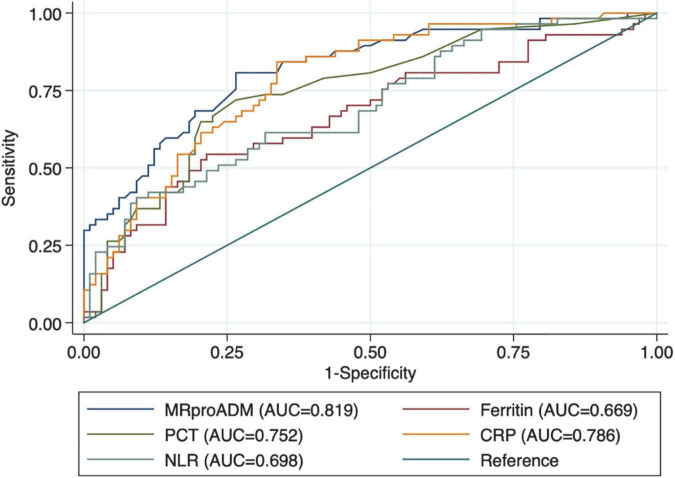
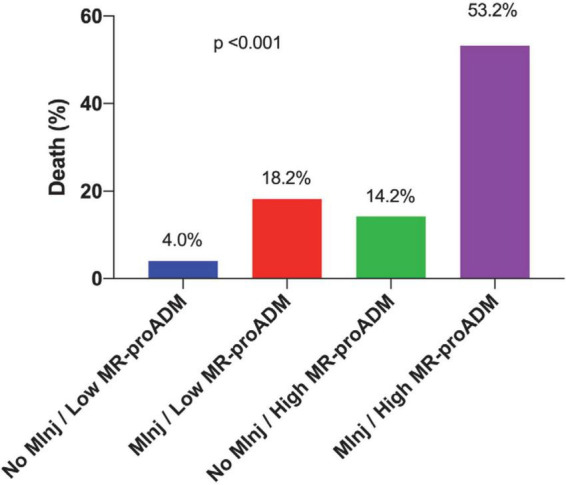
A total of 161 patients were included in this study. Of these, 58 (36.0%) presented myocardial injury at admission. An MR-proADM value ≥ 1.19 nmol/L was defined as the optimal cut-off to identify patients with myocardial injury (sensitivity 81.0% and specificity 73.5%). A total of 121 patients (75.2%) developed ARDS, which was significantly more frequent among patients with myocardial injury (86.2 vs. 68.9%, = 0.015). The overall 30-day mortality was 21%. Patients with myocardial injury presented significantly higher mortality compared to those without the same (46.6 vs. 6.8%, < 0.001). When dividing the entire study population into four groups, based on the presence of myocardial injury and MR-proADM values, those patients with both myocardial injury and MR-proADM ≥ 1.19 nmol/L presented the highest mortality (53.2%, < 0.001). The combination of myocardial injury and MR-proADM values ≥ 1.19 nmol/L was an independent predictor of death (OR = 7.82, 95% CI = 2.87-21.30; < 0.001).
The study is focused on the correlation between myocardial injury and MR-proADM. Myocardial injury induced by SARS-CoV-2 is strongly associated with high MR-proADM values and mortality.
2019冠状病毒病(COVID-19)是一种由严重急性呼吸综合征冠状病毒2(SARS-CoV-2)引起的全身性疾病,可导致心肌损伤。迄今为止,关于中段肾上腺髓质素原(MR-proADM)与心肌损伤之间的相关性数据较少。本研究的目的是评估心肌损伤与升高的中段肾上腺髓质素原值之间的关联是否能够预测SARS-CoV-2患者的死亡率,从而为COVID-19患者提供最佳治疗方案。
纳入2020年10月至2021年3月期间在罗马大学圣心生物医学园区COVID-19中心因SARS-CoV-2感染住院的所有患者,并进行回顾性分析。心肌损伤定义为心肌肌钙蛋白I值升高和/或降低,且至少有一个值高于参考上限的第99百分位数(女性≥15.6 ng/L,男性≥34.2 ng/L)。主要结局是30天死亡率。次要结局是比较MR-proADM、CRP、铁蛋白和降钙素原作为心肌损伤的诊断和预后生物标志物。此外,我们分析了急性呼吸窘迫综合征(ARDS)的发生情况、入住重症监护病房(ICU)的需求以及住院时间(LOS)。
本研究共纳入161例患者。其中,58例(36.0%)入院时出现心肌损伤。将MR-proADM值≥1.19 nmol/L定义为识别心肌损伤患者的最佳临界值(敏感性81.0%,特异性73.5%)。共有121例患者(75.2%)发生ARDS,在心肌损伤患者中更为常见(86.2%对68.9%,P = 0.015)。总体30天死亡率为21%。与未发生心肌损伤的患者相比,发生心肌损伤的患者死亡率显著更高(46.6%对6.8%,P < 0.001)。根据心肌损伤和MR-proADM值将整个研究人群分为四组,心肌损伤且MR-proADM≥1.19 nmol/L的患者死亡率最高(53.2%,P < 0.001)。心肌损伤与MR-proADM值≥1.19 nmol/L的联合是死亡的独立预测因素(比值比[OR]=7.82,95%置信区间[CI]=2.87 - 21.30;P < 0.001)。
本研究聚焦于心肌损伤与MR-proADM之间的相关性。SARS-CoV-2诱导的心肌损伤与高MR-proADM值和死亡率密切相关。