Association of Public Health Laboratories, Silver Spring, MD, USA.
Malaria Branch, Division of Parasitic Diseases and Malaria, Center for Global Health, Centers for Disease Control and Prevention, Atlanta, GA, USA.
Sci Rep. 2022 Nov 17;12(1):19802. doi: 10.1038/s41598-022-20706-6.
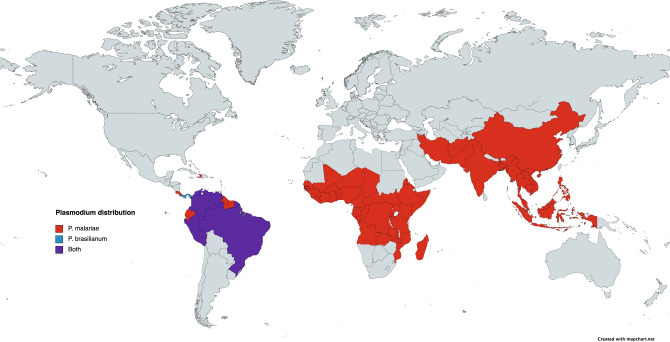
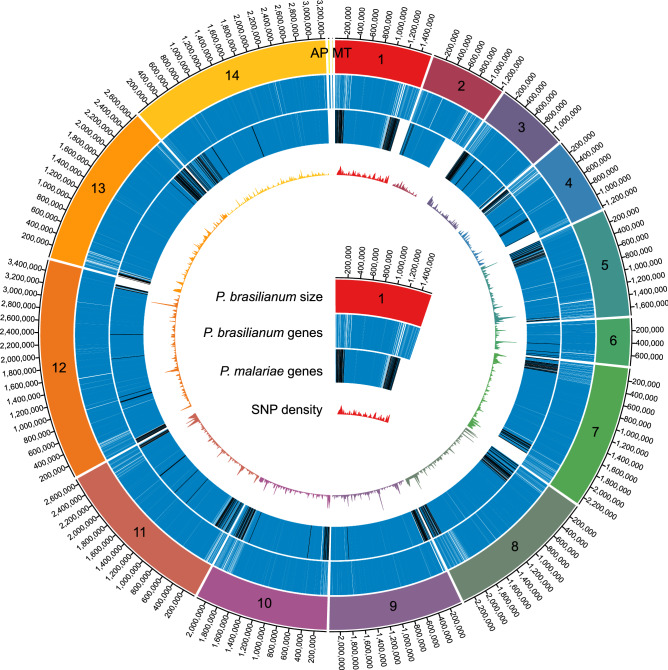
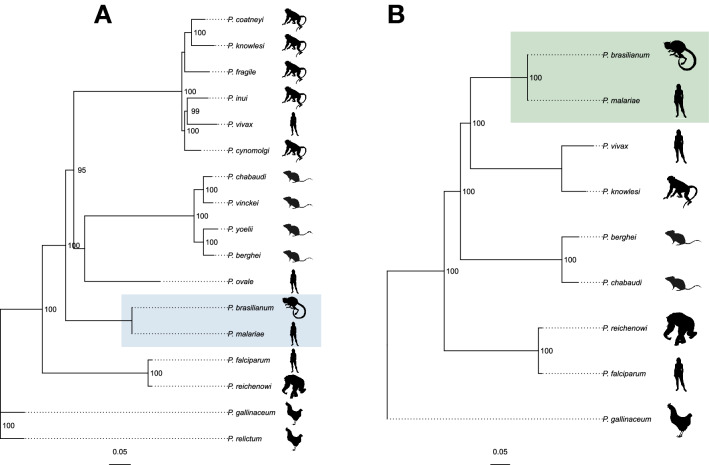
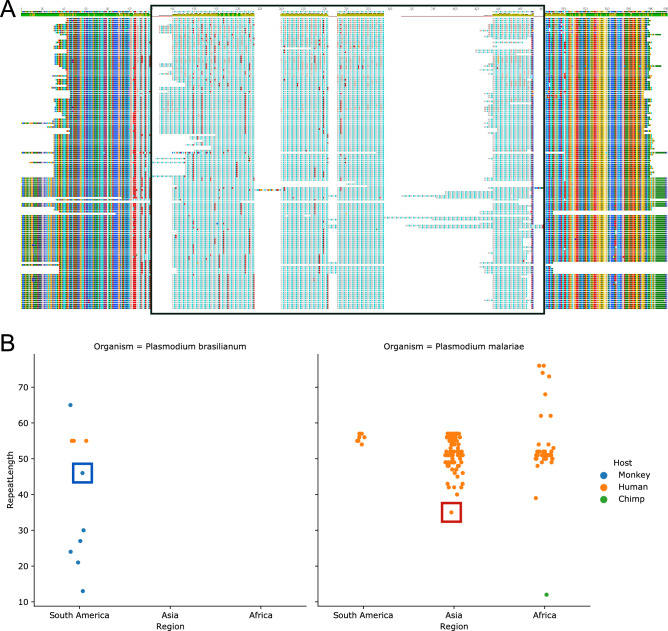
Naturally occurring human infections by zoonotic Plasmodium species have been documented for P. knowlesi, P. cynomolgi, P. simium, P. simiovale, P. inui, P. inui-like, P. coatneyi, and P. brasilianum. Accurate detection of each species is complicated by their morphological similarities with other Plasmodium species. PCR-based assays offer a solution but require prior knowledge of adequate genomic targets that can distinguish the species. While whole genomes have been published for P. knowlesi, P. cynomolgi, P. simium, and P. inui, no complete genome for P. brasilianum has been available. Previously, we reported a draft genome for P. brasilianum, and here we report the completed genome for P. brasilianum. The genome is 31.4 Mb in size and comprises 14 chromosomes, the mitochondrial genome, the apicoplast genome, and 29 unplaced contigs. The chromosomes consist of 98.4% nucleotide sites that are identical to the P. malariae genome, the closest evolutionarily related species hypothesized to be the same species as P. brasilianum, with 41,125 non-synonymous SNPs (0.0722% of genome) identified between the two genomes. Furthermore, P. brasilianum had 4864 (82.1%) genes that share 80% or higher sequence similarity with 4970 (75.5%) P. malariae genes. This was demonstrated by the nearly identical genomic organization and multiple sequence alignments for the merozoite surface proteins msp3 and msp7. We observed a distinction in the repeat lengths of the circumsporozoite protein (CSP) gene sequences between P. brasilianum and P. malariae. Our results demonstrate a 97.3% pairwise identity between the P. brasilianum and the P. malariae genomes. These findings highlight the phylogenetic proximity of these two species, suggesting that P. malariae and P. brasilianum are strains of the same species, but this could not be fully evaluated with only a single genomic sequence for each species.
已记录到人感染动物源性疟原虫物种,包括猴疟原虫、食蟹猴疟原虫、松鼠猴疟原虫、西氏猕猴疟原虫、伊蚊疟原虫、伊蚊疟原虫样疟原虫、库蚊疟原虫和巴西疟原虫。由于这些物种与其他疟原虫在形态上相似,因此准确检测每种物种都很复杂。基于 PCR 的检测方法提供了一种解决方案,但需要事先了解能够区分物种的充分基因组靶标。虽然已经公布了猴疟原虫、食蟹猴疟原虫、松鼠猴疟原虫和伊蚊疟原虫的全基因组序列,但尚未公布巴西疟原虫的完整基因组序列。此前,我们报道了巴西疟原虫的一个草图基因组,在此我们报告了巴西疟原虫的完成基因组。该基因组大小为 31.4 Mb,包含 14 条染色体、线粒体基因组、质体基因组和 29 个未定位的连续序列。染色体由 98.4%的核苷酸位点组成,与最接近的进化相关物种恶性疟原虫基因组完全相同,两个基因组之间鉴定出 41125 个非同义 SNP(基因组的 0.0722%)。此外,巴西疟原虫有 4864 个(82.1%)基因与恶性疟原虫的 4970 个(75.5%)基因具有 80%或更高的序列相似性。这一点可以通过裂殖子表面蛋白 msp3 和 msp7 的几乎相同的基因组组织和多个序列比对来证明。我们观察到巴西疟原虫和恶性疟原虫的环子孢子蛋白(CSP)基因序列的重复长度存在差异。我们的结果表明,巴西疟原虫和恶性疟原虫基因组之间存在 97.3%的成对同一性。这些发现突出了这两个物种的系统发育亲缘关系,表明恶性疟原虫和巴西疟原虫是同一物种的菌株,但仅通过每个物种的单个基因组序列无法完全评估。