Chair of Experimental and General Psychology, Department of Psychology, Ludwig Maximilian University Munich, Leopoldstr. 13, 80802, Munich, Germany.
The University of Sydney, School of Psychology and Brain and Mind Centre, Sydney, Australia.
Sci Rep. 2022 Nov 17;12(1):19787. doi: 10.1038/s41598-022-24332-0.
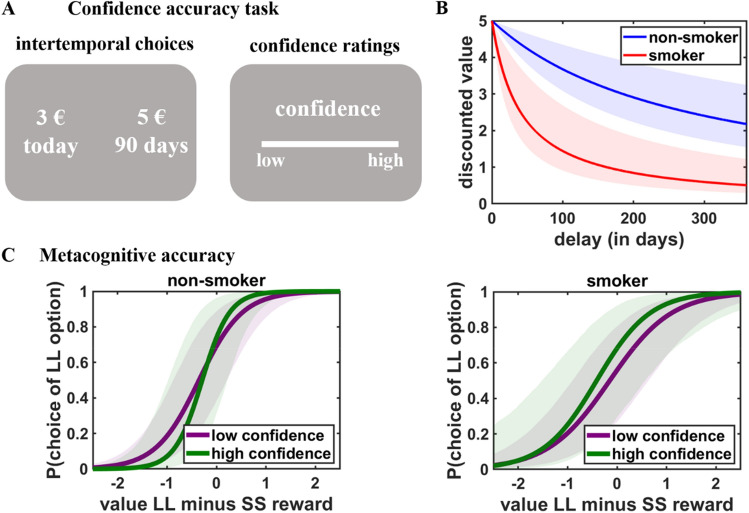
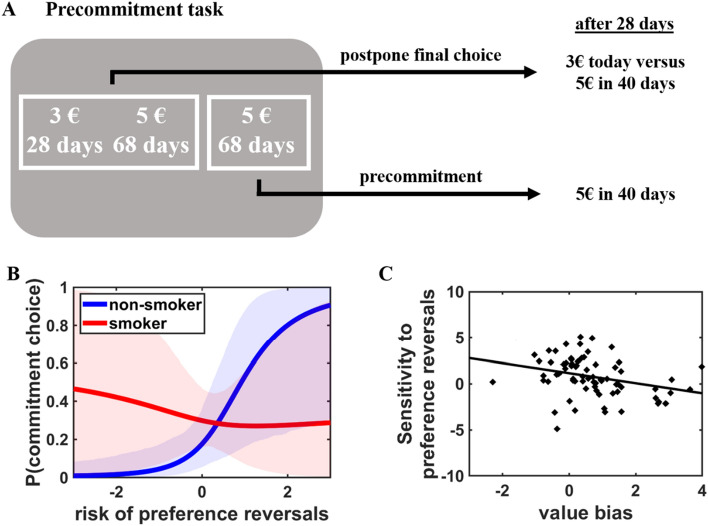
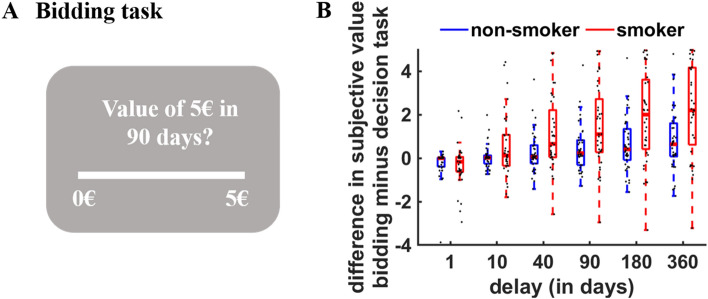
Deficits in impulse control belong to the core profile of nicotine dependence. Smokers might thus benefit from voluntarily self-restricting their access to the immediate temptation of nicotine products (precommitment) in order to avoid impulse control failures. However, little is known about how smokers' willingness to engage in voluntary self-restrictions is determined by metacognitive insight into their general preferences for immediate over delayed rewards. Here, with a series of monetary intertemporal choice tasks, we provide empirical evidence for reduced metacognitive accuracy in smokers relative to non-smokers and show that smokers overestimate the subjective value of delayed rewards relative to their revealed preferences. In line with the metacognitive deficits, smokers were also less sensitive to the risk of preference reversals when deciding whether or not to restrict their access to short-term financial rewards. Taken together, the current findings suggest that deficits not only in impulse control but also in metacognition may hamper smokers' resistance to immediate rewards and capacity to pursue long-term goals.
冲动控制缺陷属于尼古丁依赖的核心特征。因此,吸烟者可能会受益于自愿限制自己接触尼古丁产品的即时诱惑(预先承诺),以避免冲动控制失败。然而,人们对吸烟者自愿自我限制的意愿是如何由对即时奖励与延迟奖励的一般偏好的元认知洞察力决定的,知之甚少。在这里,我们通过一系列货币跨期选择任务,提供了相对于非吸烟者吸烟者的元认知准确性降低的经验证据,并表明吸烟者高估了延迟奖励的主观价值相对于他们的揭示偏好。与元认知缺陷一致,吸烟者在决定是否限制短期财务奖励的获取时,对偏好逆转的风险也不那么敏感。总之,目前的研究结果表明,不仅冲动控制,而且元认知缺陷都可能阻碍吸烟者抵抗即时奖励和追求长期目标的能力。